
Google DeepMind announced Genie 4 on October 27, 2026, a world model that generates interactive scenes in real time, with native audio and text prompts that steer the scene as it runs. It is a research preview for trusted testers for now. DeepMind says it is coming soon to Google AI Ultra subscribers in Project Genie and to early access partners in the Gemini API and Google AI Studio, with a waitlist open today. For what the model does, see our Genie 4 explainer.
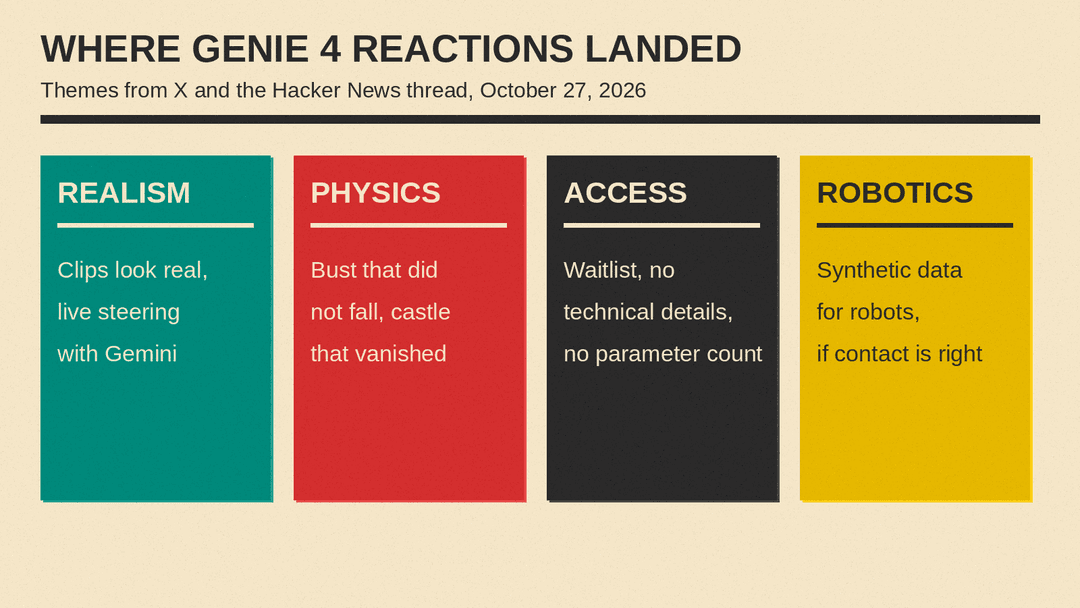
Within about two hours, the reaction split into three camps: people stunned by the demo clips, people who studied the clips frame by frame and found physics and consistency errors, and people annoyed that they can read about it but not use it. Counts below were taken at about 11:20 AM PT on October 27.
How big the reaction was
DeepMind's launch post on X had about 6,487 likes, 571 quote posts and 463,321 views. Sundar Pichai's post had about 6,104 likes and 325,987 views. On Hacker News, the Genie 4 thread, posted at 9:06 AM PT, had 312 points and more than 170 comments, and sat near the top of the front page.
The praise: realism and the "steering" idea
Most of the excited posts were about the look of the clips and the idea of walking through a scene that is generated as you move. @darcyagi wrote that "you literally move through a world and the model generates what comes next." @adityaa_behera listed Genie 4 against Runway GWM Worlds 2, Oasis 3 and NVIDIA Cosmos and wrote: "Genie 4 looks ahead on realism + audio." (We covered Runway GWM Worlds 2 and Tencent's open Hy-Nomas earlier.)
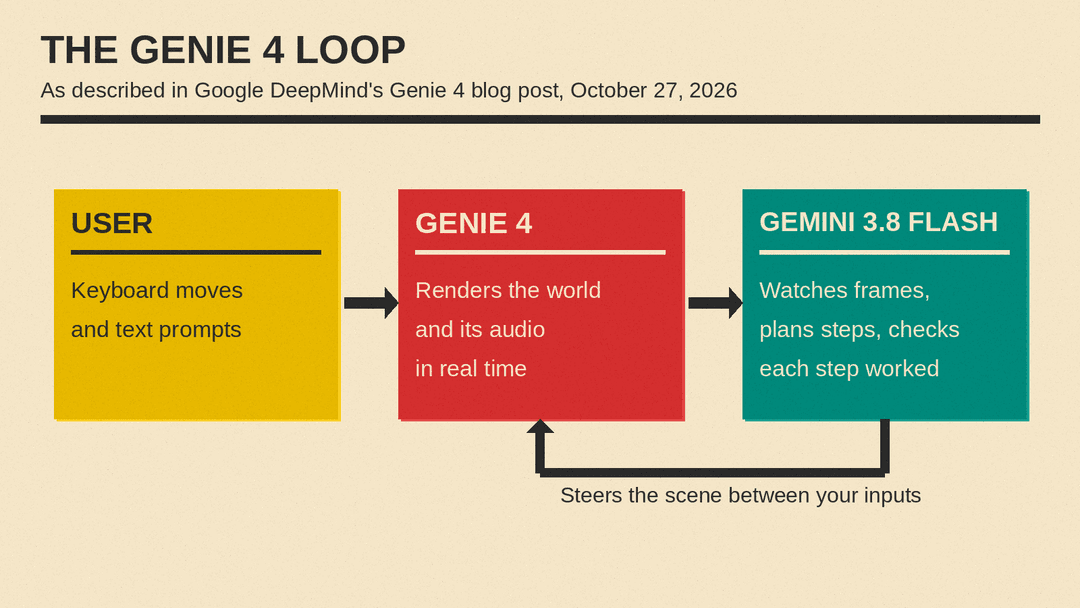
Several people singled out the Gemini loop rather than the pixels. @kimmonismus, in a post with about 221 likes, summarized it this way: "Gemini 3.8 Flash watches the generated scene, breaks a task into steps and checks whether each step worked. As the scene changes, it updates its plan." That matches DeepMind's description, which calls Gemini 3.8 Flash "a guiding agent in the loop" that reviews incoming frames to verify each step.
Some praise came from inside Google. Jack Parker-Holder (@jparkerholder) wrote that "it was a privilege to be involved with shaping this" and called DeepMind "still the leader in world modelling." Logan Kilpatrick (@OfficialLoganK) posted "An early look at Genie 4, our new frontier world model, coming soon to the API for the first time." Tejas Kulkarni (@tejasdkulkarni), who appears in the blog's contributor list, shared a workflow that went from a Nano Banana image to Genie 4 animation to Blender, and wrote: "I am excited about what Genie 4 can do for creative workflows and prototyping."
On Hacker News, OkayPhysicist, otherwise critical of one clip, wrote: "The stained glass deer, for example, was awesome."
The complaints: physics, consistency and cherry-picked clips
The Hacker News thread spent much of its energy on mistakes in DeepMind's own demo videos.
- mlmonkey said that in the clip of a marble bust dropped on a watermelon, "the bust should've toppled over, if the physics were properly modeled." dsissitka replied: "They were demonstrating steering." stevemk14ebr answered: "So what, the world model failed to model physics."
- smusamashah wrote that in the dragon flight clip, from 1:25 to 1:29, "A big chunk of the right side of castle disappeared, including catapult, when camera turned back while flying on dragon." ksec replied that they thought the rider had already flown past the catapult. OkayPhysicist said of the same clip: "That entire clip looks like it's straight out of a complete bargain-bin videogame."
- germanjoey pointed out a dressing room scene where "you can see that the left half of his body is wearing a grey suit... but the right half is wearing a grey dress."
- Kotlopou wrote: "If the checker clip is meant to be used to develop a robot to play checkers, then the physics is not remotely good enough."
- sodacanner questioned the controls: "It doesn't even seem to respond to inputs, it just looks like they took some AI generated videos and put the key widgets on top." tempfile made a similar point about the on-screen arrow and WASD keys, saying they had no relationship to the movement of the character or the camera.
TheAceOfHearts asked for failure examples: "I would like to see how it breaks, don't spend all your focus on how nice it looks with specially curated shots." DeepMind's post does list limits in text. It says visual details and object permanence "can still shift or drift over time," especially in longer runs, after many prompt edits, or while moving through the scene, but it does not show failure clips.
A side thread picked at the announcement's wording. gradascent asked: "What on Earth is audio-like music?" The phrase comes from the blog's second sentence, "enabling audio-like music, ambient noises, and interactive dialogue."
The access fight: waitlists and zero technical details
One of the most-argued comments was about openness. kouteiheika wrote that it is hard to get excited about a model "which is safetymaxxed to the limit, and whose usage quota will (most likely) be so limited that it'll be effectively useless for anyone who doesn't work at Google or doesn't have infinite money." They also noted that no technical details were released, not even the parameter count.
estearum pushed back: "Most cutting edge technologies through history have been 1) somewhat opaque and 2) narrow/exclusive in their deployment." dotancohen replied: "Most cutting edge technologies through history did not have near-peer widely-deployed open competitors. This technology does." m3kw9 put it more bluntly: "Why can't Google just announce something and release at the same day, not always this stupid wait list stuff."
What is it for?
Many asked who Genie 4 is for. On X, @dummerspast39 wrote: "Train a model to simulate some probabilistic world just to train another model in it." They also argued it is not really a new model but Gemini Omni with 3.8 Flash as a helper. DeepMind's post says Genie 4 builds on Gemini Omni and uses Gemini models for reasoning; it does not describe the architecture further.
Others saw robotics as the point. alphabetting wrote: "The playable element is cool PR but the news is that endless synthetic training data for embodied AI models is basically here or close." NitpickLawyer suggested the same use, training robot models in environments that look like real life and can scale. On X, @rahim_mirani set the bar: "if contact is actually right, this is a data source, not a demo." DeepMind's post shows Gemini 4 Argon and Genie 4 simulating Apptronik's Apollo humanoid playing checkers, the clip Kotlopou criticized.
The gaming angle split people too. rvz predicted "Stadia + World Models = New generation of DRM for games." MattDaEskimo asked: "Why would a non-deterministic engine be better for a game when it can be instead structured and made deterministic and then more effectively distributed to consumer hardware?" BatFastard wrote: "As a video game developer I live in fear and anticipation." On X, @AutismCapital, in a post with about 163 likes, took it further: "We’re years away from building the Infinite Jest. The permanent plug in digital world uniquely optimized for you specifically."
The takeaway
The clips impressed most people who watched them casually. Closer viewers found a vanishing castle, a half-suit and a bust that did not fall, the kind of drift DeepMind itself lists as a limit. The loudest complaint was not quality but access: no public product, no technical report and a waitlist. The real test comes when Ultra subscribers and API partners get hands-on time and can show what breaks.
