
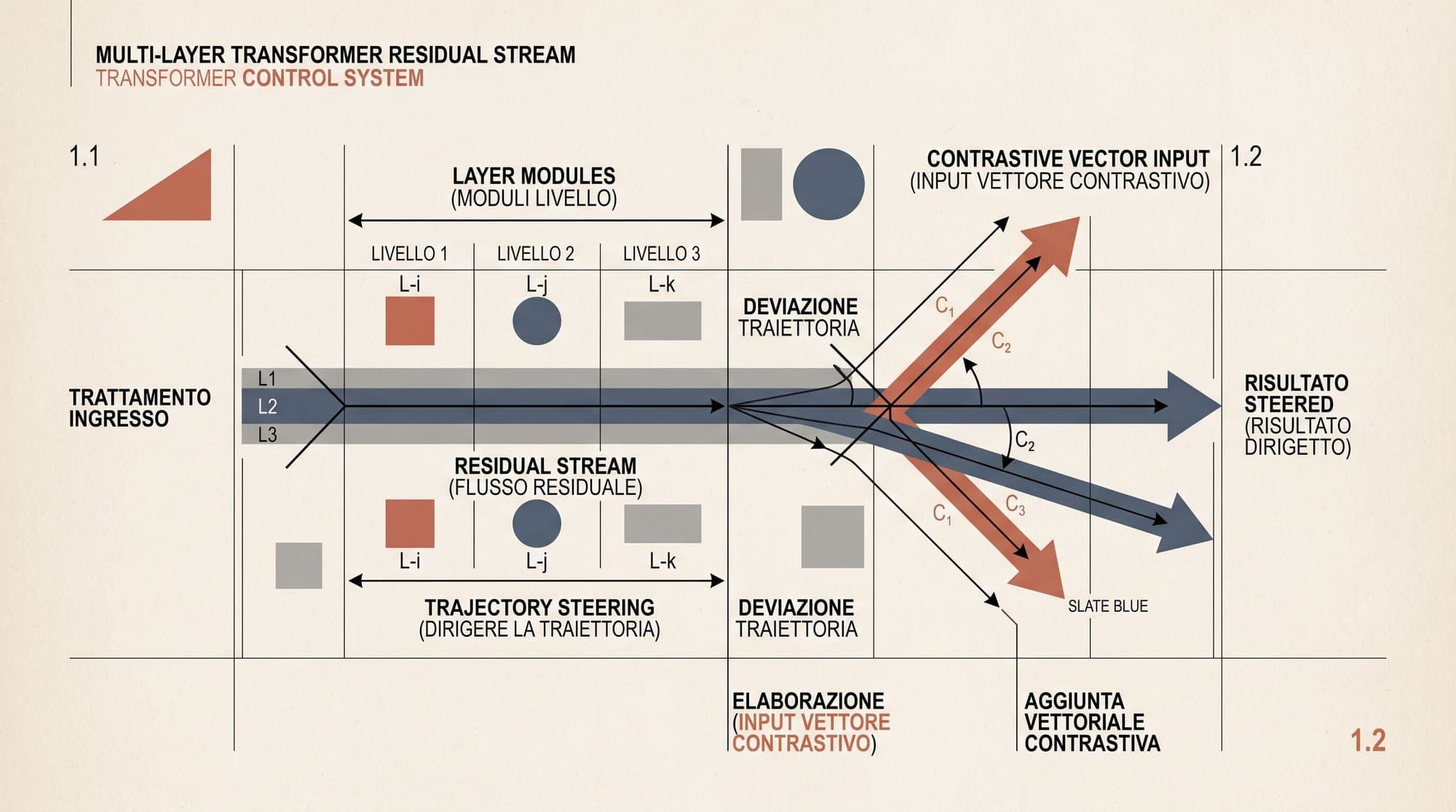
Large language models operate by sequentially transforming token representations across dozens of transformer layers. While traditional alignment and behavioral steering rely either on prompt engineering in the input context or gradient descent during fine-tuning, an alternative paradigm has emerged: representation engineering and activation steering.
By treating the transformer residual stream as a continuous semantic vector space, activation steering manipulates intermediate hidden states during the forward pass. This approach allows developers and researchers to alter model personality, enforce honesty, reduce sycophancy, or bypass safety guardrails dynamically at inference time without modifying model weights or consuming context tokens.
The Linear Representation Hypothesis and Residual Stream Mechanics
Modern decoder-only transformers route information through a shared residual stream. For a model with layers and hidden dimension , the hidden state at layer is iteratively updated by multi-head attention and feed-forward network (FFN) blocks:
Under the linear representation hypothesis formulated in mechanistic interpretability research, high-level semantic concepts, factual knowledge, and behavioral dispositions are encoded as linear directions within this -dimensional space.
Rather than individual neurons acting as discrete concept detectors, concepts exist in superposition across distributed activation directions. If a specific concept (such as truthfulness, refusal, sentiment, or sycophancy) is captured by a direction vector , the degree to which an intermediate state expresses concept corresponds to the inner product .
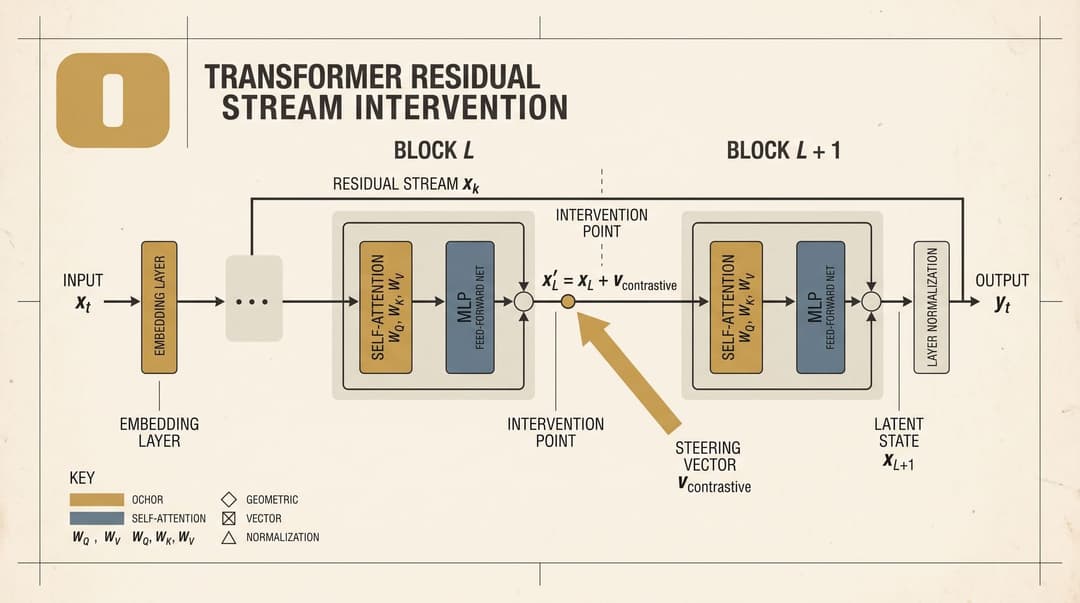
Methods for Extracting Steering Vectors
Extracting a clean, generalizable steering vector requires isolating the targeted concept from lexical and syntactic confounders. Several formal techniques have been established across the literature.
1. Activation Addition (ActAdd)
Introduced by Turner et al. (2023), Activation Addition derives steering vectors from minimal prompt pairs. Given a positive prompt (for example, "Love") and a negative prompt ("Hate"), the model processes both sequences. The difference between their residual activations at a chosen layer and token position defines the steering vector:
While straightforward, single-pair activation differences often capture prompt-specific artifacts alongside the intended behavioral concept.
2. Contrastive Activation Addition (CAA)
To improve generalization and robustness, Panickssery et al. (2023) introduced Contrastive Activation Addition. CAA uses a dataset of paired contrastive examples reflecting opposite behavioral traits, such as factual answers versus common misconceptions, or sycophantic versus objective responses.
For each pair, activations are recorded at the final prompt token position across layer . The steering vector is computed as the mean difference across all pairs:
Averaging across diverse contexts cancels out syntactic noise and prompt-specific semantics, isolating the underlying behavioral direction.
3. Linear Artificial Tomography (LAT) and PCA Extraction
In their foundational work on representation engineering, Zou et al. (2023) developed Linear Artificial Tomography (LAT). For a set of contrastive stimulus pairs, the activation differences at layer form a matrix , where each row is .
Computing the first principal component (PC1) via Principal Component Analysis (PCA) yields the direction that maximizes the variance of behavioral divergence:
LAT can be expanded into multi-direction reading vectors and supervised classifiers (such as linear probes or support vector machines) to detect truthfulness and safety violations in real time.
4. Sparse Autoencoder (SAE) Feature Steering
Whereas CAA and LAT identify global directions, Templeton et al. (2024) at Anthropic showed that Sparse Autoencoders (SAEs) trained on residual stream activations unpack superposition into thousands of monosemantic features.
An SAE decomposes activation into an overcomplete dictionary , where $\mathbf{f}(\mathbf{x}) = \text{ReLU}(\mathbf{W}_{\text{enc}}\mathbf{x} + \mathbf{b}_{\text{enc}})$. A single feature column represents an interpretable concept. Clamping or adding activation to feature index during inference provides fine-grained control over specific entities or behaviors.
Inference-Time Intervention Mechanics
Once steering vectors are computed, they can be applied during generation using two primary algebraic mechanisms.
Additive Steering
During autoregressive generation, at each new token generation step , the steering vector is added to the residual stream at layer , scaled by a steering coefficient :
- A positive coefficient () amplifies the target behavior (for example, increasing truthfulness or formality).
- A negative coefficient () suppresses the target behavior or induces the inverse trait.
- Multiple steering vectors can be applied concurrently across different layers or concepts with separate gains: $\mathbf{h}_l^{(t)} \leftarrow \mathbf{h}_l^{(t)} + \sum_k \alpha_k \mathbf{v}_{l, k}$.
Directional Ablation and Orthogonal Projection
Instead of adding a vector, safety mechanisms and refusal behaviors can be disabled or isolated by projecting out a specific direction.
As demonstrated by Arditi et al. (2024), refusal behavior across open-source chat models (including Llama, Mistral, and Qwen) is mediated by a single low-dimensional subspace. By projecting activations onto the orthogonal complement of the refusal direction , the model loses the capacity to generate refusal tokens:
This surgical ablation prevents refusal responses while leaving unrelated capabilities intact.
Layer Selection and the Coherence Pareto Frontier
Activation steering performance depends on two hyperparameters: layer depth and the steering multiplier .
Layer Depth Distribution:
[0% - 25% Depth]   Low-level tokenization, position encoding, syntax.
                   Intervention causes severe grammatical breakdown.
[40% - 75% Depth]  Abstract semantic, factual, and behavioral representations.
                   Optimal layer zone for activation steering and CAA.
[85% - 100% Depth] Output vocabulary projection and next-token distribution.
                   Intervention causes crude token substitution.
Layer Depth Dynamics
- Early Layers (0% to 25%): Activations handle positional information, local syntax, and token-level parsing. Injecting semantic steering vectors here disrupts language structure and produces incoherent text.
- Mid to Late-Intermediate Layers (40% to 75%): Representations reach peak abstraction. Features corresponding to honesty, persona, sycophancy, and task intent are clearly delineated. In models like Llama-2-7B (32 layers), layers 12 to 18 consistently yield the highest behavioral shift per unit of perplexity degradation.
- Late Layers (85% to 100%): Activations specialize in final token un-embedding and vocabulary selection. Perturbing these layers tends to force specific vocabulary tokens rather than modifying underlying intent.
Tuning the Multiplier
The steering multiplier governs the trade-off between behavioral intensity and model coherence:
- Under-steering ( too small): The model ignores the intervention and maintains default generation.
- Optimal regime: Behavioral traits shift significantly (e.g., sycophancy drops by 40% to 70% in benchmark evaluations) while sequence perplexity remains within 5% of baseline.
- Over-steering ( too large): The modified hidden state falls outside the model natural activation manifold. Symptoms include repetitive loops, degenerate token patterns, and loss of grammatical coherence.
Architectural Trade-Offs: Steering vs Prompting vs Fine-Tuning
Activation steering occupies a distinct position in the LLM alignment and control landscape.
| Dimension | System Prompting | Supervised Fine-Tuning / LoRA | Activation Steering / CAA |
|---|---|---|---|
| Context Overhead | High (consumes context window tokens) | None | None |
| Inference Compute Tax | Increases quadratic/linear attention cost | Zero additional cost | Single vector addition per token () |
| Weight Modification | None | Permanent weight update | None |
| Runtime Controllability | Static per request | Fixed by model checkpoint | Continuous dynamic scaling via |
| Sample Efficiency | 1 prompt | to training pairs | 10 to 100 contrastive pairs |
| Composability | Prompt concatenation (interference risk) | Weight merging (degradation risk) | Linear combination of vectors |
| Vulnerability to Jailbreaks | High (prompt injection/overrides) | Moderate (adversarial prefixes) | High resistance (internal representation override) |
Implementation Practicalities and Serving Overhead
From an engineering perspective, activation steering integrates cleanly into high-performance inference engines:
- Computational Cost: Adding to the hidden state of a batch during token generation requires floating-point operations per step. For a 70B parameter model (), this represents less than 0.001% of the FLOPs required by the attention and FFN layers.
- Memory Footprint: Storing several dozen steering vectors requires a few megabytes of VRAM, compared to gigabytes required for separate LoRA adapters.
- KV Cache Compatibility: Because steering modifications can be restricted to generated tokens or applied uniformly, KV caches for prompt prefixes remain valid and shareable across requests.
Failure Modes and Open Challenges
Despite its efficiency, representation engineering faces technical constraints:
- Feature Entanglement: Steering vectors derived from contrastive pairs often contain entangled secondary features. For instance, steering for "formality" may unintentionally steer toward "verbosity" or "archaic vocabulary."
- Manifold Shift and Generalization Bounds: Injections that push activations too far from the training distribution trigger out-of-distribution failure modes in deeper attention heads.
- Task-Specific Fragility: While effective for stylistic, persona, and safety modifications, activation steering is less effective at injecting complex multi-step procedural reasoning that the base model has not learned during pre-training.
Representation engineering establishes a direct bridge between mechanistic interpretability and production model control. By shifting intervention from input tokens and static weights to dynamic latent vector operations, activation steering provides a low-overhead, continuously tunable mechanism for governing large language model behavior.
Sources
- Representation Engineering: A Top-Down Approach to AI Transparency (Zou et al., 2023)
- Steering Language Models with Activation Engineering (Turner et al., 2023)
- Steering Llama 2 via Contrastive Activation Addition (Panickssery et al., 2023)
- Refusal in Language Models Is Mediated by a Single Direction (Arditi et al., 2024)
- Scaling Monosemanticity: Extracting Interpretable Features from Claude 3 Sonnet (Templeton et al., 2024)
