
SenseTime has released SenseNova 6.8 Code2Video, an open model that makes short videos by writing code instead of generating pixels. The company announced it on X on October 28 at about 7:09 AM PT, with a 90-second launch film it says the model made. The weights went up on October 25, per the model repo's commit history, and are on Hugging Face, and the workflow, skill files and prompt templates are on GitHub.
It works differently from the models in our best AI video generators guide. SenseTime says generative video models make the whole clip in one black-box sampling process. Code2Video instead writes a program, renders it, reviews the frames and revises the code. The delivered package includes the source code.
What SenseTime released
Per the model card and the repo, the release has five parts:
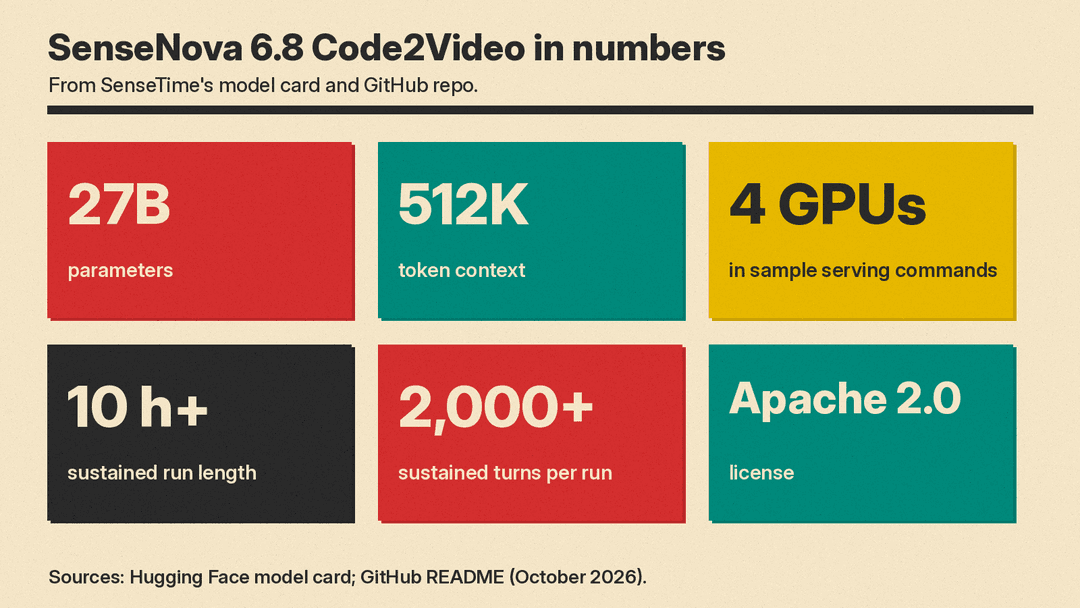
- Model weights. About 27 billion parameters, fine-tuned from Qwen3.8-27B, with a 512K-token context. The Hugging Face card lists the license as Apache 2.0.
- Deployment commands for LightLLM, vLLM and SGLang. All three sample commands split the model across four GPUs (tensor parallel size 4).
- A "code-video" skill for Claude Code: a fixed workflow, eight craft guides and tools that render and check the output.
- A prompt enhancement template that turns a short request into a detailed production brief.
- Full production trajectories on Hugging Face: messages, tool calls and rendered review images, one film per line. SenseTime says private paths are anonymized, so the recorded commands are not directly replayable.
SenseTime calls the model "a first step toward code-driven video creation with small open models." It releases these files "as a reference for researchers."
How it makes a video
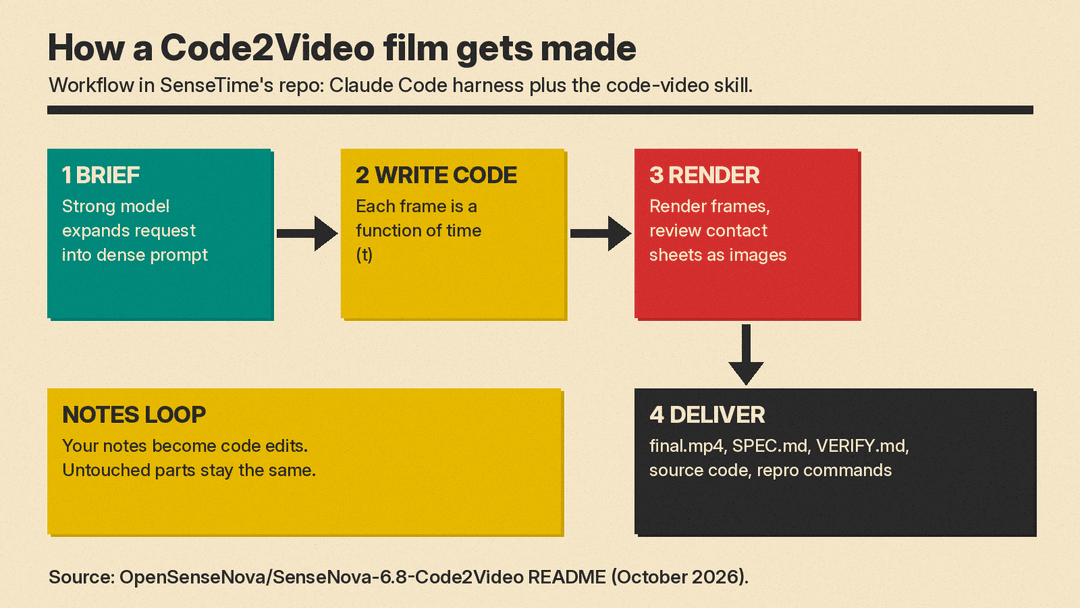
The repo describes a loop, not a single prompt. First, a strong general model expands your request into a dense brief. SenseTime suggests Claude Opus 5.5 "or another strong model" for this step, and says the model can enhance prompts on its own "only at a basic level."
Then Code2Video runs inside Claude Code with the code-video skill. It writes a spec, draws every frame as a function of time, renders, reviews contact sheets as images, and revises. The sample start command asks for at least two visual review passes. It also asks for a delivered package: final.mp4, SPEC.md, VERIFY.md, a contact sheet, source code and reproduction commands.
The eight craft guides cover explainers, stylized looks, simulations, characters, 3D scenes, motion graphics, sound and narration, and music sync. The showcase films include "Fourier Light Painting," "Golden Spiral and Sunflower," "Paper Sea" and "Robot and the Night Lamp."
These are long jobs. SenseTime says the model sustains runs of "more than 10 hours and more than 2,000 turns." It tells users to set Claude Code's context window to 512K by hand, because Claude Code otherwise treats an unknown model as a 200K model. You also need Node.js 18 or later, Python 3, ffmpeg and ffprobe, fonts for the video's language, and Playwright with Chromium for rendering.
Why code instead of pixels
SenseTime lists three problems with generative video models. They learn "how the world looks from images, not how it works from equations," so motion can look plausible and still be physically wrong. Size, timing and trajectory stay implicit, so changing one detail means re-prompting and resampling the whole clip, and the rest of the clip changes with it. And on-screen text, formulas, charts and data values are easily garbled.
Code fixes those by design, the company argues. Every element is a named object, so a change touches a few lines and leaves the rest alone. Text is typeset exactly. The same code always renders the same film. The repo shows this with a retro airport split-flap board revised in two rounds of notes: first restyled as a pastel hotel lobby, then given a plane and travellers. SenseTime says the copy, timing and flip mechanics it did not ask to change stayed the same.
If you have fought a video model over a single wrong word on a sign, this is the pitch. It is a different loop from the one in our AI video prompt guide, where a weak result means rewriting the prompt and generating again.
SenseTime also sees code as glue. It says code can call image, video, 3D and editing models and chain them into one workflow. It suggests a code render could act as a fast previs that a video model then renders on top of, and that the same programs could produce exactly labeled data such as depth and camera poses for world models. Those are stated goals, not shipped features.
The limits SenseTime lists
The repo is plain about what the model cannot do:
- No photoreal footage. It makes videos that can be written as code: motion graphics, explainers, stylized 2D and 3D scenes and procedural audio.
- No benchmark. SenseTime reports "qualitative examples only" and calls a benchmark for code-driven video "an important open problem."
- A gap to frontier models. It says the model is "clearly behind the strongest proprietary models on visual polish and long-horizon reliability."
- Cost in time. A production run "takes hours and a long context," and results depend on the harness settings.
So every example so far comes from SenseTime's own showcase, with no benchmark numbers.
Who it is for
If you want a realistic shot of a person or a street, this is the wrong tool, because it does not generate photorealistic footage. Code2Video fits a narrower group. Its model card names math explainers, paper-craft films, isometric worlds, kinetic type, data stories, character animation and product promos: work where exact text and repeatable edits matter more than photorealism.
Running it yourself is not light. The sample commands use four GPUs, and a film can take hours of agent time. Like Tencent's Hy-Nomas world model, it is an open video release that technical teams can download and run themselves.
The bigger point is the format. SenseTime's case is that a film built from code is easier to edit and check than a sampled clip. It says it plans to scale the model and extend it to editing, compositing, animation and 3D. Whether a small open model can close the polish gap is the open question.
