
Deepdub, an AI dubbing and localization company, has released Phantom Z 4.0, a text-to-speech (TTS) model built for voice agents. In its launch post dated October 26, 2026, the company says the model starts speaking in a median of 50 milliseconds, network round trip included, with a 1.2% word error rate on Coval's independent voice AI benchmark. One month earlier, Deepdub says, the same measurement put Phantom Z at roughly 250 ms.
Here is what Deepdub announced, what the numbers measure, how they line up with Coval's own public pages, and who can use the model today.
What Deepdub announced
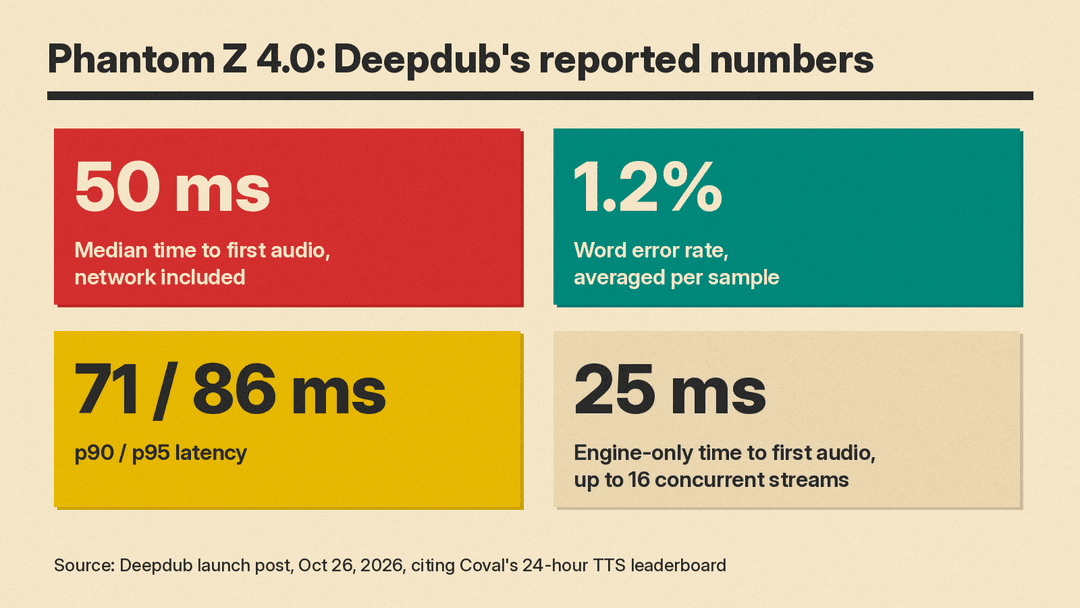
The launch post lists these headline figures for Phantom Z 4.0:
- 50 ms median time to first audio (TTFA), network included.
- 1.2% word error rate (WER), averaged per sample.
- 71 ms and 86 ms at the 90th and 95th percentile of latency. Deepdub says that ranks second on tail latency.
- 25 ms engine-only TTFA, which Deepdub says holds for a single request or a burst of 16 concurrent streams.
- 2 billion parameters and 48 kHz audio output.
Deepdub says that on Coval's word-error-rate-versus-latency chart, "no model on the leaderboard is both faster and more accurate than Phantom Z 4.0." It describes the model as having "the lowest word error rate among the fastest TTS models."
The model is in early access in the Deepdub Playground, in English and Hebrew. Deepdub says "the rest of our supported languages" will follow soon. The post does not list API pricing.
What time to first audio means
Coval calls TTFA the text-to-speech portion of a voice agent's response delay. It defines time to first audio as "the wait between sending text to a text-to-speech API and the first audible sample a listener would hear, including any leading silence at the start of the stream."
That last part matters. Coval's open-source methodology says that since a May 2026 change, TTFA counts both the arrival of the first audio chunk and any silence a provider puts at the start of the stream. Coval says numbers from before that change are not comparable with later ones.
Word error rate checks the other side: whether the words come out right. Coval transcribes each model's audio with a fixed speech recognition model and scores it against the input text, according to Deepdub's description of the test. Pooled across all datasets, Deepdub reports a WER of 1.5% for Phantom Z 4.0, split into 0.9% substitutions, 0.5% deletions and 0.1% insertions. The lower 1.2% figure averages WER per sample instead.
TTS is one link in the usual voice agent chain of speech recognition, a language model, then speech output. We covered how that chain compares with single speech-to-speech models in Speech-to-Speech vs Cascaded Voice Agents.
How the claim lines up with Coval's public page
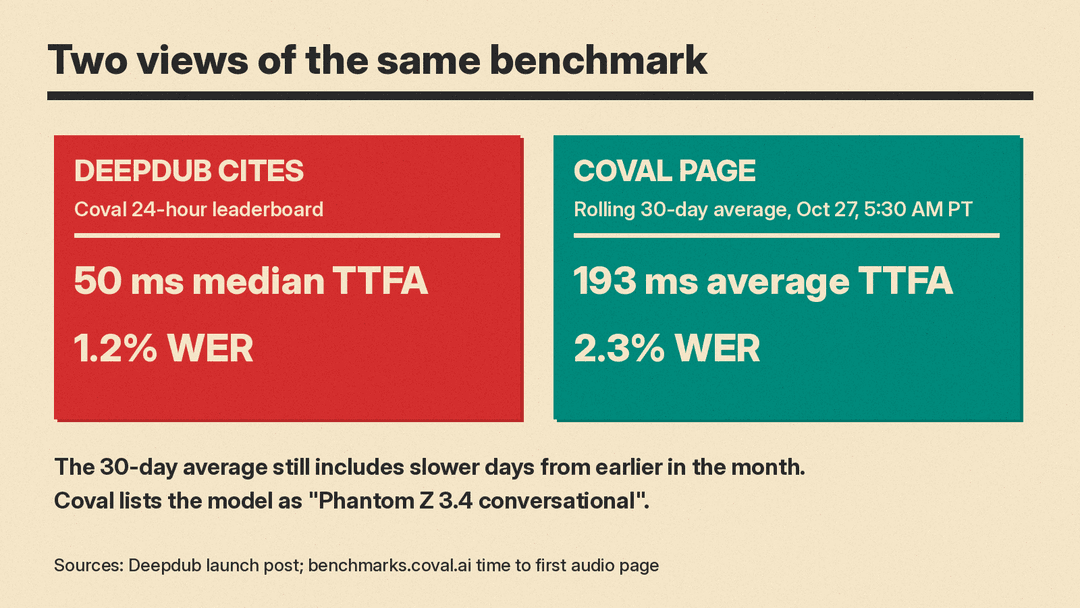
Deepdub's numbers come from Coval's 24-hour leaderboard, with 96 samples per model. Deepdub notes that Coval lists the model as "Phantom Z 3.4 conversational" and that leaderboard values are a snapshot from October 2026.
Coval's time to first audio page shows a different view: a rolling 30-day average. When we checked it at about 5:30 AM PT on October 27, 2026, it ranked 31 TTS models and listed Deepdub's "Phantom Z 3.4 conversational" at 193 ms average TTFA and 2.3% WER, in 11th place. The leader on that page was vui via Fluxions at 43 ms.
The two views are not in conflict. Deepdub's own chart of daily medians runs from September 27 to October 26, 2026, and shows its latency falling across that month, so a 30-day average still carries the slower days. The 50 ms figure is a recent snapshot; the 30-day figure will only reflect it fully after weeks of new runs.
What is new under the hood
Deepdub says the name continues the Phantom family but "almost everything underneath is new." The post names three parts:
- Model: a new modeling approach "built from scratch, drawing on recent advances in language and vision modeling."
- Engine: a new inference engine with kernel fusion, quantization, dedicated Triton kernels and custom scheduling.
- Scale: 2 billion parameters with 25 ms engine-only TTFA.
On training, Deepdub credits seven years of professional, multilingual performance data from real dubbing productions, and RL tuning on "thousands of hours of human-rated audio." Chen, Deepdub's chief scientist, is quoted in the post: "Designing the model and the inference engine together, rather than optimizing one after the other, is what let us push latency down without giving up quality."
The post also promises expressive, content-aware delivery, text normalization for numbers, dates, abbreviations and spelled-out codes, and fine-grained control over delivery. It gives no separate measurements for those features.
What comes next
Over the next few weeks, Deepdub says it will ship more kernel optimizations, a 24 kHz telephony variant and distilled "flash" models. The company says these "should take roughly another 10 ms off time-to-first-audio and raise throughput further."
Why it matters
Phantom Z 4.0 arrives alongside several other recent voice launches. ElevenLabs shipped Eleven Realtime and Destined AI released the open Hurston-1 model for phone calls. Deepdub comes at voice agents from the media side: its homepage says it has localized more than 5,000 titles, and the company frames Phantom Z 4.0 as bringing what it learned in Hollywood dubbing to voice agents.
For teams choosing a TTS vendor, the practical points are:
- Check the benchmark yourself. Coval's pages update daily and its method is open source. The 30-day average will show whether the 50 ms result holds.
- Languages are limited for now. Early access covers English and Hebrew only.
- No price in the launch post. It gives no cost per character or minute.
- Self-reported framing. The ranking claims are Deepdub's reading of Coval's data, not a statement from Coval.
