
A tiny piece of Claude Code's interface turned into a big argument overnight. On October 26, 2026, Flamerix AI published a GitHub gist saying that the short status text next to each background agent in Claude Code was costing its team more than the main conversation. A link to it was posted to Hacker News on the evening of October 28 PT and reached the Hacker News front page. Developers on X, writing in several languages, passed the numbers around.
Point, comment, like and view counts below were checked at about 1:25 AM PT on October 29, 2026. At that time the Hacker News thread had 317 points and 98 comments.
What the gist claims
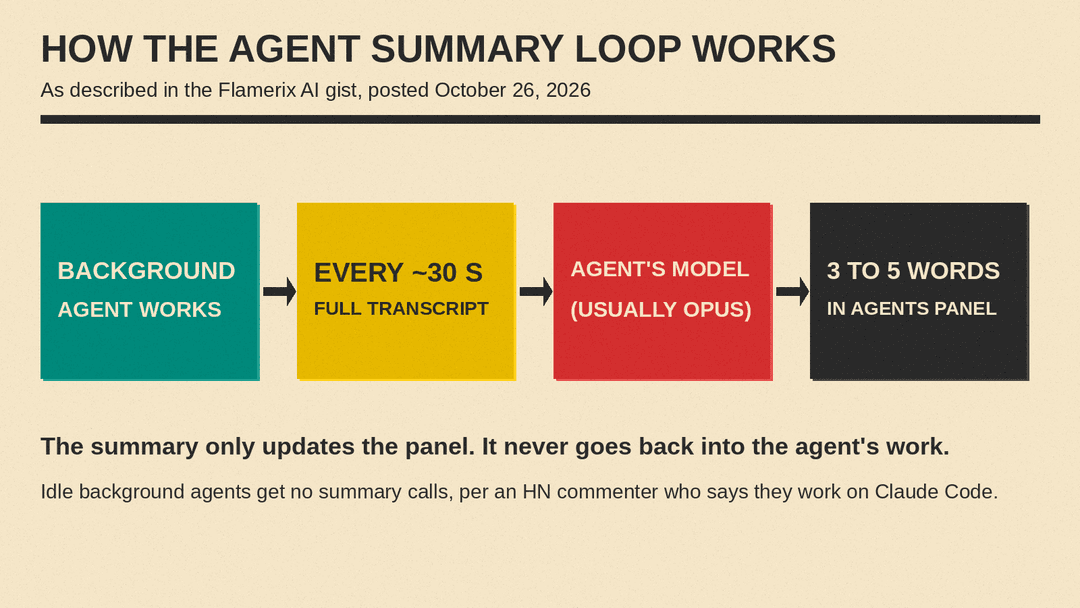
Claude Code can run background agents (helper agents that work on a task while you keep going in the main session). The agents panel shows a 3 to 5 word note on what each one is doing. According to Flamerix, Claude Code produces that note by sending the agent's whole transcript to the agent's model, usually Opus, about every 30 seconds and asking it to "describe your most recent action in 3-5 words." The answer only updates the panel. It never goes back into the agent's work.
Flamerix says it found this in Claude Code's OpenTelemetry export (a standard way to send app logs and metrics to monitoring tools) by grouping requests by a field called query_source. Over one week, its numbers for requests labeled agent_summary were:
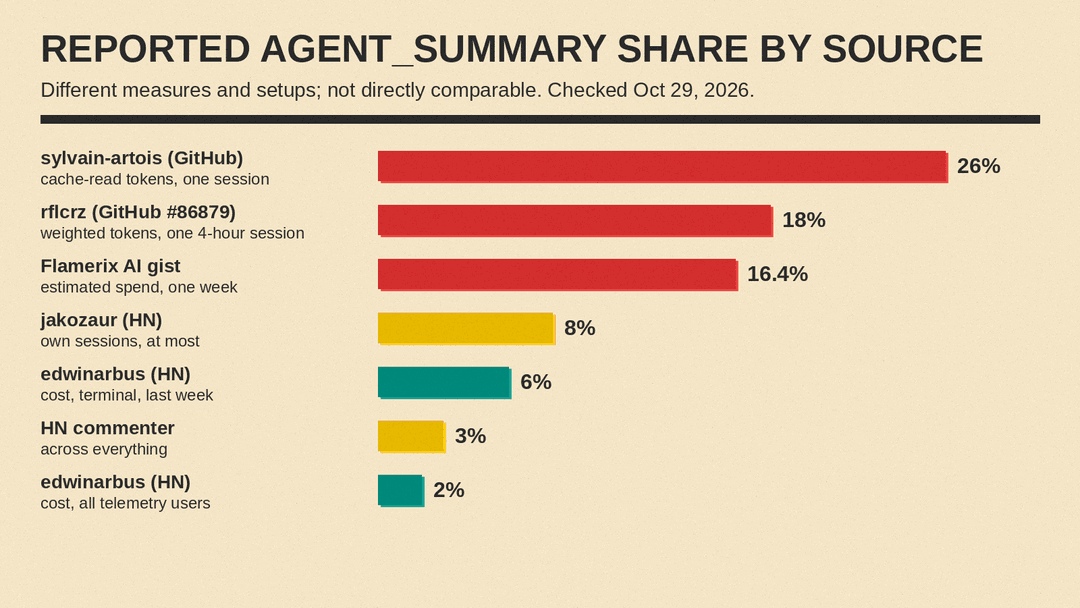
- 16.4% of Claude Code's own estimated spend, against 15.7% for the main conversation
- 19.7% of all API requests, about 1 in 5
- 96% of that spend on Opus
- about 9,000 input tokens per output token
The gist says this has been on by default since version 2.1.232 in August 2026 and that there is no setting to turn it off. Its workaround is a roughly 80-line script that loads before Claude Code and stops the summary timer, so the panel text simply stops updating. Flamerix notes that the spend figure is Claude Code's own estimate, not an invoice, and that on a subscription "what you lose is rate-limit headroom." It also says an update can silently undo the fix.
The gist points to an open GitHub issue, #86879, filed in August by user rflcrz. That issue asks for a supported way to disable the summaries and reports agent_summary at 22.7% of requests and about 18% of weighted tokens in one 4-hour session with 27 subagents. Other commenters there posted their own measurements, including one from sylvain-artois showing the calls at 26% of a session's cache-read tokens.
An Anthropic-side answer: closer to 2% on average
About 80 minutes after the Hacker News post went up, Hacker News user edwinarbus, who wrote "I work on Claude Code," replied. They confirmed the basic mechanism but said it applies only to background agents that are actively working: "They get a summary call about every 30 seconds, and idle background agents don't." They added that the summaries are used "for both you and Claude Code to track what each background agent is working on, without reading transcripts."
They said the 16.4% "sounds like it was for a team running mostly background agents, and doesn't seem like a typical session." Their figures for last week, across users who send Claude Code telemetry: agent_summary was "about 2% of cost at API list prices and just under 4% of requests," and about 6% of cost in the terminal, where nearly all of these calls happen. They added: "That said, we agree that's a lot for a status line." They said a fix for summaries that miss the prompt cache shipped in version 2.1.311 and later, and that the team is working on "a much cheaper mode that sends short notes to a smaller model instead of the full transcript."
Replies to that comment pushed on documentation and control. esikich asked whether this is "common knowledge" and whether it is documented anywhere. simoncion, replying to esikich, said it might be terminology confusion, but pointed out that the Claude Code status line docs say status lines run locally and do not consume API tokens. rptx said the reply "helps put the 16 percent in context" but asked for "a real setting to turn agent summaries off," because in the current binary the SDK option and environment variable "can only switch them on."
"Isn't this cached?"
A large part of the thread argued over prompt caching, where a provider reuses recently sent text at a lower price (our explainer on how AI usage is billed in tokens covers cache pricing). HeavenFox asked whether almost all of the tokens would be cache hits "and therefore fairly cheap." minraws replied that even at cache prices, ten summaries cost about as much as reading the whole session fresh once.
odo1242 answered that an agent "burns the exact same number of tokens (actually more) every time the model makes a tool call." kristjansson agreed in a reply: "It costs as much as one additional tool call in the conversation." The gist itself says about 98% of these calls read from cache, and the 2% that miss the cache carry over a third of the cost, which matches the case edwinarbus said was just fixed.
People who measured their own setups
Some commenters checked their own numbers. jakozaur wrote: "I tested it, and it looks real but more nuanced." They said it affects subagents but workflows "do not seem affected," and that in their sessions it looked "more like ~8% at most." lemming replied that 8% "still seems pretty indefensible, especially if you can't turn it off," and chii added that "this should be user toggled."
Another commenter said they were seeing about 3% "across everything / everyone." gym, on a Pro plan, said that two days ago a full 5-hour window used 25% of their weekly limit and that "Today, 100% 5 hour is like 13% so something was fixed." For context, Claude Code draws on the same usage limits as Claude chat, with a rolling five-hour window and weekly limits on paid plans, as our comparison of Cursor, Claude Code and Codex explains.
Trust, incentives and the harness
The sharpest comments were about motives, not math. emsign called it "fraud." franticgecko3 said Claude Code "burning a large amount of tokens for no good reason is a headline we've seen more than a few times now" and said it is "time to start questioning the motivations of model providers shipping their own harnesses." dozerly put it briefly: "Incentives are not aligned for inference providers to own the harnesses." Others, such as messh, said they prefer Pi, another harness, for its minimalism.
Not everyone was angry. aidos called the patch "horrible (but crafty)" and praised its method of checking every timer for the summary code: "There's something reassuring about seeing the true hacker spirit still at work here. I approve."
The timing added fuel. On the afternoon of October 28, before the Hacker News thread, Boris Cherny of the Claude Code team (@bcherny) posted the results of a review of session IDs users had shared about fast usage. He wrote that the team "found a few smaller things along the way that made some sessions burn through tokens faster than they should have" and was rolling out fixes, but "didn't find a single root cause or any regression in Claude Code." He suggested watching effort levels, since subagents inherit them, and using /usage to see where tokens went. His post does not mention agent summaries.
On X: mostly relays, some practical advice
X reaction was smaller and mostly summaries of the gist, including posts in Chinese and Japanese. A few added advice. @Block4Roots told heavy background agent users to "check your own setup before blaming the model" by turning on OpenTelemetry and grouping by query_source, and noted that on a Pro or Max plan "It eats your rate limits instead." @jatingargiitk called it "One setup, not a universal rate" and suggested measuring background calls "Before downgrading your coding model." @automatethebs drew a broader lesson: "the costly part of an automation is rarely the main job, it's the quiet stuff running next to it."
What to take from it
Both sides agree on the mechanism: active background agents get a model call about every 30 seconds to write their status note. They disagree on size. One team measured 16.4% of its spend, other users reported figures from 3% to 26% on different measures and setups, and the Anthropic-side figure was about 2% across telemetry users and about 6% in the terminal.
If you run many long background agents, the reported share was highest in exactly that setup. The cache-miss fix is in 2.1.311 and later, a cheaper summary mode is in progress, and as of this writing there is still no documented setting to turn the summaries off. The Flamerix workaround changes how Claude Code runs on your machine, and its own license note warns that this "may conflict with the terms of the service you use it with."
Sources
- Flamerix AI gist: Claude Code agent summary cost and workaround
- Hacker News discussion
- edwinarbus comment on Hacker News
- GitHub issue #86879: a supported way to disable agent_summary
- Claude Code status line documentation
- @bcherny on X: session ID review results
- @Block4Roots on X
- @jatingargiitk on X
- @automatethebs on X
