
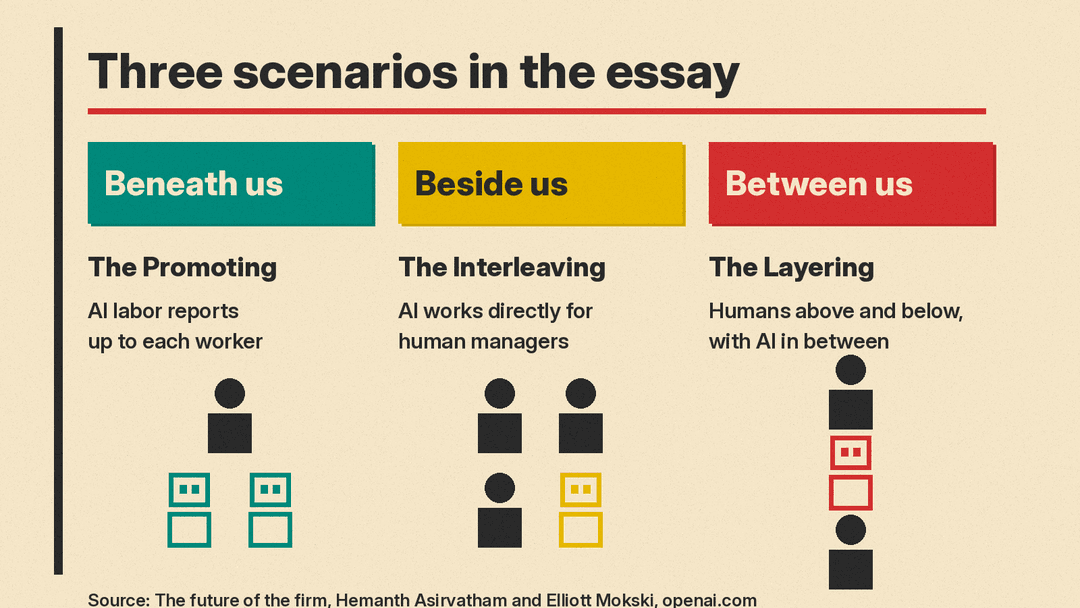
Two OpenAI employees have published a long essay on how AI agents could change the shape of a company. The future of the firm, by Hemanth Asirvatham and Elliott Mokski, asks a simple question: "When AI enters the firm, where does it go?" Their answer is three org charts, with AI placed beneath, beside, or between people.
The piece is not an OpenAI product announcement or company policy. The authors' note says it is "the second essay in our series on the next economy, part of a new platform to host independent voices exploring an AGI future," and that it "reflects our views, not those of OpenAI or our colleagues."
Why it matters
OpenAI is selling agents to businesses right now, through deals such as its ServiceNow partnership and the Oracle apps coming to ChatGPT. This essay shows how people inside the company think that work could change who manages whom. It also argues against a common way of judging AI progress: automating a single job.
The authors say their focus "isn't total automation but a transitioning economy." They write that "None of these scenarios will play out exactly as we describe, but we think aspects of all three will come true."
Scenario 1: beneath us ("The Promoting")
In the first case, everyone keeps their seat and "a new basement of AI labor grows underneath." Each worker gets agents to manage: first assistants, then chiefs of staff, and in time "entire miniature firms reporting up to each of us."
The authors say this scenario "doesn't imply layoffs." Their argument: if AI can do ninety percent of what you did before, you might not be left with ten percent of a job. You might instead do "a full job, just a different one," aimed at a goal ten times larger. They add two conditions. People must still add value to production, and consumers must want more output. If demand does not grow, they say, "the equilibrium will shift toward fewer workers or fewer hours worked."
They expect adoption to start with front-line workers, "so long as the person who best gets AI to do the work is the person who used to do it themselves." The biggest change is for entry-level workers. There "would no longer be a lowest rung, at least not for humans," and the essay names the loss of apprenticeship and learning by grunt work as "genuine costs," though the authors "mostly see this as a privilege": "The greenest hire with a good idea has resources to experiment."
Scenario 2: beside us ("The Interleaving")
Here AI joins the org chart as a colleague of sorts, "working directly for existing human managers and executives." The example is a furniture company VP who gives an AI marketing team a budget and a sofa to sell. The agents split the launch work among themselves and return a campaign for her to approve.
What the authors call "the central asymmetry of the whole transition" sits in this section. AI that handles bigger scope is harder to build, but "bigger scope is easier to adopt." A narrow tool needs the whole workforce to learn it. A team-like AI can be adopted straight from the top. In the authors' words: "firms must learn technologies, but labor learns the firm and can onboard itself."
They also argue that judging AGI by whether it can do one job "doesn't give us humans enough credit," because most output comes from teams and firms, not lone workers. "An economic AGI must reach the standard of people, not person."
Scenario 3: between us ("The Layering")
The third case puts AI above some people: "human, AI, human: an automation sandwich." The authors call it the most confounding scenario but say it has, "in less radical ways," already begun.
Their near-term version is advice, not management. They write that an executive can already ask ChatGPT to read Slack channels, documents and code from across her company and answer questions about it. They see this growing into "a full-service consultancy" for executives. The structural effect, they say, "is centralization," with more power at the top.
The same section covers monitoring. The authors say AI could judge real work instead of "clicks counted, mouse wiggles, green status dots," which could build trust and allow more flexible work. They also warn that "any new surveillance mustn't be implemented lightly."
Four open questions
The essay ends with four questions. It leans one way on some and leaves others open:
- Red tape: cheap prototyping should push firms to "aim less, fire more," with fewer layers of middle management. The same tools can also "enforce larger spools of red tape."
- Worker agency: the AI consultancy "is a double-edged sword." The authors' view is that "on net, workers will gain agency."
- Firm size: better communication could justify bigger or smaller firms. They "expect to see many smaller firms, but also sprawling AI 'holding companies.'"
- Pay: if AI gives everyone the same good ideas, pay scales should compress. If each person runs a larger AI operation, judgment matters more and pay gaps could grow. The result "will perhaps hinge on whether we are mostly providing judgment or following it."
What to take from it
This is an argument, not data. The essay gives no survey results or adoption figures, and its examples (Jace in accounting, Sheila the VP, Asha the CEO) are illustrations. Its use is as a map of how some OpenAI staff frame the move from chat tools to agent teams. For OpenAI's own measured data on how people use ChatGPT at work, see our post on OpenAI's Signals work data.
