
On November 10, 2026, Andreessen Horowitz (a16z) published an essay called Welcome to the B2A Economy. Its second paragraph makes a big claim: "Agents now make up the majority of web traffic, write more than half of new articles published online, and generate most of the code pushed to production."
Our news write-up of the essay covers what a16z said. This piece is my view of it. The business argument in the essay is worth taking seriously. The headline number is not, at least not yet. The essay text gives no source, method or time period for the "majority of web traffic" line. The chart beside it counts all bots, not only AI agents, and so does the best public traffic data I know of.
What the essay does back up
The essay has real figures. Almost all of them come from named companies:
- Shopify reported that AI-driven traffic to its stores "grew eightfold year over year in Q1 ‘26", while orders from AI-powered searches grew "nearly thirteenfold".
- Human Security "saw agentic browser traffic grow 8x between August and October", with Muse at 60% of that activity and OpenAI products at a combined 30%.
- As of September 2026, "upwards of 40% of GitHub PRs started with an agent’s draft", versus 17% six months before.
- Supabase reported in June 2026 that more than 60% of new databases are launched by AI tools. Neon reported in May 2025 that automated agents deploy 80% of its new databases.
- Stripe reported in June 2026 that agents accounted for nearly 40% of documentation traffic and 70% of CLI requests for API resources. Vercel reported in October 2026 that agent-triggered deployments had increased 28x over the last twelve months.
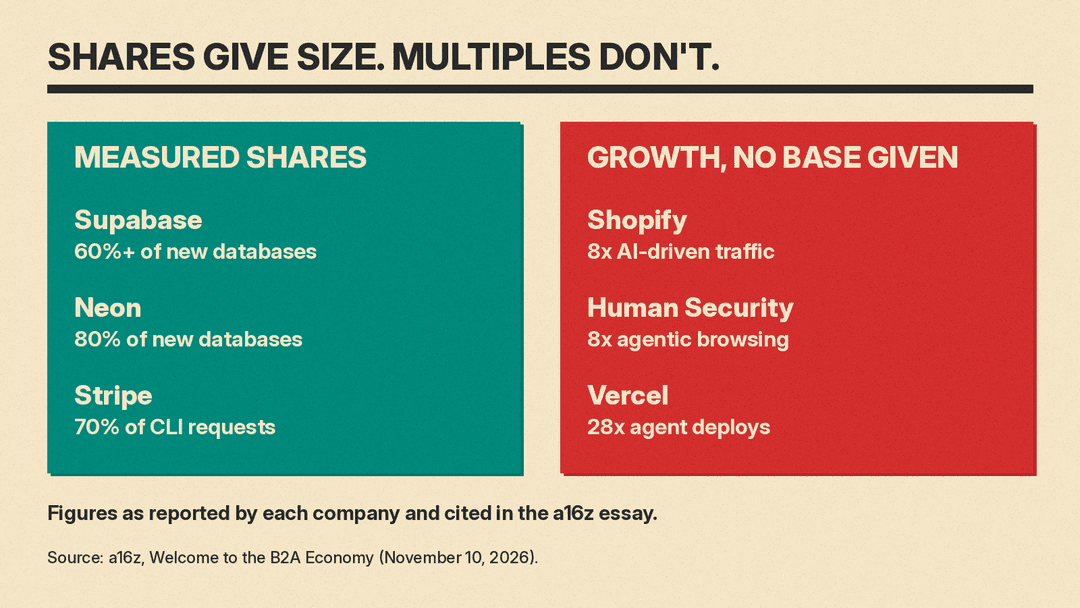
Look at the kind of number each one is. The consumer figures are growth multiples: 8x, nearly thirteenfold, 8x. A multiple tells you the speed of change, not the size. Eight times a small number is still a small number. The essay does not give an absolute base for any of them.
The essay itself hints that the base is small. In its section on infrastructure, a16z writes: "We’re already seeing system strain at fairly low agent volume on payments, fraud and identity, and communication." It also says "Most enterprises are still blocking agent traffic due to concerns about fraud and chargebacks," though it predicts they will have to embrace it. Both lines are hard to square with agents as the main users of the web today.
Bots are not the same as agents
There is public data that says most web traffic is automated, and the essay draws on it. The chart beside its traffic line, titled "Bot vs. Human Web Traffic Share," cites NP Digital, Security Magazine, Imperva and Soax. It shows bots, not agents, at 51% of web traffic in 2024 and 2025 and 54% in 2026, a figure the chart labels a forecast. Imperva, which publishes an annual Bad Bot Report, has said bots are the majority in its last two reports.
Its 2025 Bad Bot Report found that automated traffic "surpassed human activity, accounting for 51% of all web traffic" in 2024. Malicious bots alone made up 37% of all traffic that year. By my math, that means more than 72% of the automated share was bad bots. Its 2026 report puts automated traffic at "more than 53% of all web traffic in 2025", with human activity at 47%.
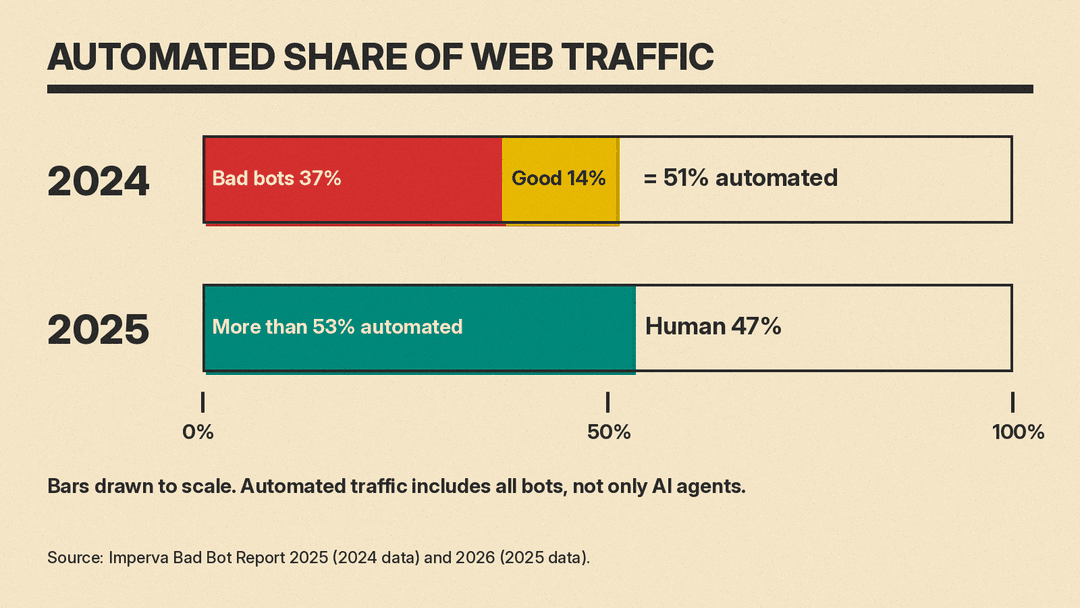
That is a majority, but of what? Imperva's own reports describe search engine crawlers, scripts, background processes, account hijacking and data exfiltration as automation. Imperva describes AI agents as "a new category of internet participant". In other words, agents are one part of the automated total, not the total.
So there are two ways to read a16z's line. If "agents" means all automated traffic, the claim matches Imperva's numbers, but most of that traffic is not an assistant shopping for you. If "agents" means AI systems acting for a person, I have not seen public data that puts them above half of the web, and the essay cites none: its chart counts all bots. Either way, the sentence does more work than its evidence.
Where the agent shift is real
The underrated part of the essay is the developer section. There, the numbers are shares, not multiples: more than 60% of new Supabase databases, 80% of new Neon databases, 70% of Stripe CLI requests for API resources. Shares tell you size. My read is that these numbers are also easier to trust, because the agent's work happens on the platform itself (a new database, a CLI request, a deployment) rather than in a browser that may or may not be a person.
That is where I would look for the first real "B2A" businesses: places where agents already do most of the setup work and the platform can measure it. For anyone building agent products, the practical lesson is the one in our piece on why you should start with a workflow, not an agent: pick a narrow job you can measure first.
Who wins, and what to check
If agent traffic grows the way a16z expects, the near-term winners are the companies that can tell an agent from a human and measure it: identity, payments and fraud tools. The essay names these same areas as places where it sees "system strain". Imperva makes a similar point from the security side: "Uncontrolled automation can distort business metrics, inflate infrastructure costs, degrade performance, and expose sensitive workflows."
For a business owner, that suggests a simple order of work. First, measure your own logs: how much traffic is automated, and how much of it is an agent doing a task for a real customer. Then decide how much to redesign for agents. A headline share of "the web" tells you less about your site than your own data does, the same way a leaderboard rank tells you less about an AI model than you think.
One more thing to keep in mind when you read essays like this one. The a16z page says "Certain information contained in here has been obtained from third-party sources, including from portfolio companies of funds managed by a16z" and that a16z "has not independently verified such information". That is standard disclosure, and it is a good reason to ask for the source behind each number.
My verdict
- Overhyped: "Agents now make up the majority of web traffic." The essay cites no data on agents for it. Its own chart counts all bots, and Imperva's data shows most of that automation is bad bots.
- Underrated: the developer numbers. Shares like 60%, 70% and 80% at Supabase, Stripe and Neon show agents already doing most of some jobs.
- Worth watching: a16z says this is "the first in a series" and that it will publish "more insights and data" over the next few weeks. If those pieces show the method behind the traffic claim, I will happily revisit this view.
