
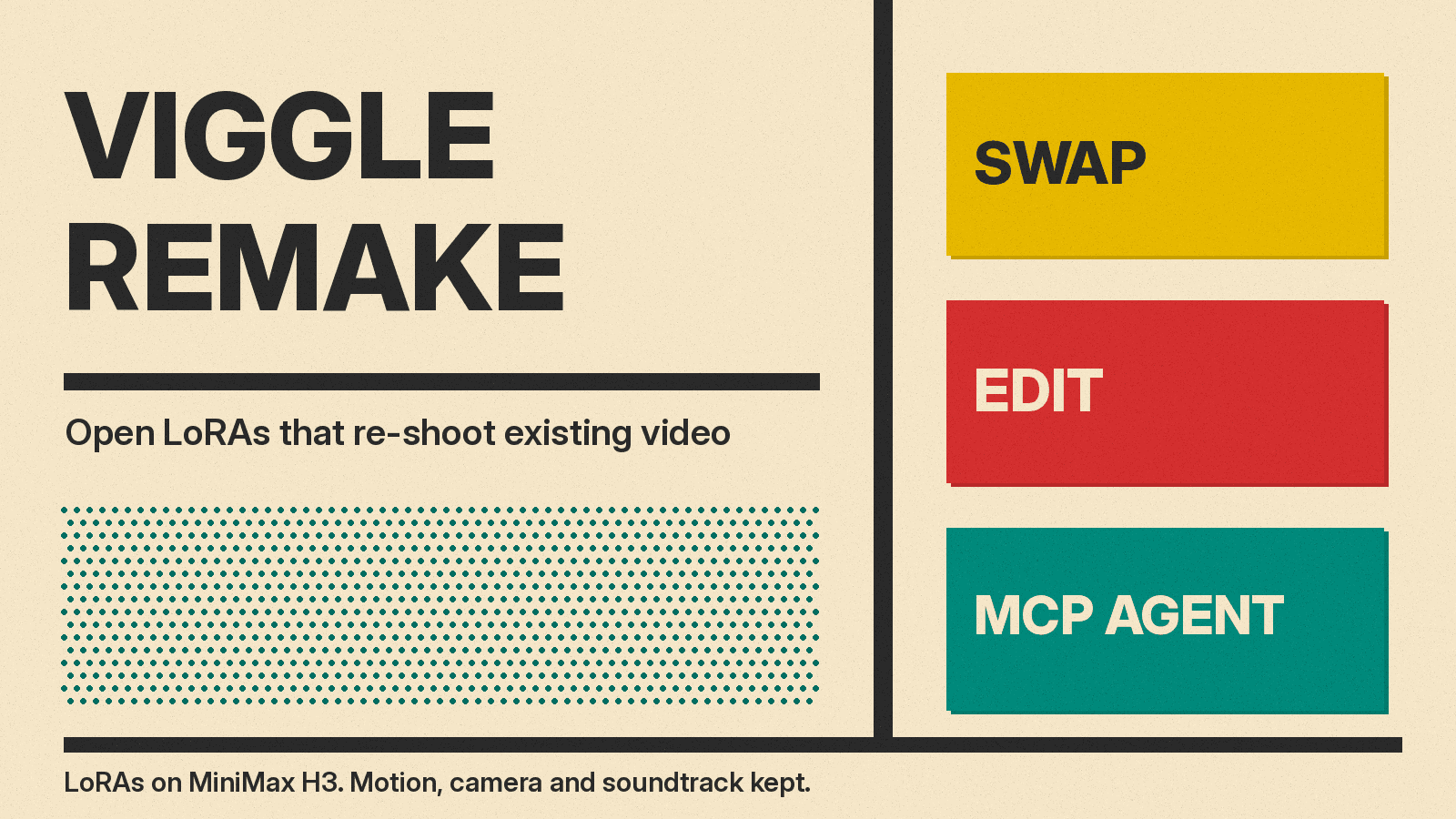
Viggle has released Viggle Remake, a video-to-video tool that re-shoots footage you already have. It can recast the people in a clip, swap or remove objects, and change the setting, weather or light, while it keeps the original motion, camera moves, timing and soundtrack. Viggle announced it on X on November 4, calling it "the most powerful video transformation agent" and saying "we're releasing the weights today." The weights and code are on Hugging Face, where the repository was last updated on November 7.
Two things set it apart. The weights are open: you can download them and run them on your own GPUs, within the limits of the MiniMax H3 license covered below. And it is built for AI agents, so a coding agent such as Claude Code or Codex can take one sentence of instructions and remake a whole multi-shot video, not just a single clip.
What Viggle released
Remake is not a new base model. It is two LoRAs, small add-on weight files that teach an existing model a new skill, trained on top of MiniMax-H3, the open video model from MiniMax. Each LoRA is rank 256 and about 2.67 GB. Viggle also ships smaller rank-128 and rank-64 versions (1.34 GB and 0.67 GB) that it says give "near-identical output."
Viggle describes Remake as the "Viggle-Animate v2" it previewed earlier. Animate replaced one character. Remake also swaps, removes and inserts objects, and changes the scene. An earlier Viggle release, Viggle's JST-2 world model, is a 3D world model for scenes, characters and motion. Remake instead edits real footage.
In its launch post, Viggle says Remake can recast every character in a scene and keep them consistent across cuts, handle videos up to 2 minutes, and let you keep chatting to fix any shot. It lists the app price as "From $0.96 per 10 seconds at 720p," which Viggle says is less than half of what Higgsfield Genjutsu charges. That comparison is Viggle's own.
How it works: swap and edit
Remake has two modes, one per LoRA:
- Swap: replace people and characters, one or several at once.
- Edit: everything else. Swap, remove or insert objects, change the background, the weather or the light.
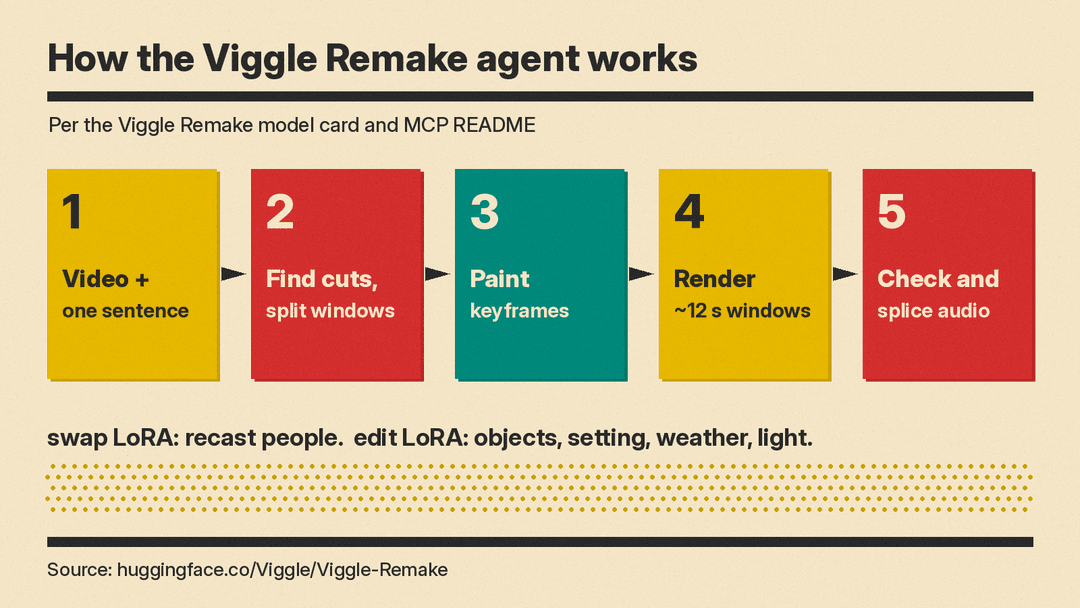
To run it by hand, you write a prompt in MiniMax-H3's six-section format and paint one to four reference frames. You can pin each painted frame to the source frame it came from. According to the model card, the painted frames decide identity and look, and pinned frames also fix the composition at that frame.
Each render covers one window of 90 to 345 frames at 24 fps, and Viggle recommends up to 294 frames, or about 12 seconds. Output goes up to 1280 x 736. The sound is carried over, not generated: the result uses the source soundtrack, and a silent source gives a silent result.
Agent mode: an AI director over MCP
The bigger idea is the agent. Remake ships with an MCP server. MCP is a standard way for AI agents to call outside tools. You give an agent a video and one sentence, such as "make it snow" or "turn everyone into cats." The agent finds the cuts, paints the keyframes, writes the prompts, renders each window, checks its own work and stitches the result back together with the soundtrack. The MCP README says the server gives the agent 27 tools for this.
One demo is White House Funk, a 116-second recast of the Uptown Funk music video with 69 cuts, which the card labels an AI-generated parody. Viggle says Codex ran that whole film in about 1.5 hours on two GPUs. Other demos include one shot from La La Land remade 22 ways and a Matrix Reloaded fight with Neo as a tuxedo cat. We covered a related move earlier this month: the Luma and Runway tools for coding agents, which bring video models into coding agents.
What hardware you need
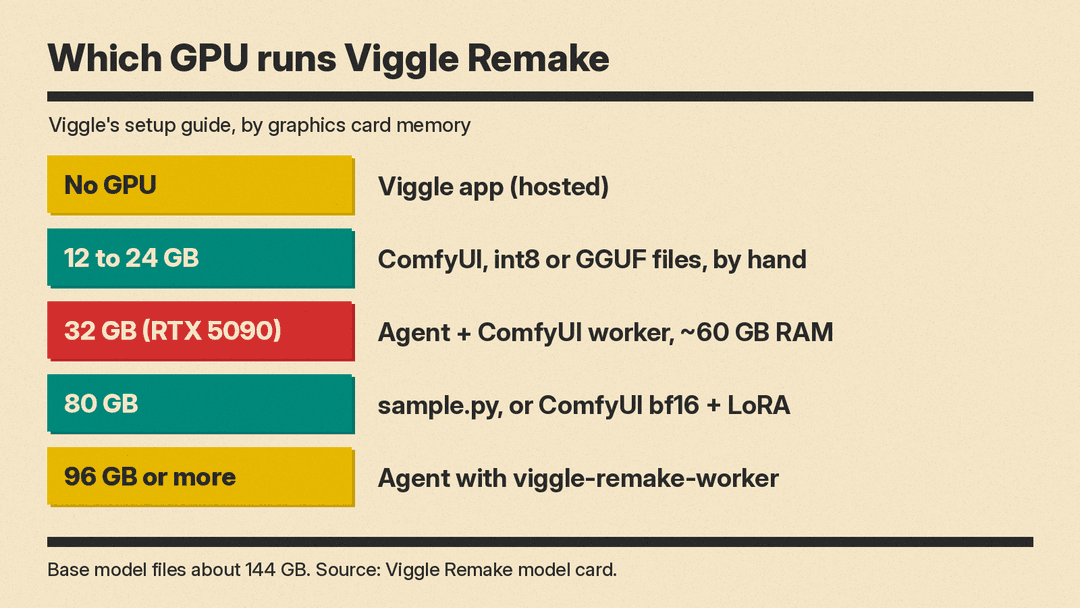
Remake is heavy. Per the model card:
- The MiniMax-H3 base model files are about 144 GB. The key Remake files are about 5.5 GB, and the whole repository is about 210 GB.
- The reference script needs one GPU with 80 GB or more of memory at full bf16 precision.
- With ComfyUI and merged int8 or GGUF files (smaller number formats that cut memory), it runs on cards with as little as 12 GB of VRAM, the memory on a graphics card, but on 12 to 24 GB cards you run the workflows by hand, without the agent. Viggle notes it tested these settings only on B200 cards, emulating the smaller sizes.
- On one 32 GB RTX 5090, the agent with a ComfyUI worker renders a 1280 x 736 window of 345 frames in about 28 minutes and needs about 60 GB of system RAM. The Uptown Funk remake took about 3 hours end to end on that setup.
- With no GPU, Viggle points users to its app.
For comparison, HyperFlow H3 Flash, another MiniMax H3 derivative, shrinks the base model itself to fit on one GPU. Remake instead keeps the full base and adds editing skills on top. Beeble's SwitchX 3.0, a cloud-only video-to-video tool also built on MiniMax H3, takes another route: it keeps the performer's original pixels inside an alpha mask and generates only the world around them.
Limits Viggle lists
- About 12 seconds per render. Longer videos must be split into windows.
- The six-section prompt is required, and its timestamps must fit the frame count.
- Known failures: a non-humanoid character in one long take, small artifacts in fine detail, and shots drifting in time when a multi-shot clip is rendered without pins.
- The card gives no benchmark scores or training data details. Its only quality numbers compare the smaller files with the full model.
Consent and license
The model card is direct about the deepfake risk. It says Remake "will just as readily put a real person's likeness into footage they never agreed to appear in" and "cannot verify identity or consent." Viggle asks users not to run it on people who have not agreed and to label results as AI-generated.
The license matters too. The code is Apache 2.0, but the weights are a derivative of MiniMax H3, so the MiniMax H3 Community License applies. That license covers the world excluding the European Union, the United Kingdom, South Korea and the United States. The license says people there are welcome to contact MiniMax about a license. Commercial products must show "MiniMax H3" in their interface, companies whose products earn more than US$20 million a year need written approval from MiniMax, and outputs may not be used to improve other AI models.
Why it matters
Remake edits footage that already exists, rather than making new clips from text or images, and its agent can plan and render a full multi-shot video from one instruction. That moves open-weight tools closer to real editing work: recasting a scene, fixing a set, changing the weather. The tradeoffs are real, though. It needs serious hardware, the license does not cover the EU, the UK, South Korea or the US, and the card says no safeguards are built into the model.
What to watch
- Independent quality tests, since Viggle has published no benchmarks.
- Speed reports from more consumer GPUs. Viggle's own tests ran on B200 cards plus one RTX 5090 setup.
- Whether MiniMax changes the excluded territories in its license.
