
Video Rebirth has published HyperFlow H3 Flash, a compressed, few-step version of the MiniMax H3 video model that generates video and synchronized stereo audio together. The weights appeared on Hugging Face on November 4, 2026, and the code followed on GitHub on November 6. The model card states that the repository "is not an official MiniMax product."
What Video Rebirth released
The release spans four places:
- Weights on Hugging Face at VideoRebirthAI/hyperflow-h3-flash, created November 4, 2026.
- Code on GitHub at Video-Rebirth/hyperflow-h3-flash, created November 6.
- Custom ComfyUI nodes at Video-Rebirth/ComfyUI-HyperFlow-Flash.
- A landing page describing the project.
Per the landing page, this is the third release in the HyperFlow series. The original HyperFlow was an 8-step LoRA for the full-size MiniMax-H3 that reduced training cost, HyperFlow Infinity extended single-generation length, and H3 Flash targets latency. The repository holds only the compressed transformers. The text encoder, based on Qwen3-VL 32B, and the video and audio VAEs load from their upstream repositories, such as MiniMaxAI/MiniMax-H3.
What it can make
The model card lists three tasks:
- Text to video with audio.
- First keyframe, or first and last keyframes, to video.
- Reference to video with up to 12 references, limited to 9 images, 3 videos and 3 audio clips. Audio references need at least one image or video reference. In GGUF runtimes, reference inputs are images only; video and audio references need the Python package.
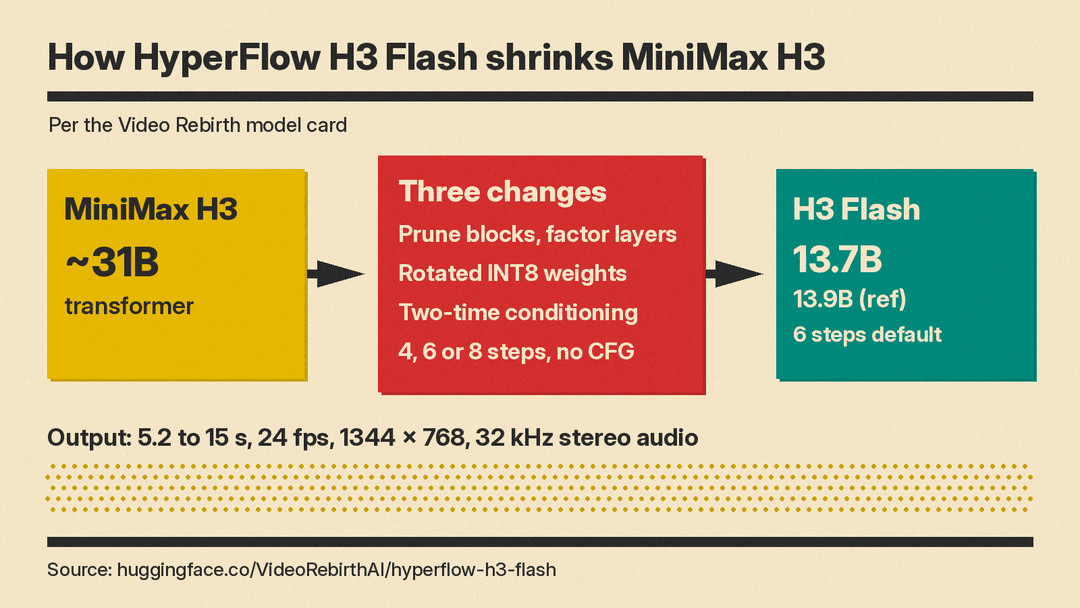
Output is a 5.2 to 15 second video at 24 fps, 1344x768 by default, with a 32 kHz stereo soundtrack. The model has about 13.7 billion parameters for the keyframe and text model, or 13.9 billion for the reference model, which the card calls "less than half of the ~31B MiniMax-H3 transformer." The landing page rounds this to 14B.
How it got smaller and faster
The model card describes three techniques. First, structural pruning and low-rank factorization of linear layers: the text and keyframe model drops 3 of 50 blocks, and the reference model drops 1. Second, rotated W8A8 INT8 quantization of 180 linear layers. Quantization means storing numbers in a smaller format; INT8 uses 8-bit integers instead of larger floating-point values, which cuts memory use, and GGUF files package quantized weights for lightweight runtimes. Third, "two-time" conditioning that tells every token both the current noise level and the step endpoint. Steps are the denoising passes a model makes to turn noise into a picture. This conditioning allows 4 to 8 step sampling without classifier-free guidance (CFG). The default is 6 steps, with 4 for speed and 8 for quality.
The landing page says that on a single B200, HyperFlow H3 Flash delivers a 12.7x speedup over the H3 baseline. That is a vendor claim. The page also says INT8 output quality "was verified against the bf16 baseline," but it publishes no metric for that check.
Speed on consumer and data-center GPUs
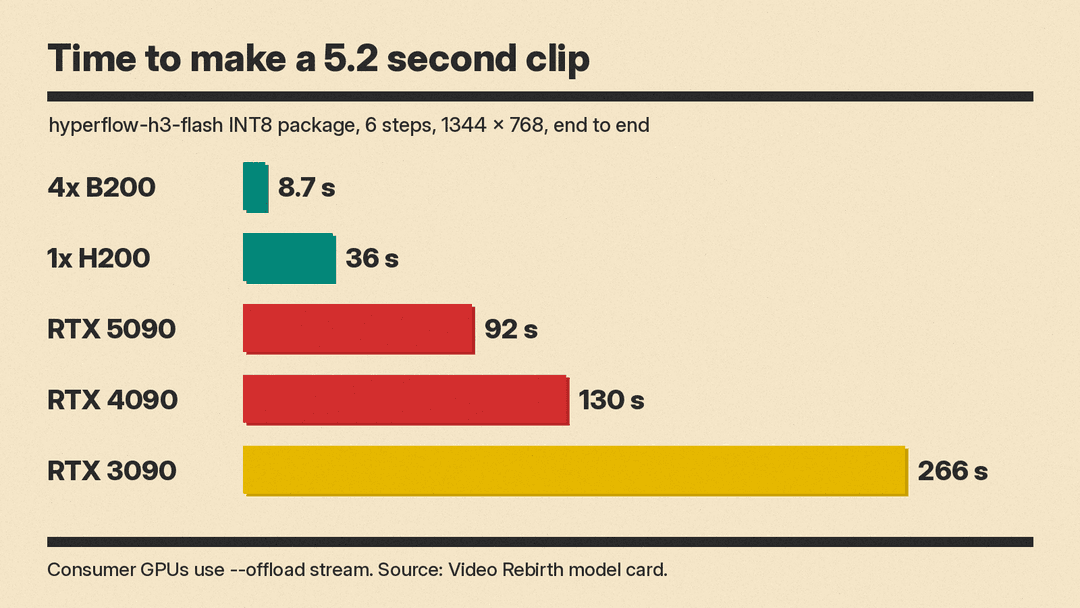
The model card gives end-to-end times for a 5.2 second clip at 1344x768 with 6 steps: 8.7 seconds on 4x B200, 36 seconds on 1x H200, and 92 seconds on an RTX 5090. A 15 second clip took 229 seconds on 1x H200 and 66 seconds on 4x H200.
On consumer GPUs in ComfyUI with INT8 files, an RTX 5090 needs 83 seconds for 5.2 seconds of video and 518 seconds for 15 seconds. An RTX 4090 needs 152 and 747 seconds. An RTX 3090 running the GGUF Q4_K_M file, in a PC with 64 GB or more of system RAM, needs 315 and 1835 seconds. With Video Rebirth's own Python package and streamed offloading, the card lists 92 seconds on an RTX 5090, 130 seconds on an RTX 4090 and 266 seconds on an RTX 3090 for the short clip. In plain terms, Video Rebirth's own package takes 8.7 seconds for a 5.2 second clip even on four B200 GPUs, and a home RTX 5090 needs roughly a minute and a half. The landing page says it generates 768p video "in real time on four B200 GPUs," and the card says real time on four B-series GPUs uses NVIDIA's SOL-H3 implementation, which Video Rebirth calls its inference-acceleration partner. NVIDIA's SOL-H3 page lists 3.4 seconds for a 5 second text-to-video clip on four GB200 GPUs, measured on November 5.
For memory, meaning VRAM, the graphics card's own memory, the smallest recommended file is GGUF Q4_K_M at 9.1 GB. GGUF files for the text and keyframe model range from 7.2 GB (Q3_K_M) to 14.9 GB (Q8_0). INT8 files are about 16 GB. The card says it runs on 24 GB and 32 GB GPUs in PCs with 16 GB of system RAM. Cards with 16 GB of VRAM are not measured yet.
How to run it
Four runtimes are supported: ComfyUI with custom nodes and templates named hyperflow_t2v, hyperflow_i2v, hyperflow_flf2v and hyperflow_ref2v; Unsloth Studio; stable-diffusion.cpp with a patch; and a Python package with a CLI and diffusers support. The Python package requires an Ampere or newer NVIDIA GPU, and multi-GPU use needs Linux or WSL2. The first Python run downloads about 90 GB, or about 68 GB with the fp8 text encoder. The nvfp4_awq text encoder used for ComfyUI is 15.7 GB. One prompting tip from the card: describe subject, action, setting, camera movement and sound in one prompt, and do not use a negative prompt.
License: who can use it
The weights are a Model Derivative of MiniMax-H3 under the MiniMax H3 Community License Agreement. Per the model card, they are licensed worldwide excluding the European Union, the United Kingdom, the Republic of Korea and the United States. People and organizations in those regions need MiniMax's prior authorization before downloading, and MiniMax has an application form. Publicly shared output must be disclosed as AI-generated. Products above 20 million US dollars in yearly revenue need written authorization from MiniMax, and products must display "MiniMax H3" in their interface. Outputs may not be used to train other AI models. The inference code is Apache-2.0, the ComfyUI nodes are GPL-3.0, and the stable-diffusion.cpp patch is MIT.
Why it matters
MiniMax H3 makes video with native stereo audio, according to its model card, but its transformer alone is about 31B parameters. (Our explainer on MiniMax and its models covers the company.) Flash puts text-to-video, keyframe-to-video and reference-to-video with sound within reach of a single 24 GB or 32 GB card, which matters for hobbyists and small studios testing locally. It also joins a growing set of H3 add-ons, including Pika H3 Flex, an open-weight H3-based model with audio stems, Viggle Remake's open swap and edit LoRAs for recasting existing video, and NVlabs' open Open-H3-Regenerate-2K-IC refiner, which carries the same license limits. The catch is the license itself: it blocks users in the US, UK, EU and Korea without MiniMax approval, so people there must get MiniMax's prior authorization before they download it. The quality and speed claims are the vendor's own, and we found no independent benchmark yet.
What we don't know yet
- How output quality compares with full MiniMax-H3 in independent tests.
- Whether 16 GB graphics cards can run it. Video Rebirth has not measured them yet.
- Whether MiniMax will change the excluded territories.
- Whether Video Rebirth or others will offer it as a hosted service.
