
Search for "AI engineer salary" and you get numbers that are far apart. One reason is that there is no single official pay figure for the title. The US Bureau of Labor Statistics (BLS) does not list an occupation called "AI engineer." Employers, for their part, post their own pay ranges in job ads, and those ranges change by company, level and city.
This guide puts the two public sources side by side: BLS wage data for the occupations closest to AI engineering, and the pay ranges that employers post on their own job pages. Job-post figures are as of November 2026. They are posted ranges, not what people in those jobs are paid.
Is there an official AI engineer salary?
No. The BLS Occupational Outlook Handbook has no "AI engineer" entry. Our reading is that most people with that title fall inside three BLS occupations: computer and information research scientists, software developers, and data scientists. BLS describes data scientists as people who "create, validate, test, and update algorithms and models," and research scientists as people who design experiments "frequently using techniques from data science and machine learning." Neither group is limited to AI work, so BLS figures are a floor-level reference, not an AI-only number.
What does BLS wage data show?
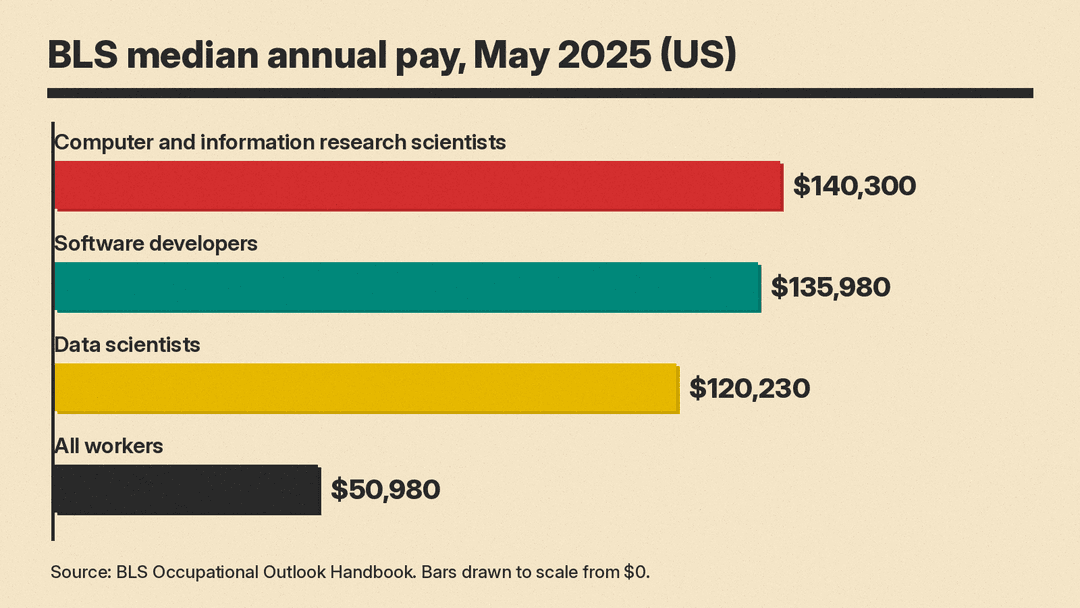
All three figures below are US medians for May 2025. A median is the midpoint: half of workers earned more and half earned less. For context, BLS gives the median annual wage for all US workers as $50,980.
- Computer and information research scientists: median $140,300. The lowest 10 percent earned less than $82,200 and the highest 10 percent more than $230,630. BLS lists a master's degree as the typical entry-level education and projects 22 percent job growth from 2025 to 2035. (BLS)
- Software developers: median $135,980. The lowest 10 percent earned less than $82,460 and the highest 10 percent more than $214,670. BLS projects 10 percent growth for the wider group of developers, quality assurance analysts and testers. (BLS)
- Data scientists: median $120,230. The lowest 10 percent earned less than $67,240 and the highest 10 percent more than $199,130. BLS projects 35 percent growth from 2025 to 2035. (BLS)
BLS also breaks pay down by industry. For research scientists, the median in the miscellaneous information services industry was $218,560, and for software developers at software publishers it was $164,550, per the same BLS pages. Industry changes the picture.
What pay ranges do tech companies post for AI and ML engineers?
Many US employers now print a pay range in the job ad. Here is what six companies posted for AI and machine learning engineering roles in the US, read from each job page in November 2026. Each line says whether the range is base salary, as the post words it.
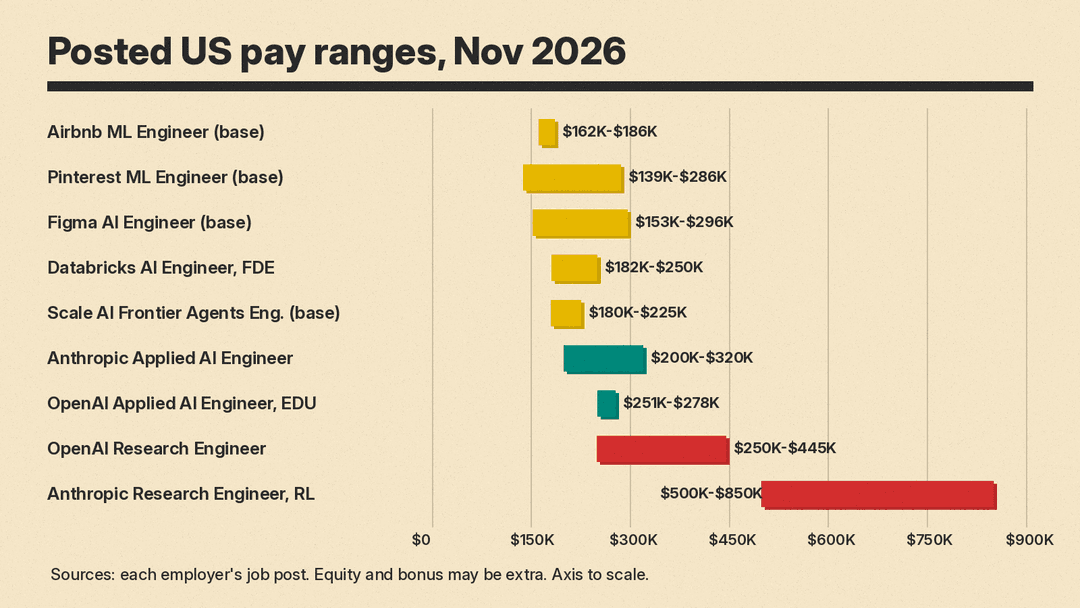
- Airbnb, Machine Learning Engineer, Assistance Engineering (Remote-USA): base pay range $162,000 to $186,000. The post says the role "may also be eligible for bonus, equity, benefits, and Employee Travel Credits." (Airbnb)
- Airbnb, Senior Machine Learning Engineer, Relevance (United States): $200,000 to $235,000. (Airbnb)
- Pinterest, Machine Learning Engineer, Core Engineering (San Francisco, Palo Alto, Seattle or remote US): base salary range $138,905 to $285,982. The post says the position "is also eligible for equity." (Pinterest)
- Figma, AI Engineer, Internal Tools (San Francisco, New York or US): annual base salary range $153,000 to $296,000. (Figma)
- Databricks, AI Engineer, Forward Deployed Engineering (United States): local pay range $182,000 to $250,208. Databricks says the package "may also include eligibility for annual performance bonus, equity, and the benefits listed above." (Databricks)
- Scale AI, Frontier Agents Engineer (Applied AI), San Francisco: base salary range $180,000 to $225,000 for San Francisco, New York and Seattle. (Scale AI)
Two points stand out in this small sample. Every low end in this sample is above the BLS software developer median of $135,980. And the width of a single band can be large: Pinterest's range spans more than $147,000 from bottom to top.
How much do frontier AI labs post?
OpenAI and Anthropic, two of the labs that train frontier models, publish ranges on their job boards. They are a small slice of the market, and their numbers should not be read as typical.
OpenAI (San Francisco, each post lists a salary range and says "Offers Equity"):
- Applied AI Engineer, Enterprise, EDU: $251K to $278K. (OpenAI)
- Partner Applied AI Engineer, Google Cloud: $197K to $278K. (OpenAI)
- Research Engineer: $250K to $445K. (OpenAI)
Anthropic (each post says "the annual compensation range for this role is listed below"):
- Applied AI Engineer, Enterprise, San Francisco or New York City: $200,000 to $320,000. (Anthropic)
- Research Engineer, Interpretability, San Francisco: $315,000 to $560,000. (Anthropic)
- Research Engineer, Machine Learning (Reinforcement Learning), San Francisco or New York City: $500,000 to $850,000. (Anthropic)
Outside the US, the same labs post in local currency. Anthropic lists €220,000 to €235,000 for an Applied AI Engineer, Enterprise, in Paris (Anthropic) and £260,000 to £630,000 for a Research Engineer, Pretraining, in London (Anthropic).
In both labs, the posted research engineer ranges reach higher than the applied AI engineer ranges. That is a pattern in these specific posts, not a rule for the whole industry.
Why are AI engineer pay ranges so wide?
The job posts themselves name several reasons.
- Level. Titles carry levels such as Senior, Staff and Principal. Airbnb's Senior Machine Learning Engineer range starts above the top of its non-senior Machine Learning Engineer range in the examples above.
- Location. Databricks calls its figure a "Local Pay Range" and says pay depends on factors including "specific work location." Pinterest says "final salary is based on a number of factors including location, travel, relevant prior experience, or particular skills and expertise."
- Applied versus research work. In the OpenAI and Anthropic posts above, research engineer bands run higher than applied AI engineer bands.
- What the range covers. Airbnb, Pinterest and Figma label their ranges as base pay. Databricks says its range is the expected salary for non-commission roles and on-target earnings for commission roles. Anthropic says that for sales roles its range is on-target earnings, which include commission. Equity and bonus are often listed as extra, so two ranges with the same numbers may not be the same offer.
How should you use these numbers?
- Compare like with like. Match the title, the level and the city before you compare. A remote US base range and a San Francisco research band are different things.
- Read what the range includes. Check if a post says base salary, total cash, or on-target earnings, and whether equity is extra.
- Use BLS for a wider view. The BLS pages above link to state and metro-area wage data, which helps if you plan to work outside the big tech hubs.
- Ask early. If a job post has no range, ask the recruiter for it and for the split between base, bonus and equity.
If you are still picking a path, see our guides on AI engineer vs ML engineer vs data scientist, how to become an AI engineer and the AI research engineer roadmap. When you start applying, read how to build an AI portfolio that gets interviews and our list of AI interview questions.
Bottom line
There is no official AI engineer salary. BLS medians for the closest US occupations ran from $120,230 to $140,300 in May 2025. Posted ranges for AI and ML engineers at the tech companies above started near $139,000 and, at frontier labs, reached $850,000, as of November 2026.
Sources
- BLS: Computer and Information Research Scientists
- BLS: Software Developers, Quality Assurance Analysts, and Testers
- BLS: Data Scientists
- Airbnb: Machine Learning Engineer, Assistance Engineering
- Airbnb: Senior Machine Learning Engineer, Relevance
- Pinterest: Machine Learning Engineer, Core Engineering
- Figma: AI Engineer, Internal Tools
- Databricks: AI Engineer, Forward Deployed Engineering
- Scale AI: Frontier Agents Engineer (Applied AI)
- OpenAI: Applied AI Engineer, Enterprise, EDU
- OpenAI: Partner Applied AI Engineer, Google Cloud
- OpenAI: Research Engineer
- Anthropic: Applied AI Engineer, Enterprise
- Anthropic: Research Engineer, Interpretability
- Anthropic: Research Engineer, Machine Learning (Reinforcement Learning)
- Anthropic: Applied AI Engineer, Enterprise (Paris)
- Anthropic: Research Engineer, Pretraining (London)
