
MiniMax is an AI company based in Shanghai that builds language, video, speech and music models and offers consumer apps that use them. Its Wikipedia entry lists the AI character apps Talkie and Xingye and the video service Hailuo AI among its products, and says the company listed on the Hong Kong Stock Exchange in January 2026. The company's own home page states its mission as "Intelligence with Everyone."
This guide explains who MiniMax is, what its model families do, which apps and tools carry those models, how to try them, and what to check on privacy before you upload anything. All facts were checked on November 4, 2026 against the pages linked in each section.
The short version
- MiniMax is a Chinese AI lab founded in December 2021, according to Wikipedia.
- Its model families cover text (the M series), video (H3, and the older Hailuo models), speech and music, per the MiniMax models overview.
- Some of its models are published as open weights on Hugging Face, including MiniMax-M3.1-Flash and MiniMax-H3.
- People reach the models through apps (Hailuo AI, Talkie, MiniMax Code) or through the MiniMax API.
- The privacy policy for its AI app and web services is issued by a Singapore company, Nanonoble Pte. Ltd.
Who makes MiniMax
Wikipedia says MiniMax was founded in December 2021 by "several computer vision researchers from SenseTime," and that the name comes from the minimax algorithm. It names Yan Junjie as chief executive. The same page says Alibaba Group led a $600 million financing round in March 2024 and that Tencent is among the other investors. SiliconANGLE relayed a Bloomberg report from March 5, 2024 that Alibaba was leading a round of at least $600 million that was still in progress then. CNBC reported on January 9, 2026 that MiniMax shares doubled on their first day of trading in Hong Kong, and that investors such as Alibaba and Tencent back the company.
Wikipedia also describes MiniMax as one of China's "AI Tigers," a label it attributes to a Quartz article. For how MiniMax sits next to DeepSeek, Alibaba's Qwen team, Moonshot's Kimi and Zhipu's GLM, see our guide to China's AI labs.
MiniMax describes itself in its own words. Its home page says the company "develops a family of proprietary foundation models across text and multimodal capabilities" and offers "AI-native products, including MiniMax Code and MiniMax Design, alongside an open platform for enterprises and developers worldwide." The same page claims "300M+ Global Individual Users" and "2M+ Enterprise Clients & Developers." Those are MiniMax's figures; we did not find an independent count.
How MiniMax started
According to Wikipedia, its first product was Glow, an app launched in October 2022 that let users create virtual characters and chat with them. Glow was later removed from Chinese app stores and relaunched under two brands: Talkie for international markets in June 2023, and Xing Ye for the Chinese market in September 2023.
The same page says MiniMax launched its first text model, abab1, in April 2022, then Hailuo AI in March 2024 and a text-to-video model, video-01, in September 2024. The MiniMax-01 models followed in January 2025 and MiniMax-M1 in June 2025.
The model families in plain words
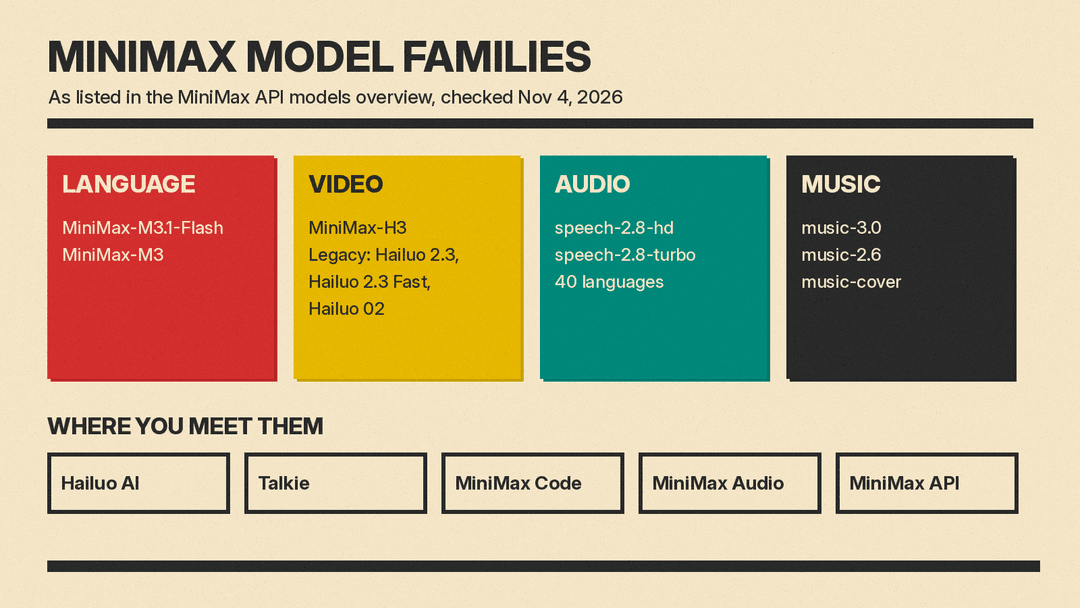
MiniMax groups its models by what they produce. The models overview in its developer docs lists four groups: Language, Video, Audio and Music.
Language models: the M series
The M models read and write text. The models overview lists two current ones:
- MiniMax-M3.1-Flash, described as a "Frontier multimodal coding model with 1M context window and tunable thinking depth."
- MiniMax-M3, described as a "Frontier multimodal coding model with 1M context window."
"Multimodal" here means the model can take more than text as input. The MiniMax-M3.1-Flash model card on Hugging Face lists "Text, image, and video inputs; text output" and a context window of "Up to 1,000,000 tokens."
The same model card calls M3.1 Flash a "native multimodal mixture-of-experts model for coding, agentic workflows, computer use, and cybersecurity." For parameter size, the card lists "Approximately 428B total; 23B activated per token." The Hugging Face page sidebar shows a different model size figure ("220B params"), and the card does not explain the gap, so treat the size as the card text states it.
MiniMax's launch post for M3.1 Flash, dated 2026-10-19, says "Space Bunny," a model that ran anonymously before launch, "was an early version of MiniMax M3.1 Flash." That post lists API pricing of $0.15 per million input tokens and $0.60 per million output tokens, as of November 4, 2026. It said at launch that "Model weights will be released later"; the Hugging Face model card now offers a download. For the weights, license and hardware, see our M3.1 Flash open weights explainer.
Video models: H3 and Hailuo
MiniMax's video work started under the Hailuo name. The models overview now lists MiniMax-H3 as the current video model and moves Hailuo 2.3, Hailuo 2.3 Fast and Hailuo 02 into a "Legacy Models" section.
MiniMax's H3 open-source announcement, dated 2026-08-03, calls H3 "a general-purpose, omni-modal generative system." It says H3 "can generate video with native stereo audio at resolutions up to 2K and durations of up to 15 seconds," and lists stable dialogue support for 11 languages. H3 can start from text only, from a first or last frame, or from reference images, video clips and audio.
The open release is not the whole system. The announcement says two parts are not in the open-source release. H3-Context-IR (which interprets and refines your request before generation) is a hosted system, and MiniMax says it provides an API for it. H3-Regenerate-2K (which produces the 2K version) is "not yet open-sourced," and the announcement says "We will release it once it is ready." MiniMax also points to its API for validating the official 2K results. The weights come under the "MiniMax H3 Community License Agreement." The local serving example in the same post uses four GPUs (--num-gpus 4).
Speech and music
The models overview lists speech-2.8-hd and speech-2.8-turbo, each with "40 languages supported" and "7 emotions supported." These turn text into spoken audio.
For music, the overview lists music-3.0, music-2.6 and music-cover. It also carries a notice: "Starting August 20, 2026, the paid APIs (Music Generation and Lyrics Generation) will no longer be available to new users," and the free music generation APIs "will be discontinued." The notice points new users to MiniMax Audio or "the open-source MiniMax Music 3 model on Hugging Face."
Where you meet MiniMax models
MiniMax models reach users through these apps and services.
- Hailuo AI (hailuoai.video) is the video generation site. Its page title, checked on November 4, 2026, reads "Hailuo AI: MiniMax H3 LIVE NOW."
- Talkie is the international AI character chat app, according to Wikipedia. Its Chinese counterpart is Xingye.
- MiniMax Code (code.minimax.io) is a desktop agent for coding and office work. Its page says it "connects to your local files, tools, and browser" and offers "Coding and Work modes."
- MiniMax Audio (minimax.io/audio) is the speech and music site that the developer docs point music users to.
- The MiniMax API (platform.minimax.io) is for developers who want to call the models from their own software.
How to try MiniMax
In an app
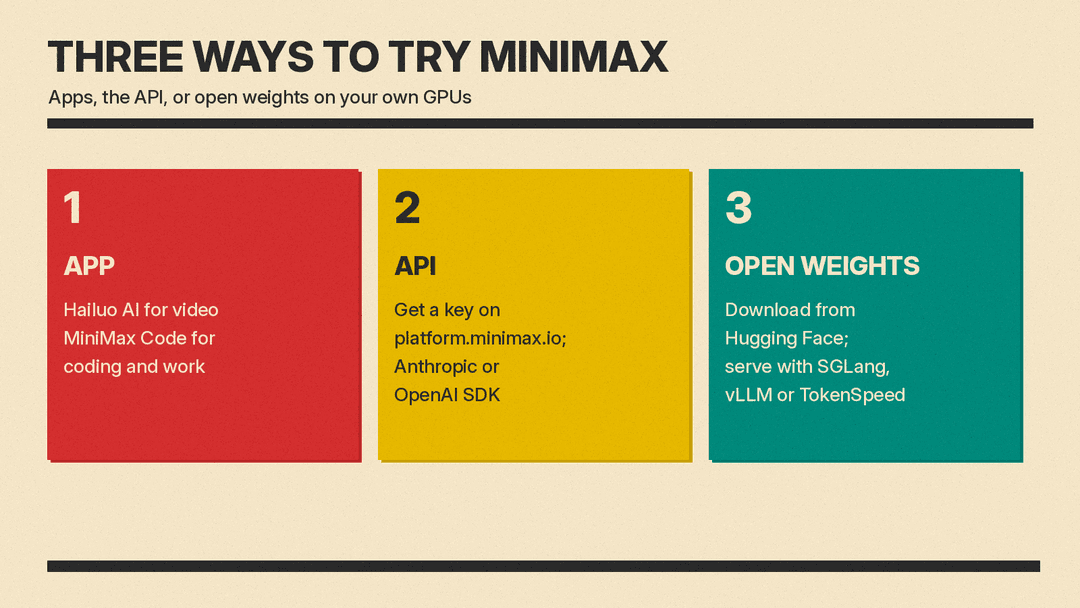
For video, open Hailuo AI in a browser and sign in. For coding and documents, the MiniMax Code page offers downloads for macOS and Windows and lists Terminal, Web, iOS and Android options. Its FAQ says the web version "requires no installation," and a comparison table on the page says you can "Log in daily to claim free credits." On desktop, the FAQ says the app can "read and modify files, run commands" in a project folder "with your permission," so pick the folder you share with care.
The FAQ also says scheduled tasks "depend on the desktop app running: your computer must stay awake and the app must remain running."
Through the API
The API prerequisites page lists three steps: register or log in, get a key, and add resources. You can pay as you go, or use an M Plan subscription key. The page says the API works with the Anthropic SDK, which it marks "(Recommended)," and with the OpenAI SDK, by pointing the SDK at a MiniMax base URL. It gives setup commands for macOS and Linux (export in a terminal) and for Windows ($env: or setx in PowerShell). It also warns: "Do not commit your Key to a code repository or share it with others."
On your own hardware
The MiniMaxAI organization on Hugging Face hosts downloadable models, including MiniMax-M3.1-Flash, MiniMax-M3, MiniMax-M2.7 and MiniMax-H3. The M3.1 Flash card names SGLang, vLLM and TokenSpeed as recommended serving frameworks and says "Usable context length and throughput depend on GPU memory and the serving configuration." If you want to compare M3.1 Flash with other Chinese open models on price and scores from a single source, see our Kimi K3.1 Pro vs DeepSeek V4.1 Flash vs MiniMax M3.1 Flash comparison.
What MiniMax models are good for
MiniMax pitches each family at a different job. These are the company's claims, not our test results.
- Coding and agent tasks. The M3.1 Flash launch post says the model "delivers a generational leap in agentic tasks, coding, Computer Use and cybersecurity." The post reports 73.7% on DeepSWE v1.1 and 61.7 on OSWorld V2, MiniMax's own reported scores.
- Long documents. The model card lists a context window of "Up to 1,000,000 tokens."
- Short videos with sound. H3 generates video and stereo audio together, per the H3 announcement.
- Voices. The speech models list 40 languages in the models overview.
Safety and privacy basics
Read the policy for the app you use. The MiniMax AI App and Web Privacy Policy (updated January 19, 2026) is issued by "Nanonoble Pte. Ltd.," a Singapore company. Points worth knowing from that page:
- It says the company may disclose personal information "To our subsidiaries and affiliates" and "To contractors, service providers, and other third parties we use to support our business."
- It says it may disclose information "To comply with any court order, law, or legal process, including to respond to any government or regulatory request."
- Singapore residents get a separate section that covers withdrawal of consent for direct marketing, and access to and correction of personal data.
- The page we read does not say directly whether chat or upload content is used to train models. If that matters to you, ask MiniMax before you upload work files.
On content rules, the H3 announcement says user text, images and videos "are subject to automated moderation" and that MiniMax "cannot eliminate false positives or false negatives."
Practical steps:
- Do not paste passwords, API keys, client data or personal documents into any chat app you have not vetted.
- In MiniMax Code, share one project folder, not your whole home directory.
- Check model output before you rely on it. MiniMax's benchmark scores are self-reported.
Sources
- MiniMax (company), Wikipedia
- SiliconANGLE: Report: Chinese AI startup MiniMax raises $600M at $2.5B valuation led by Alibaba (citing Bloomberg)
- CNBC: MiniMax doubles in Hong Kong debut, marking yet another Chinese AI listing
- MiniMax home page
- MiniMax models overview, MiniMax API docs
- MiniMax M3.1 Flash: Redefining Agent Performance and Cost, MiniMax
- MiniMax-M3.1-Flash model card, Hugging Face
- MiniMaxAI organization, Hugging Face
- Open General Intelligence: MiniMax H3 Is Now Open Source, MiniMax
- Hailuo AI
- MiniMax Code
- MiniMax Audio
- MiniMax API prerequisites
- MiniMax AI App and Web Privacy Policy
