
Google has opened Gemini 4 Carbon to paying developers, enterprises and Google AI Ultra subscribers. The November 10 announcement, written by Koray Kavukcuoglu, SVP of Google DeepMind and Chief AI Architect at Google, comes two weeks after Google first released the model to a set of cybersecurity defenders through its Fairwind Program. We covered that limited launch in Gemini 4 Carbon Launches First for Cyber Defenders.
Google calls Carbon "our strongest model with frontier performance in cybersecurity capabilities and long-horizon agentic workflows across complex knowledge work, software engineering, and scientific reasoning."
Who can use Gemini 4 Carbon now
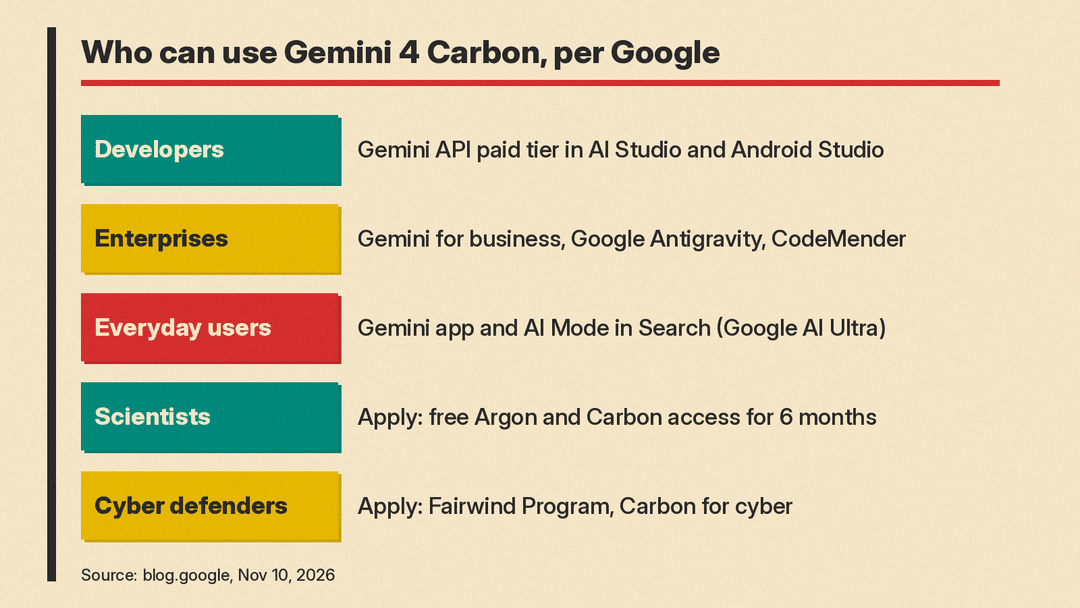
Google lists these access routes in its announcement:
- Developers: the Gemini API paid tier in Google AI Studio and Android Studio. Google AI Ultra subscribers can also try it in Google Antigravity and AI Studio.
- Enterprises: Gemini for business, through the API or the model drop down, plus Google Antigravity and CodeMender.
- Everyday users: the Gemini app and AI Mode in Search, for Google AI Ultra subscribers. Google says it is "rolling out" to them.
- Scientists: an application program for free access to Argon and Carbon in Google Antigravity's highest usage tier for six months, "subject to eligibility, capacity, and selection."
- Cybersecurity defenders: applications to the Fairwind Program for "Carbon for cyber," on a rolling basis.
The model ID is gemini-4-carbon, according to Google's what's new page for developers.
Price: introductory rate until November 30
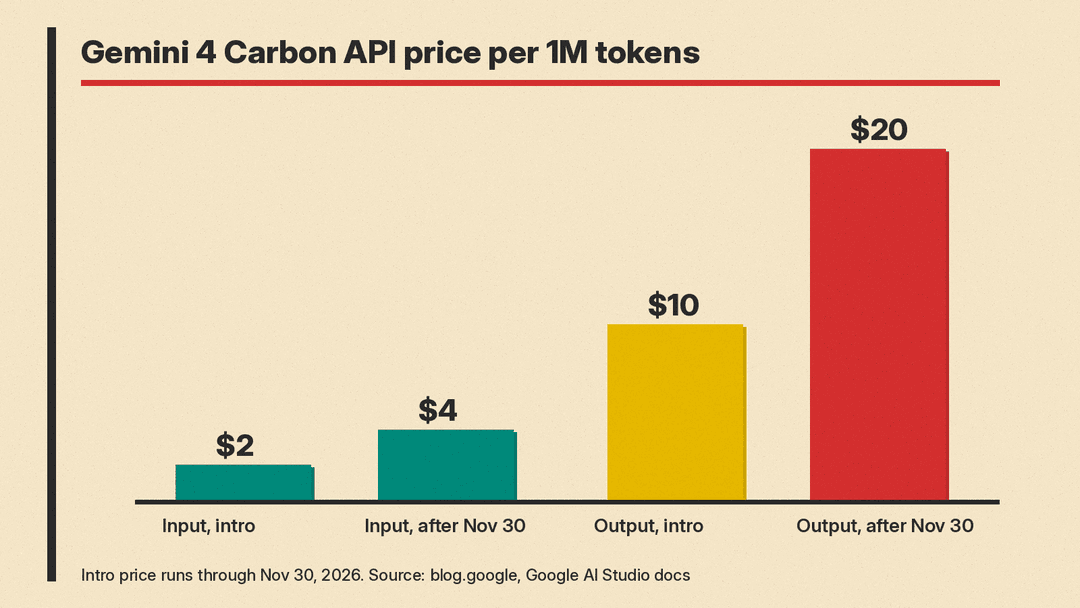
Google says Carbon costs the same introductory price as Gemini 4 Argon: $2 per million input tokens and $10 per million output tokens. A footnote in the announcement says that after the introductory period ends on November 30, 2026, the price becomes $4 per million input tokens and $20 per million output tokens. The developer docs and Google's pricing page give the same two rates, with the higher rates starting December 1, 2026. Carbon is not available on the Gemini API free tier.
On those numbers, the per-token price doubles once the introductory period ends.
Carbon or Argon?
Google does not present Carbon as a replacement for Argon. The announcement says "Argon remains the ideal choice for the majority of software engineering and knowledge work," while Carbon is built for "complex, multi-step coding and debugging and open-ended scientific research and discovery." Google adds that Carbon does this by "using more tokens than Argon to explore thoroughly, reason deeply, and run extended verification loops."
The developer docs say the same thing in practical terms. Both models share a 1M-token context window, built-in tools and per-token pricing. The difference is thinking tokens: Carbon "spends more thinking tokens per turn," which the docs say "increases per-turn token use and latency compared to Argon." The docs suggest Carbon for root-cause debugging, architectural design, dense multimodal synthesis, scientific proofs and security auditing.
That matters for cost. The price per token is equal, but a Carbon answer can use more tokens than an Argon answer to the same prompt. Developers set this with thinking levels (low, medium and high), and the docs say medium is the default. For a broader view of how Carbon compares with rival frontier models, see our Claude Fable 5.2 vs Gemini 4 Carbon vs GPT-6 Astra comparison.
What Google claims Carbon can do
All of the results below are Google's claims, from its own post:
- Benchmarks from partners: Google says Carbon ranks first on CursorBench 4.0, Perplexity's WANDR and Zapier's AutomationBench, "at more than 2X lower cost per task compared to the next best external model."
- A new benchmark: Google says it worked with Artificial Analysis on a Multimodal Knowledge Agent (MKA) benchmark for agents that read dense files such as charts, blueprints and tables. Google says Carbon ranks second there, at "more than 6X lower in average cost per task compared to the top performing model."
- Finance: Google says Carbon matched the best model tested on Hebbia's E2E Financial Agentic evaluation, and ranked first of 23 frontier model configurations on Balyasny Asset Management's General Financial Intelligence benchmark.
- Security: with Fairwind access, Google says Carbon leads on SEC-bench Pro, ExploitGym and CWE-bench v1, which test finding, exploiting and patching vulnerabilities.
- Science: Google says drug toxicity company Axiom Bio found "novel mechanisms of toxicity they hadn't found previously" with Carbon. Google also points to AlphaProof Code, where DeepMind researchers used agents powered by Carbon to formally verify the code of the Signal protocol. We cover what those proofs include and leave out in our AlphaProof Code report.
/swarm in Google Antigravity
Google is also previewing a feature called /swarm in Google Antigravity. Google says it turns "a single prompt into a coordinated team of agents you can track in real time." Developers can give Carbon the roles that need the deepest reasoning, such as architecture, coordination and auditing, and pair it with faster, lighter models and "adversarial verifiers that test every change."
Our post on the /swarm preview explains how the coordinator, workers, and verifier share one board, and where Google's blog and docs differ. Our opinion piece argues that agent swarms are a budget decision first, because each worker spends tokens.
Google's demos include a 3D exhibition of the Eiffel Tower's construction and a 3D reconstruction of a Google office built from seven public planning PDFs. These are Google's own showcase projects, not independent tests.
Safety notes
Google says it built on Argon's safety stack because Carbon has stronger cyber skills. Google repeats an earlier claim that Carbon reached a 0% attack success rate on the Gray Swan indirect prompt injection benchmark. In the same post, Google says "prompt injection robustness remains an area for continued improvement." Details are in the Gemini 4 Carbon safety and security report.
Why it matters
Carbon, which Google calls its strongest model, went from a security-only release to paid API access in two weeks. In the Gemini app and AI Mode in Search, it is for Google AI Ultra subscribers. For developers, the key choice is not only quality but token use, because Google itself says Carbon thinks longer than Argon at the same per-token price, and Google's listed price doubles after November 30.
If you are new to Google's developer tools, our guide What Is Google AI Studio? explains where Carbon shows up for builders. For early user reactions to the first launch, see What People Are Saying About Gemini 4 Carbon.
