
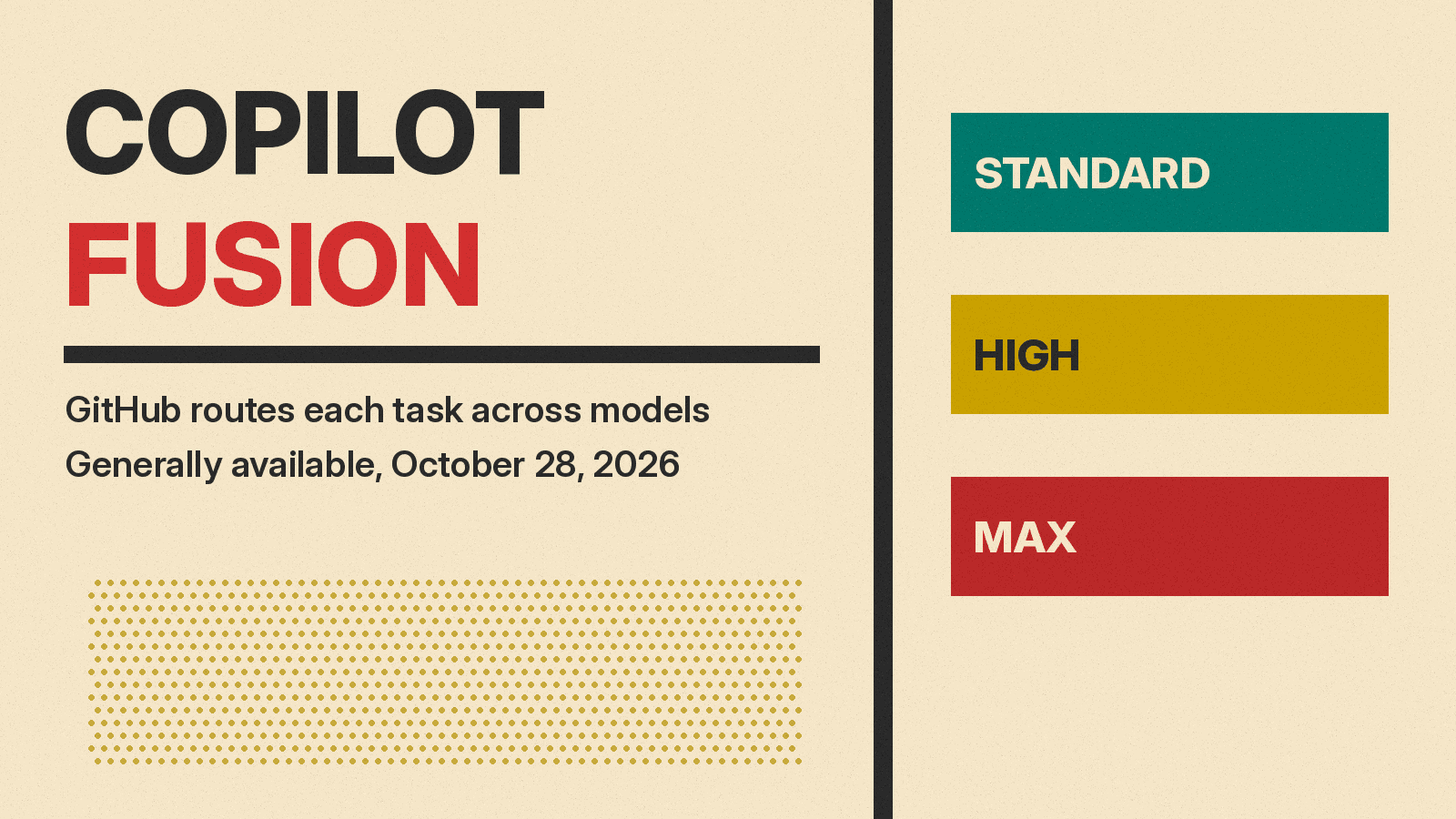
GitHub made Copilot Fusion generally available on October 28, 2026, at its Universe conference. Fusion is not a new model. It is an option in the Copilot model picker that decides, for each prompt, which models to use and how they work together. The developer picks only an effort level.
The pitch is about cost per finished task, not the price of one model. An independent test from Artificial Analysis puts Fusion Max two points behind Claude Code with Claude Opus 5.5 at about half the cost per task. That is a useful result, with some limits that are worth reading before you switch.
What Copilot Fusion does
GitHub's Fusion documentation calls it "an intelligent runtime model router and orchestrator." It "chooses models and execution patterns for your task, then returns a single response." The changelog says Fusion combines the multi-model orchestration from GitHub's earlier Project HydraFusion research preview with Copilot's auto model selection.
The developer chooses one of three effort levels in the picker. The changelog describes them this way:
- Fusion Standard: "Prioritizes versatile models for everyday coding."
- Fusion High: "Prioritizes capable models for challenging tasks and deeper reasoning."
- Fusion Max: "Prioritizes the most capable models for the most demanding tasks and complex reasoning."
The docs also list a fourth level, Fusion Fast, which is "not selectable by users" and is only available in VS Code inline chat.
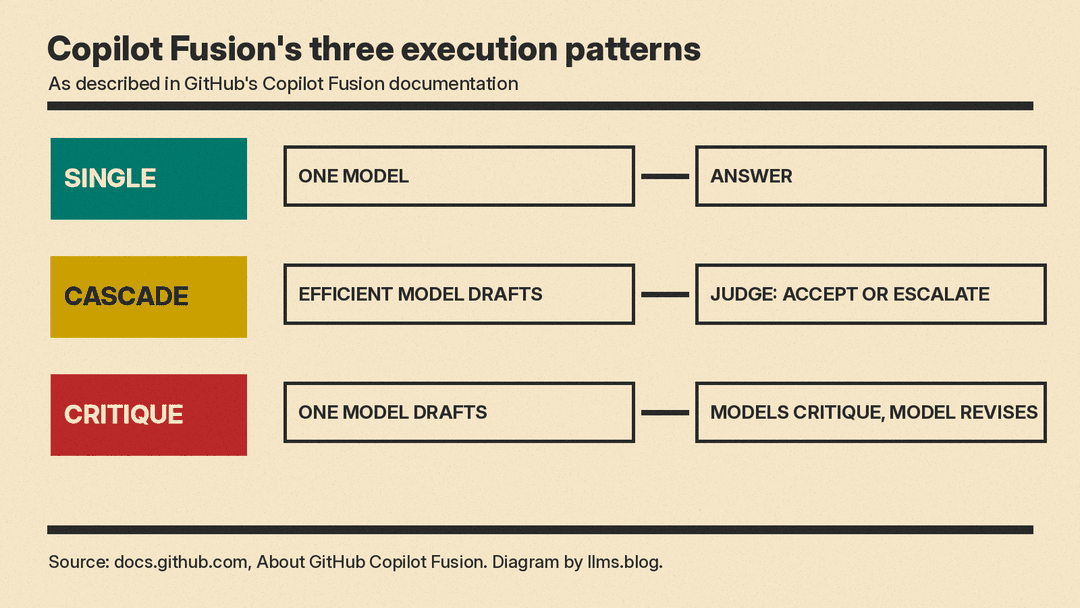
For each prompt, Fusion picks one of three execution patterns, per the docs:
- Single: one model completes the task.
- Cascade: an efficient model drafts a solution, and a judge decides whether to accept it or escalate to a stronger model.
- Critique: one model drafts a response while multiple models independently critique it in parallel. The original model then revises based on the combined feedback.
Different prompts in the same session can use different patterns. The docs say Fusion "only adds model calls when a task warrants them," and that cascade and critique take longer because they include review calls. You can hover over the effort level under a response to see which models it used.
The benchmark numbers
Artificial Analysis tested Fusion Max in GitHub Copilot CLI on its Coding Agent Index v2.0. Its article says Fusion chooses between models from Anthropic and OpenAI, "including Claude Opus 5.5, Claude Sonnet 5.5, GPT-6 Astra, and GPT-6 Sol."
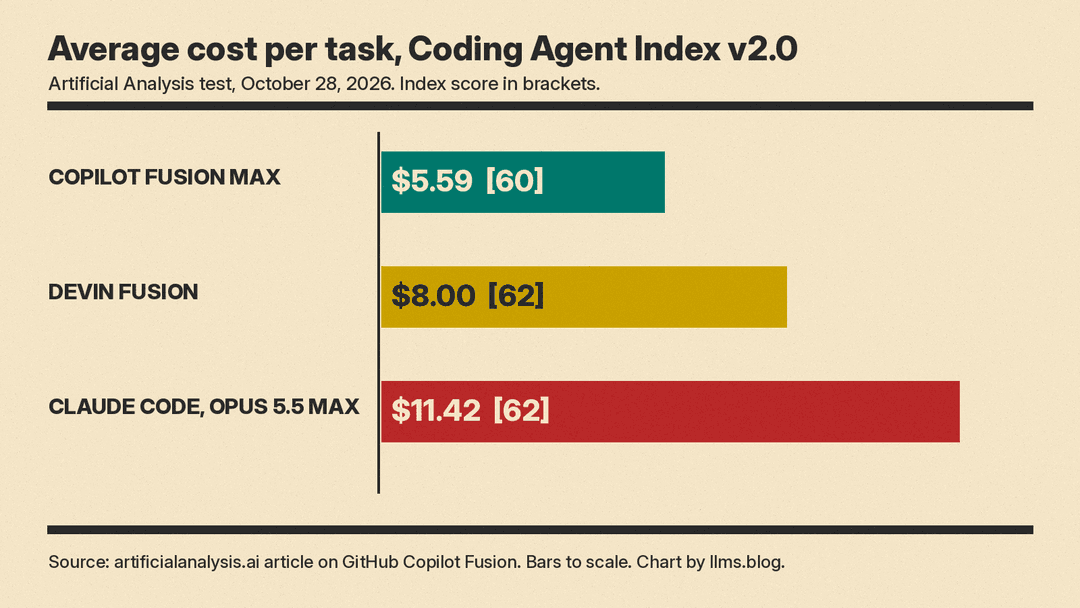
The main results from that article:
- Copilot Fusion costs $5.59 per task, versus $11.42 for Claude Code with Opus 5.5 (max).
- Devin Fusion with Opus 5.5 (max) and GPT-6 Luna (high) scores 62 at $8.00 per task.
- Fusion used 7.2M tokens per task, "approximately half" of the tokens used by Opus 5.5 in Claude Code and 30% less than Devin Fusion.
- Fusion has a slight lead on Terminal-Bench 4.0 with 71, but ranks third on FrontierCode at 51, behind Claude Code (56) and Devin Fusion (54). Its SWE-Atlas-QnA-AA score "lags at 57."
GitHub's changelog puts the Fusion Max index score at 60, within two points of Claude Code with Opus 5.5 Max. That close score hides uneven results. Fusion is strongest at terminal tasks and weaker at the repository-change tasks in FrontierCode. The index methodology weights the three benchmarks equally.
GitHub's changelog adds that Fusion Max took "about 40% less time per task." VentureBeat notes that the Artificial Analysis article does not report the timing data behind that figure, so it remains a GitHub-reported claim. VentureBeat also notes that a larger "up to 77%" savings figure, promoted by Microsoft CEO Satya Nadella, comes from GitHub's own DeepSWE tests under different conditions, not from the Artificial Analysis average.
How billing works
There is no separate fee for Fusion. The docs say: "you're billed for each model it uses, at that model's standard rate." Usage is paid in Copilot AI credits, at the per-model rates on GitHub's models and pricing page. Because Fusion High and Max can call more than one model for a task, "a task may consume more AI credits than it would with Fusion Standard."
Through November 30, 2026, users on paid Copilot plans get a 30% discount on model costs when they use Fusion. That promotion is separate from the benchmark savings above.
Note that the Artificial Analysis costs are benchmark API costs per task. They are not a quote for what a given team will pay in AI credits.
GitHub also changed how some enterprises pay for Copilot on the same day. Enterprises that work with a GitHub or Microsoft account team can now get Copilot included with GitHub Enterprise, with no seat charge for licensed users and no included AI credits. On that model, every credit Fusion uses is metered from the first request, as our post on GitHub Enterprise including Copilot explains.
Where it runs and what admins control
The changelog says Fusion is available on all Copilot plans in VS Code, the GitHub Copilot app, Copilot CLI and JetBrains IDEs, with "support for additional clients" coming soon. Research preview users who had auto, HydraFusion or HydraFusion Max turned on move to the matching Fusion effort levels.
Fusion only uses models that enterprise and organization policies allow. Enterprise admins can see which models Fusion picks from, disable a model for Fusion without disabling it for everyone, and set Fusion at any effort level as the default for their users. The docs add that Fusion can use local models, MAI Code 1.1 Flash on Windows or Qwen3.8 Flash Next in Copilot CLI, at the Standard level, as a public preview behind experimental settings.
Limits to know
The docs list a few caveats:
- If Fusion discards a draft, file edits that the draft already made "aren't undone automatically." Review changes before you commit.
- Fusion works separately from subagents and does not start them.
- Fusion has no context window of its own. Each step runs within the limits of the model running it.
- The model pool and patterns "may change over time."
Why it matters
Model routing for coding agents is now a crowded idea. We covered Bito Governor's model router for the same cost problem, and Devin Fusion sits in the same benchmark. GitHub's version matters because it ships inside the default Copilot model picker, where admins can set it as the default. It builds on the multi-model harness covered in our VS Code 1.143 explainer, and on admin controls like Copilot assisted permissions.
The harness under Copilot is also opening up. On the same day, Microsoft put the Copilot harness in Foundry Agent Service in public preview, so outside developers can build their own agents on it, as our post on the Copilot harness in Foundry explains.
For teams, the practical test is simple. Run Fusion Standard on everyday work, try High or Max on hard tasks, and compare AI credit use against your current fixed model. The benchmark says it can be cheaper. Your own bill is the result that counts.
GitHub made Agentic Workflows generally available the same day. It runs coding agents inside GitHub Actions, and its workflows can also use a model router, as our post on GitHub Agentic Workflows explains.
Sources
- GitHub Changelog: Route and orchestrate models with GitHub Copilot Fusion
- GitHub Docs: About GitHub Copilot Fusion
- GitHub Blog: GitHub Universe 2026
- Artificial Analysis: GitHub Copilot Fusion orchestrates Anthropic and OpenAI models
- Artificial Analysis: Coding Agent Index v2.0 methodology
- VentureBeat: GitHub Copilot Fusion mixes models
