
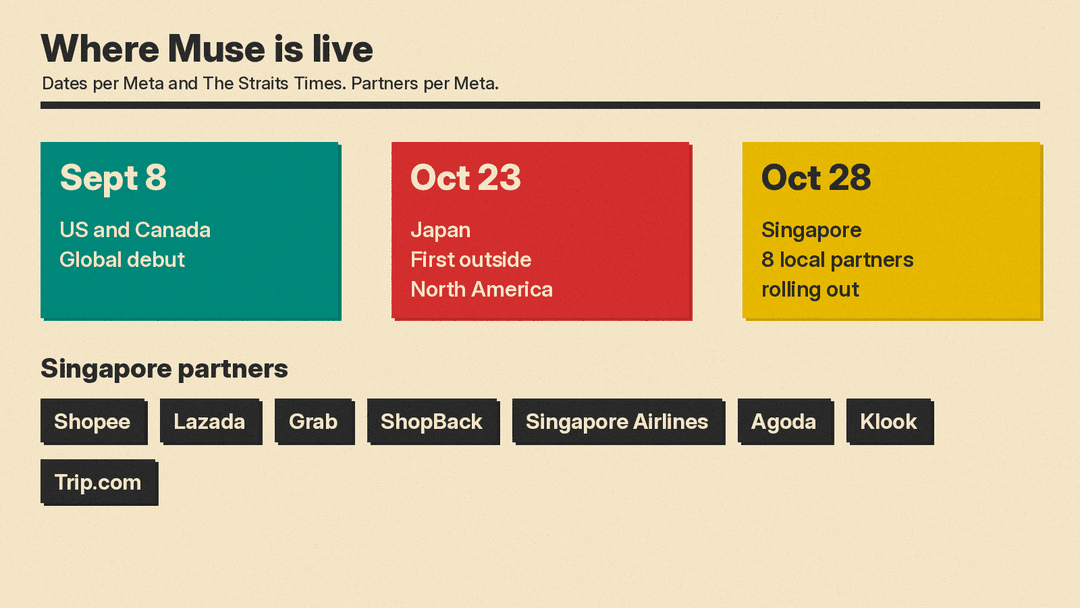
Meta's personal AI agent, Muse, is now available in Singapore. Meta announced the rollout on October 27, US time (October 28 in Singapore), and The Straits Times reports that people in Singapore can download the app from October 28. It runs on iOS, Android and the web at muse.ai.
Singapore is the third launch. Muse made its debut in the United States and Canada on September 8, The Straits Times reports (Meta's September post names the US rollout), then came to Japan on October 23, Meta's first market outside North America. In Japan, Meta said it is working on connections with Mercari and Money Forward ME. In Singapore, it named eight local partner apps.
What Muse is
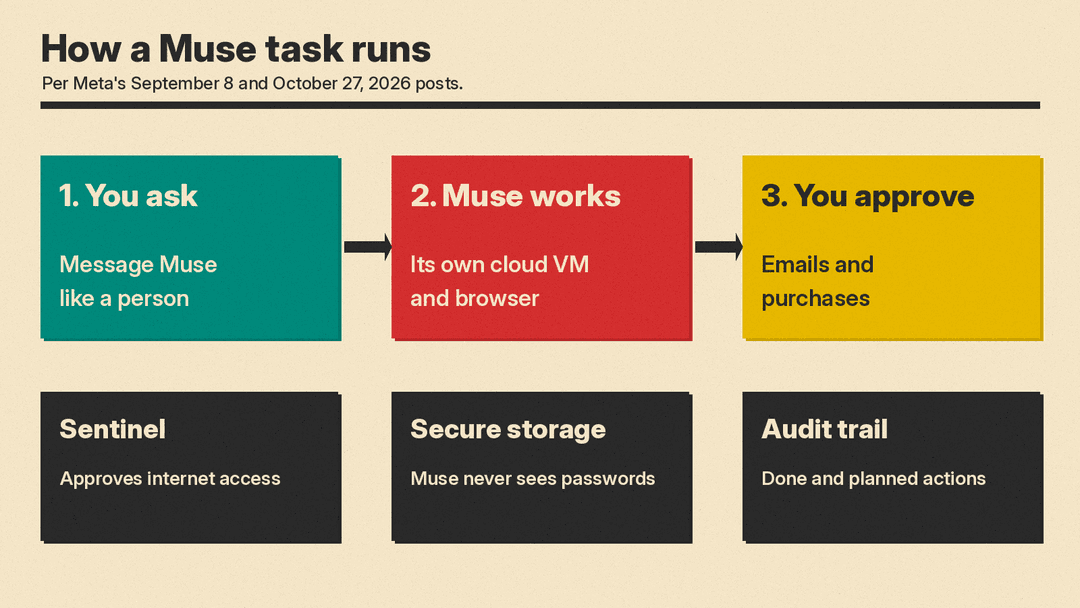
Muse is not a chatbot that only answers questions. Meta calls it a personal AI agent: you tell it what needs to get done, and it does the work. In its September launch post, Meta said talking to Muse works like messaging another person, in the Muse app or in WhatsApp. Meta's Singapore post lists iOS, Android and muse.ai, and does not mention WhatsApp. Muse is powered by Muse Spark, which Meta describes as its most capable model to date.
Muse runs on what Meta calls Muse Secure VM, a dedicated computer in the cloud with its own browser. That lets it open websites, fill in forms and keep working on long tasks after you close the app. In Japan, Meta said it sends a notification when something changes or when it needs your approval, for example to send an email or buy something. It also remembers what matters to you and uses past conversations to make suggestions.
The Singapore apps
Meta says people in Singapore can connect Muse to Gmail, Google Calendar and Instagram to manage email, coordinate schedules and draw on saved content. The local partners Meta named are:
- Shopee and Lazada, to research products and compare prices before buying
- Grab, to plan grocery shopping and dining through GrabMart and Grab Dine Out
- Singapore Airlines, Agoda, Klook and Trip.com, for travel, tickets and reservations
- ShopBack, to earn cashback on travel and shopping and claim in-store dining deals
There is a catch. Meta says connector features "will roll out progressively, with some experiences becoming available after launch." So some partner features may not work on day one.
The Straits Times adds that Muse can still search the web without a direct app link, to do research, find open dining slots, reserve tables and look for deals online.
What it costs
Meta says Muse is free for most of what people need, with subscription plans for people who want to do more. The Straits Times reports that the free tier has a weekly usage limit, which Meta said is enough for most of what people need, and that paid plans cost between $22 and $139 and come with more Muse tokens or credits. The paper does not name the plans or say how often they are billed. Meta's Singapore post does not list prices. For comparison, Meta's Help Center lists two plans, Power at $20 a month and Maximum at $100 a month, and says benefits and availability may vary by region. Meta's separate Muse Code plans for developers are covered in our Muse Wonder explainer.
How it did in a real test
The Straits Times tried Muse before writing its report. Some tasks worked well. Muse watched online weather forecasts on its own and sent umbrella reminders. It also spotted an upcoming overseas trip in the reporter's iPhone calendar and flagged visa requirements for business travel and the digital arrival card.
Other tasks did not go well. Muse booked a restaurant table easily but could not cancel it, because it tried to log in to an account on the booking platform Chope that did not exist. It also suggested a restaurant that had recently closed, because its details on Google had not been updated. Meta warns at sign-up that Muse may make mistakes and asks users to review its work.
Privacy and safety controls
Handing an agent your email and shopping accounts is a big step, so the controls matter. Our guide to how AI agents get into your accounts explains the main methods. Meta's posts describe these:
- You choose the access. You pick which apps Muse connects to and how much it can do. For email, you choose whether it only reads your mail or can also send. The Straits Times notes you can set read-only access, so Muse cannot send messages, change files or buy anything.
- It asks first. Muse checks with you before sensitive actions such as sending an email or making a purchase.
- It cannot see passwords or cards. Meta says Muse has no visibility into passwords or payment methods. Credentials go into secure storage, so Muse can use them without seeing them, including passwords you type into the browser yourself.
- A second agent guards the internet. A separate Sentinel agent runs on the same machine, and nothing Muse does reaches the internet unless the Sentinel approves it.
- There is a full log. Muse shows a complete record of everything it has done and plans to do.
- Ads and training. Meta says Muse does not share your conversations or the data in your VM with its ad systems, and you can opt out of having your interactions used to train Meta's AI models.
Meta also said in September that later this year it will introduce Muse Confidential VM, where the whole VM, including your data and conversations, is encrypted with a key only you hold.
Why it matters
Meta bills Muse as "the world's first personal AI agent built for everyone." That is Meta's own claim. The Straits Times calls Muse the first AI personal agent designed for the mainstream consumer market, and contrasts it with OpenAI's Dots and the open-source OpenClaw, which it says have focused heavily on office productivity and software development.
Singapore is also a test of whether local apps will let agents in. The Straits Times points out that some large platforms, including Amazon, JPMorgan Chase, Delta Air Lines and Amtrak, are actively blocking third-party AI agents. Meta's Singapore launch comes with eight named local partners instead. If those connectors work as described, Muse can shop, book and compare across apps people already use. If they arrive slowly, Muse has to work through the open web. Both failures in The Straits Times test came from there: a login on Chope, which is not a named partner, and an outdated Google listing.
Should you try it
If you live in Singapore and want help with reminders, trip planning or price comparisons, the free tier is a no-cost way to start. Give it the least access that works, such as read-only email at first, and check its bookings yourself until you trust it. The restaurant test shows why: making a booking and undoing one are not the same task.
