
Three model names that DeepSeek has never announced, deepseek-v5, deepseek-v5-open and deepseek-v5-next, sit in a test file in the company's official DeepSeek Harness repository on GitHub. IT之家 (IT Home) reported on October 28 that a developer spotted them the evening before, and TechNode followed on October 29.
The strings are real. What they prove is narrow. Here is what the code says, what it does not say, and one detail the first reports did not mention: the names have been public for about a month.
Where the names appear
The strings are in provider.spec.ts, a test file for the module that connects Harness to a DeepSeek account. Harness is DeepSeek's open-source agent harness. TechNode's Chinese edition describes it as a plugin-based framework that is still in developer preview. The repository's own tagline is "Everything is a Plugin." It uses the MIT license.
The test builds a fake /models listing, the list of models a DeepSeek account server returns to the client. It then checks how the client reacts to each entry:
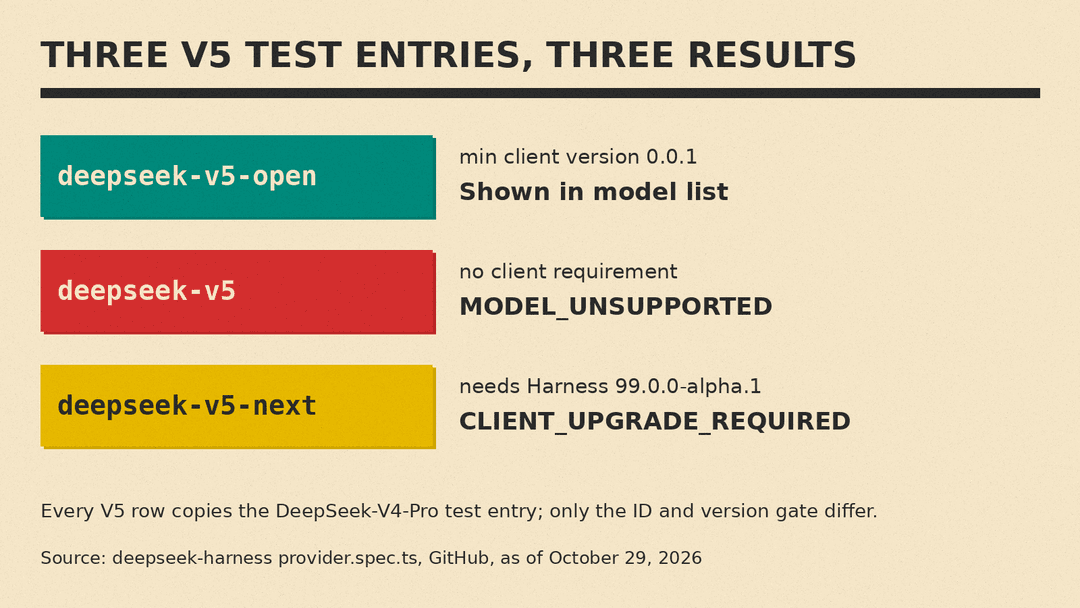
deepseek-v5-openhas a minimum client version of 0.0.1. The test expects it to show up in the usable model list, next to DeepSeek Flash.deepseek-v5has no client requirement block. The test expects a call to it to fail with the error codeMODEL_UNSUPPORTED.deepseek-v5-nextrequires Harness version 99.0.0-alpha.1. The test expects aCLIENT_UPGRADE_REQUIREDerror that tells the user to upgrade.
So each V5 name drives one branch of the client's logic: shown, refused, or told to upgrade.
Why this is test scaffolding, not a spec sheet
Three details in the file point to placeholders rather than leaked specs.
First, the V5 entries carry no specs of their own. Each one is written as { ...PRO, id: 'deepseek-v5' }, which copies every field from the existing DeepSeek-V4-Pro test entry and changes the ID. Two of the three also add a client version requirement. The context window, output limit and display name attached to these rows are V4-Pro's, not V5's.
Second, the version gate is not a real release number. A required version of 99.0.0-alpha.1 is a value chosen to be higher than any real build, so the test can trigger the upgrade error.
Third, a second test sets a context window override of 9 tokens for deepseek-v5. No production model has a 9-token window. It is a dummy value used to check that overrides apply once the model appears.
TechNode reported that the entries "are part of test scenarios and contain no model specifications, benchmark results, or release schedule." IT Home warned that a placeholder "does not mean a release is near" (our translation). It added that, as of October 28, DeepSeek had published no V5 announcement, model card or API identifier.
The names have been public since September
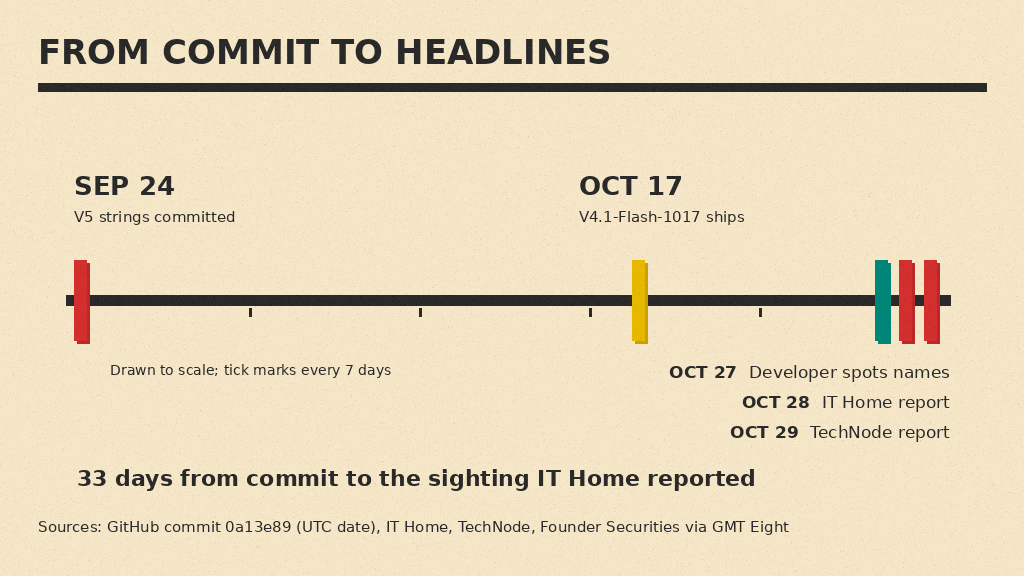
The GitHub commit history for that test file shows when the V5 strings arrived. They first appear in commit 0a13e89, dated September 24, 2026 (UTC), with the message "feat(llm): serve the DeepSeek account catalog from the account listing." The two earlier versions of the file in its history do not contain them.
That is 33 days before the October 27 sighting that IT Home described, and 35 days before TechNode's report. The strings were added as part of a feature that lets the client read its model catalog from the account server. They were not new in late October, and they were committed before the V4.1-Flash-1017 update that DeepSeek shipped on October 17.
What it does tell us
The code shows how DeepSeek has set up its client to handle new models. Harness asks the server which models an account can use. It hides models the installed build cannot serve, and it asks users to upgrade when a model needs a newer client. IT Home's reading is that DeepSeek could switch on V5 by changing the server-side /models configuration, with no new client release. In the test, that holds for the deepseek-v5-open path. The deepseek-v5-next path still asks for a newer client.
The naming is also a clue, though only a clue. The test uses an "open" variant, a plain variant and a "next" variant. DeepSeek has not said what the -open or -next suffixes mean, and a test author may simply have picked labels that cover each branch.
Where DeepSeek's lineup stands
For context, IT Home recounts that DeepSeek released the V4 series as a preview on April 24, 2026, in V4-Pro and V4-Flash versions, and that V4-Pro became generally available on August 13. The same test file's DeepSeek-V4.1-Flash entry uses a 1,048,576-token context window and a 393,216-token output limit. A Founder Securities report summarized by GMT Eight says the V4.1-Flash-1017 update launched on October 17 on web, app and API, with weights on Hugging Face and ModelScope. We covered independent safety tests of that model and DeepSeek's 100 billion yuan funding round.
Why it matters
A V5 name from DeepSeek draws attention, and two outlets reported it within two days. The useful reading here is modest. DeepSeek's test code uses V5 family names, and its client is built to roll new models out from the server side. Nothing in the test entries gives a size, a benchmark, a price or a date. Until DeepSeek posts a model card or an API notice, treat "DeepSeek V5" as a name in a test file that has been public since September 24.
Sources
- DeepSeek Harness: provider.spec.ts test file (GitHub)
- Commit 0a13e89, September 24, 2026 (GitHub)
- DeepSeek Harness repository (GitHub)
- TechNode: DeepSeek V5 identifiers surface in official Harness code repository
- TechNode (Chinese edition)
- IT之家 (IT Home): DeepSeek-V5 placeholders appear in Harness codebase
- GMT Eight: Founder Securities report on domestic models
