
GitHub has made GitHub Agentic Workflows generally available. The open source project from GitHub Next lets a team write repository automation as a plain Markdown file, then runs a coding agent on it inside GitHub Actions. GitHub gives issue triage, CI failure analysis, documentation updates and test writing as examples.
The launch came on October 28, the same day GitHub shipped Copilot Fusion, its multi-model router. Fusion decides which models answer each Copilot prompt. Agentic Workflows is about agents that run on a schedule or an event when nobody is at the keyboard.
What it does
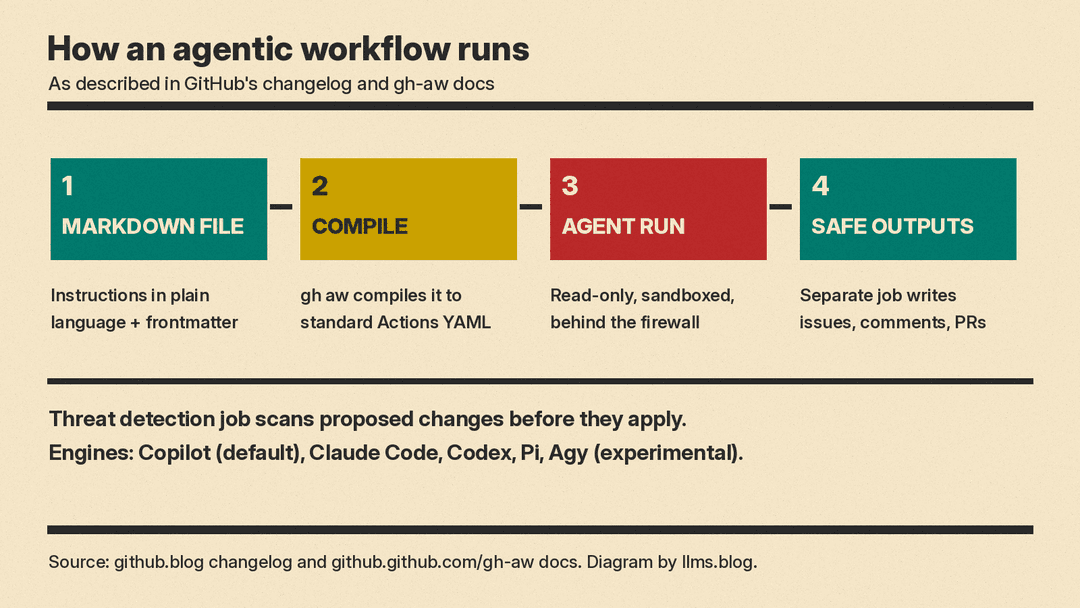
A workflow is a Markdown file with a short configuration block at the top. The quick start guide describes it as "AI-powered repository automation in Markdown with YAML frontmatter". The body is the instruction in natural language. An example on the project homepage reads "Summarise yesterday's issues. Flag anything that needs a reply." GitHub's changelog says the tool "compiles them into standard Actions YAML", so the result is an ordinary GitHub Actions workflow.
That design choice matters for teams that already run Actions. GitHub says these workflows "reuse your existing runner groups and policy constraints".
Which agents it runs
The changelog says "You can use GitHub Copilot or bring your own coding agent to power each workflow." The AI engines reference lists GitHub Copilot as the default, plus Claude Code, OpenAI Codex, Pi and an experimental engine called Agy. Gemini CLI is still listed but marked deprecated. The docs warn that "Switching engines may require different credentials, models, tools, and network rules."
New at general availability, per the changelog: model providers can be picked per workflow, and workflows "can use a model router that optimizes for task type and difficulty."
The safety model
Letting an agent act on a repository with no human watching is the obvious risk, and GitHub's announcement lists layered safeguards. GitHub says agents "run with read-only permissions by default, and execute inside a sandboxed container behind the Agent Workflow Firewall."
Writes go through a step GitHub calls safe outputs. The safe outputs reference explains that the agent writes structured requests, and "separate permission-controlled jobs execute permitted requests." In practice the agent can ask for an issue, a comment, a label or a pull request without holding any write permission itself. The changelog adds that "a dedicated threat detection job scans all proposed changes before they are applied."
The docs say this does not always include a human review. The same page says configured outputs "may publish content, update metadata or merge pull requests automatically. Review requirements depend on the output configuration and applicable policy gates." If you want a person to approve every change, you have to set it up that way.
The security architecture page says the design protects "against prompt injection, rogue MCP servers, and compromised agents." That threat is real: we covered how a planted AGENTS.md file hijacked Codex earlier this week. For GA, GitHub also says agents can run in a Cloud Hypervisor or NVX micro-VM, and can "prevent data leaks in cross-repository workflows with enclaves."
What else changed since the preview
The changelog lists these additions since public preview:
- Self-hosted runners: workflows can run on Actions Runner Controller (ARC) runners with Docker-in-Docker.
- Budget forecasting: the
gh aw forecastcommand "is no longer experimental" and now includes threat detection credits and monthly ranges. - Templates: new workflow templates can be added with
gh aw add-wizard. - Model routing and stronger isolation, described above.
The full list is in the gh-aw release notes.
What it costs
GitHub's changelog says the tool is available on github.com for GitHub Free, Team and Enterprise, and "Using the default GitHub Copilot CLI engine to power a workflow requires a Copilot license."
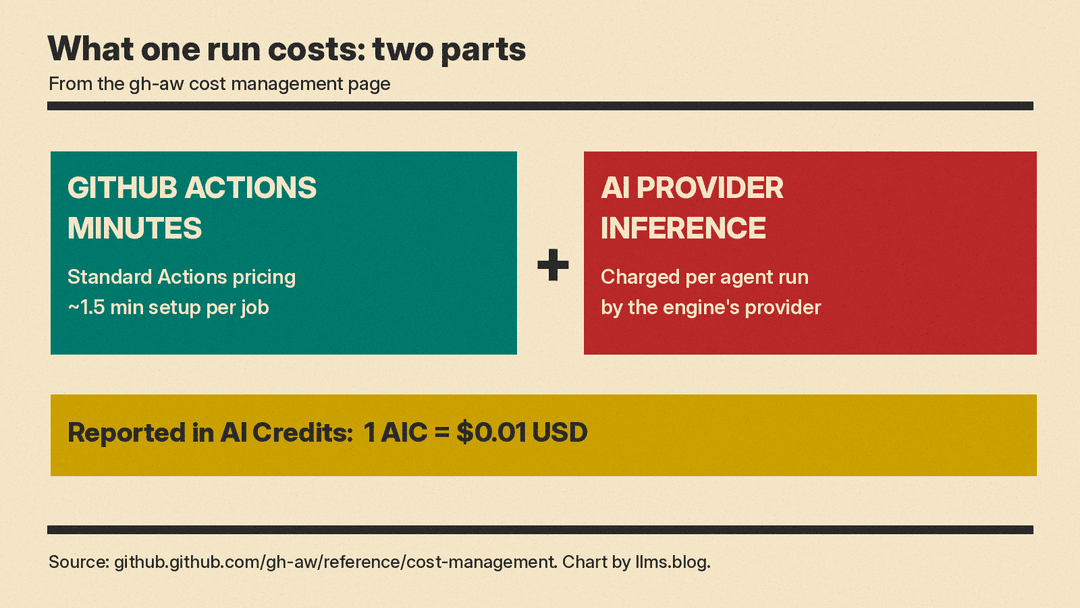
The cost management page says the cost of a run is "the sum of two components": GitHub Actions minutes for the workflow jobs, and "inference costs charged by the AI provider for each agent run." Per that page, a typical run has a short pre-activation job and an agent job of 1 to 15 minutes, each with about 1.5 minutes of runner setup billed at standard GitHub Actions pricing. The tool reports spend in AI Credits, where "One AIC equals $0.01 USD." The page calls AI Credits the primary metric for monitoring and budgeting inference costs. By default, gh-aw caps a run at 1,000 AI Credits and a workflow at 5,000 AI Credits a day.
The same page gives blunt advice: "If a task can be solved using deterministic tools, use deterministic tools. Only use agents when necessary, as they incur higher cost."
How to try it
The quick start says setup takes about 10 minutes and needs the GitHub CLI. You install the extension with gh extension install github/gh-aw, then add a sample from GitHub Next's agentics repository, such as the daily repo status report, with gh aw add-wizard githubnext/agentics/repo-status. You need write access to the repository and GitHub Actions turned on.
Why it matters
Agentic Workflows runs coding agents in GitHub Actions, on the runner groups and policy constraints a team already has. That is the same direction as Cursor's Agent SDK, which also treats agents as code that runs on events. With Agentic Workflows, the trigger, the runner and the repository are all on GitHub.
GitHub's announcement quotes Ben Alton, a senior manager at Accenture. He says that across one lead's team, AI "now authors 91% of the team's commits," and that the team cut production errors "from about 11,000 a day to under 1,000." Those are a customer's own figures in a GitHub announcement, not an independent measurement. The safer takeaway is the design: read-only agents, separate write jobs, and cost reports you can check before a bill arrives.
