
GitHub is changing how big companies pay for Copilot. In a changelog post on October 28, GitHub said that "enterprises working with a GitHub or Microsoft account team can now get Copilot included with GitHub Enterprise for every licensed user." There is no Copilot seat charge for those users. Instead, every AI request is metered against the company's budget from the first use.
The change came during GitHub Universe, on the same day GitHub made Copilot Fusion generally available and shipped Agentic Workflows for GitHub Actions. Together, they move Copilot further from a per-seat tool and closer to a metered platform.
What GitHub announced
GitHub's documentation calls the new model "Copilot access." The docs page on what is changing describes it as "a new way for eligible enterprises to provide Copilot to their developers." It has two parts:
- Users with a GitHub Enterprise Cloud license: $0 Copilot seat charge.
- Users without that license: Copilot Standalone, at $10 per user per month.
In both cases, the docs say, "metered usage is billed separately." The changelog says Copilot through GitHub Enterprise and Copilot Standalone "has the same features and models as Copilot Enterprise but does not include monthly AI credits per seat." The docs add that the Standalone charge "covers identity, access, policy, security, and administration controls."
Copilot Business and Copilot Enterprise are not going away. The changelog says both "remain available to purchase for new and existing enterprises."
How the old and new models compare
The same docs page lists the three models side by side:
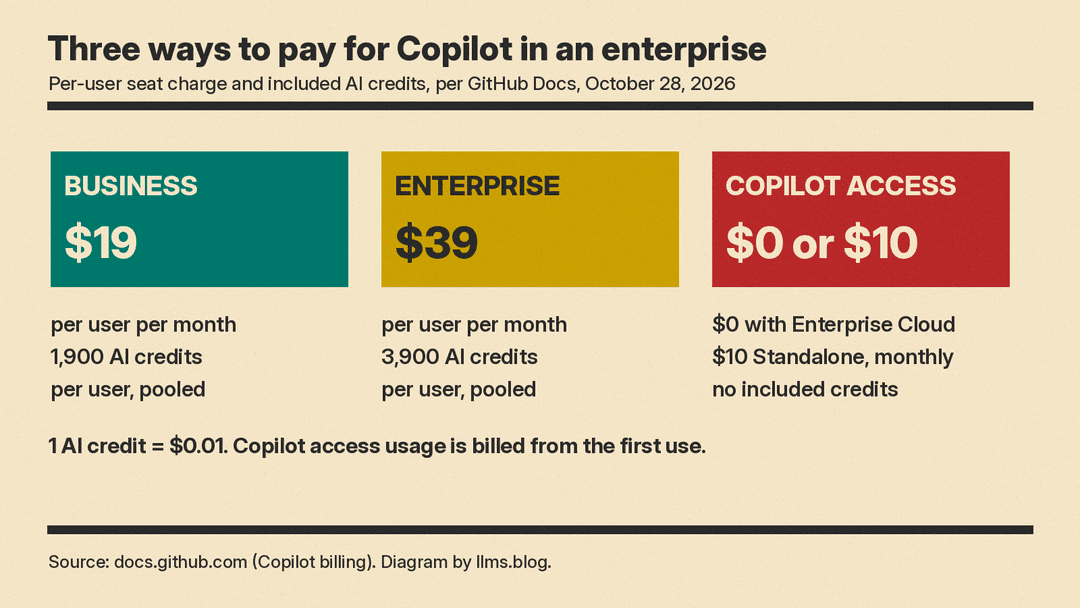
- Copilot Business: $19 per user per month, with 1,900 AI credits per user per month, pooled.
- Copilot Enterprise: $39 per user per month, with 3,900 AI credits per user per month, pooled.
- Copilot access: $0 seat charge for GitHub Enterprise Cloud users, or $10 per user per month as Copilot Standalone. No included AI credits.
An AI credit is GitHub's billing unit. According to GitHub's usage-based billing docs, "1 AI credit = $0.01 USD," and the cost of each interaction depends on the model and the number of tokens it uses. The same page says a quick chat question with a lightweight model "might cost a fraction of a credit," while a long coding agent session with a frontier model "will cost more."
So the trade is simple to state. On Business or Enterprise, part of each seat price comes back as a pooled credit allowance. On Copilot access, the seat is free or cheaper, but every credit is paid for.
What still works when the budget runs out
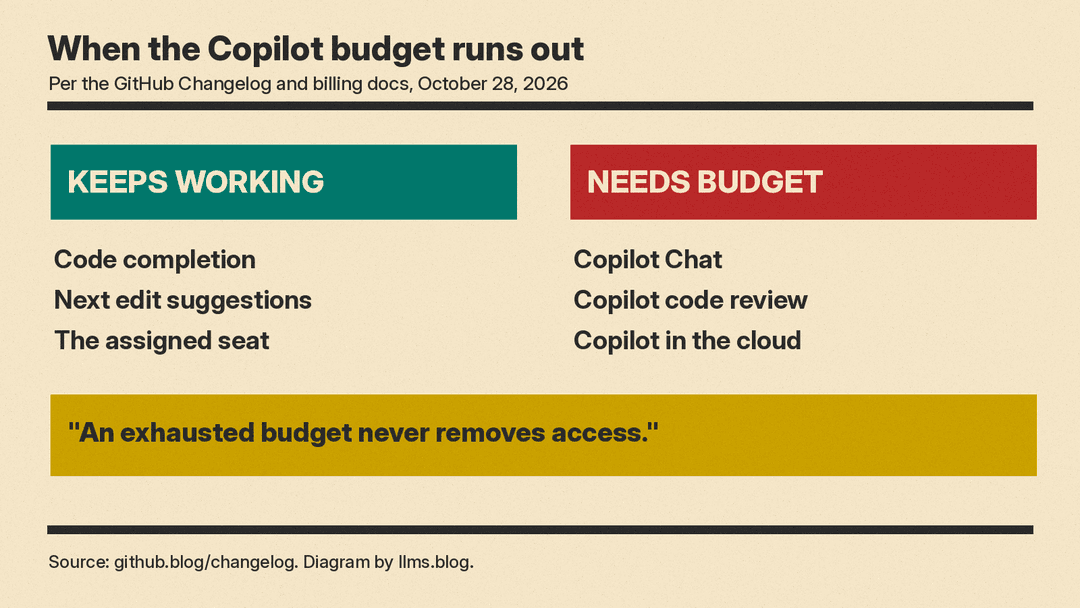
The most practical detail is what happens when a company's AI budget hits zero. The changelog says code completion and next edit suggestions "keep working even with no budget available." Copilot Chat, Copilot code review and Copilot in the cloud "require available budget to use." It adds: "An exhausted budget never removes access."
The billing docs give the full list of features that consume AI credits: Copilot Chat, Copilot CLI, Copilot cloud agent, Copilot Spaces, Spark and third-party coding agents. Inline completions and next edit suggestions "are not billed in AI credits and remain unlimited."
This matters most for agent work. Cloud agents and automations run long sessions, and long sessions use many tokens. GitHub's new shared Copilot Automations, also announced October 28, bill AI credits "to the organization or user that owns the repository, rather than to the person who created the automation." Under Copilot access there is no included allowance, so those credits are metered from the first request.
Who can get it, and when
Availability is limited for now. According to the docs and the changelog:
- If you work with a GitHub or Microsoft account team, it is available starting October 28, 2026, for GitHub Enterprise Cloud. Talk to your sales team.
- If you manage your own subscription, it is "currently unavailable." GitHub says it is "opening this to self-serve customers in stages and will share dates in the coming weeks."
- It is also unavailable to organizations on GitHub Free or GitHub Team, and to self-service GitHub Enterprise Cloud trials.
Switching is voluntary. The docs say enterprises on Copilot Business or Copilot Enterprise "do not transition automatically," and that transitions "take effect on the first day of a month."
Two rules are worth knowing before you plan a switch. First, the billing model applies to the whole enterprise: you "cannot combine Copilot access with Copilot Business or Copilot Enterprise seats in the same enterprise, including in individual organizations." You can, however, mix GitHub Enterprise Cloud users and Copilot Standalone users. Second, the docs say "developers do not automatically receive access to Copilot." Enterprise owners must still assign Copilot seats, including to users who already have a GitHub Enterprise Cloud license.
How to tell if it saves money
GitHub's docs give a short method to compare costs for the same month, users and usage:
- Add your current Copilot license charges and metered usage charges.
- Estimate the cost of your total usage with no included allowance. The docs say to include usage your current pooled allowance covers, "not only your current overage charges."
- Count users without a GitHub Enterprise Cloud license and multiply by $10.
- Add steps 2 and 3, compare with step 1, and confirm any account-specific pricing with your account team.
The docs also list setup tasks: set spending controls from your estimate, keep the "AI credits paid usage" policy turned on (with no allowance, credit-using features are blocked if it is off), and add *.enterprise.githubcopilot.com to firewall allowlists that permit only the Business endpoint.
Why it matters
For a team of light Copilot users, mostly using completions, this could lower the bill: completions are not billed in AI credits, and the seat charge for Enterprise Cloud users is $0. For a team that runs coding agents all day, the answer depends on usage, because the pooled 1,900 or 3,900 credits per user no longer cushion the first part of the bill.
It also shifts the admin's job. The changelog says that before, you had to manage "how many Copilot seats you were paying for and how much AI usage those users consumed." Now "usage against your enterprise budget is the primary thing to manage." For companies already watching agent costs, as with GitHub's AI approval mode for Copilot, budgets and policies become the main control, not seat counts.
Self-serve customers have nothing to do yet. GitHub says current self-serve subscriptions are unaffected, and dates will follow.
