
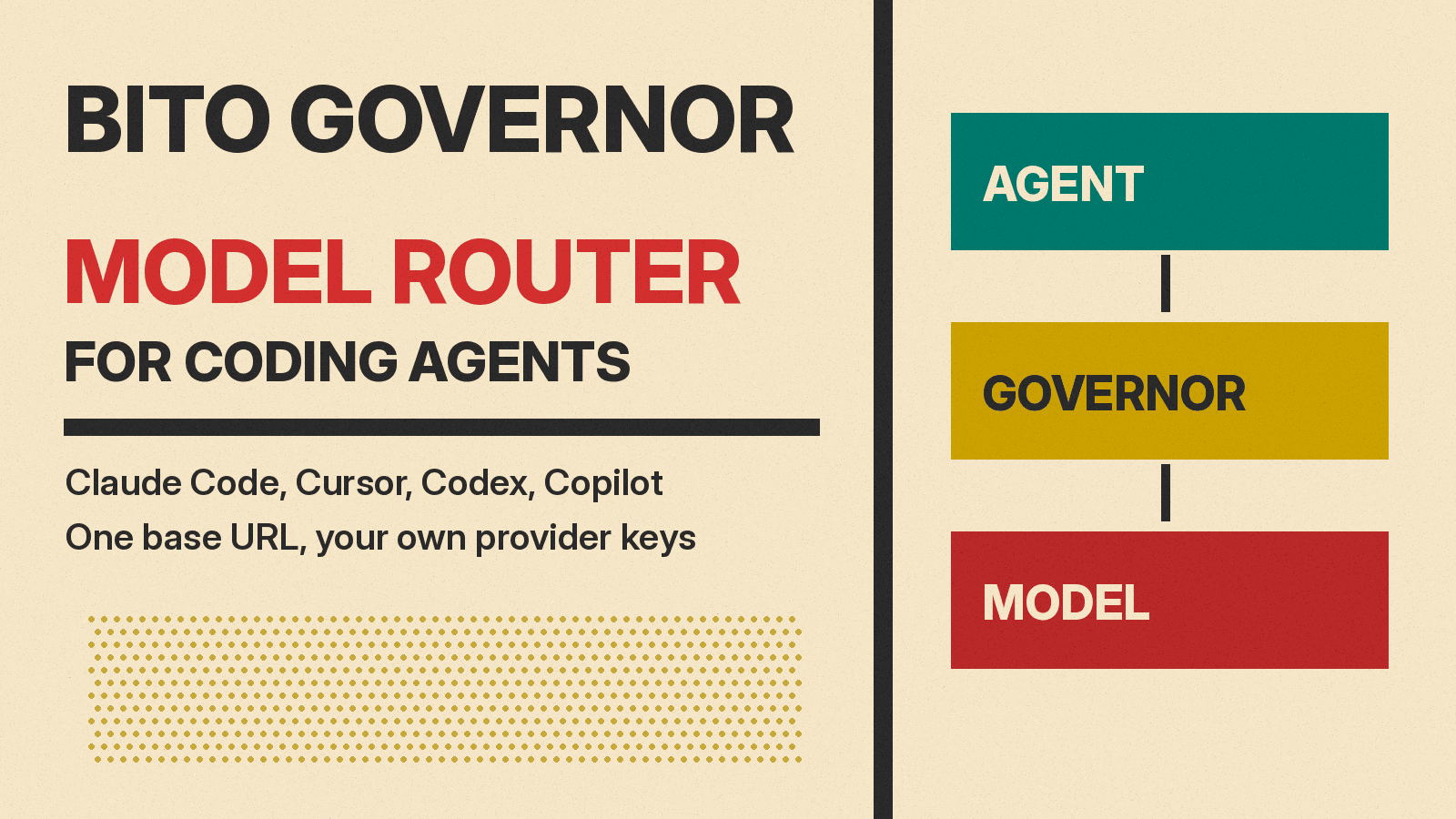
Bito, a company that sells AI code review and codebase context tools, launched Governor on October 27, 2026. Governor sits between a team's coding agents and the model providers. It picks a model and a reasoning level for each request, and it answers code search questions on its own side so the agent reads less of the repository. Bito says the setup works with Claude Code, Cursor, Codex, Pi and GitHub Copilot, and that teams keep using those tools "exactly as they are."
Bito's pitch is that most of a coding agent's bill pays for searching the codebase, not for writing code. All the figures below come from Bito. We found no independent test of them.
Where Bito says the money goes
Bito's post states: "In our measurements, 60% to 80% of what a coding agent costs goes to searching and reading its way around your codebase, and nearly all of it is billed at frontier-model prices."
The reason is how agents work. Each step (a search, a file read, an edit, a test run) is added to a transcript, and the whole transcript goes back to the model on the next step. A file read at step 3 is paid for again at every later step. In one Claude Code session that Bito measured, searches returned about 65,000 tokens of results, and by the end the session had processed 6 million tokens. Prompt caching makes the repeats cheaper but does not remove them. Bito says cache reads were 77% of all tokens processed across its model research.
We covered a research take on the same problem in cache engineering for agents, where dropping old cache cut cost in Tsinghua's tests.
How the router picks a model
Governor puts each request into one of several tiers, based on the kind of work and how much risk it carries. Tiers run from carrying out a plan the developer already agreed to, up to planning, code review and anything that touches production. For each tier it picks a model and reasoning level from the models the team allows. The team decides how aggressive it should be on cost.
Bito gives an example of why one model is not always best. In the same long session, Sonnet 5.5 scored 91% and Opus 5.5 scored 81% on writing a plan. One turn earlier, on working out why something failed, Sonnet scored 76% and Opus 90%.
Three design choices stand out:
- It reads the whole task, not only the last message. A message like "looks good, implement this" is treated as a build, not a cheap request. Bito says the share of its hand-labelled test requests that landed in the right tier went from 62% to 100% after it switched to sorting requests by kind of work and risk.
- It does not switch models mid-task. Governor decides when the developer starts a new request and holds that choice while the agent works. Bito says that across 80 turns since it made this change, Governor has not switched models mid-task once.
- It counts the cache. Bito says reading a warm Opus cache costs $0.20 per million tokens, while sending the same conversation cold to Gemini Flash costs $0.75. So Governor moves to a cheaper model only when the switch pays for itself.
It also sets reasoning level and can add guidance to the prompt. Bito says better prompts let a less expensive setup match Opus's default score at 18% lower cost.
Code context instead of grep
The second half of Governor is a live graph of the team's repositories, down to symbols, calls and service dependencies. When the agent needs to find something, Governor does the research with a smaller, faster model and returns a short answer with file and line references.
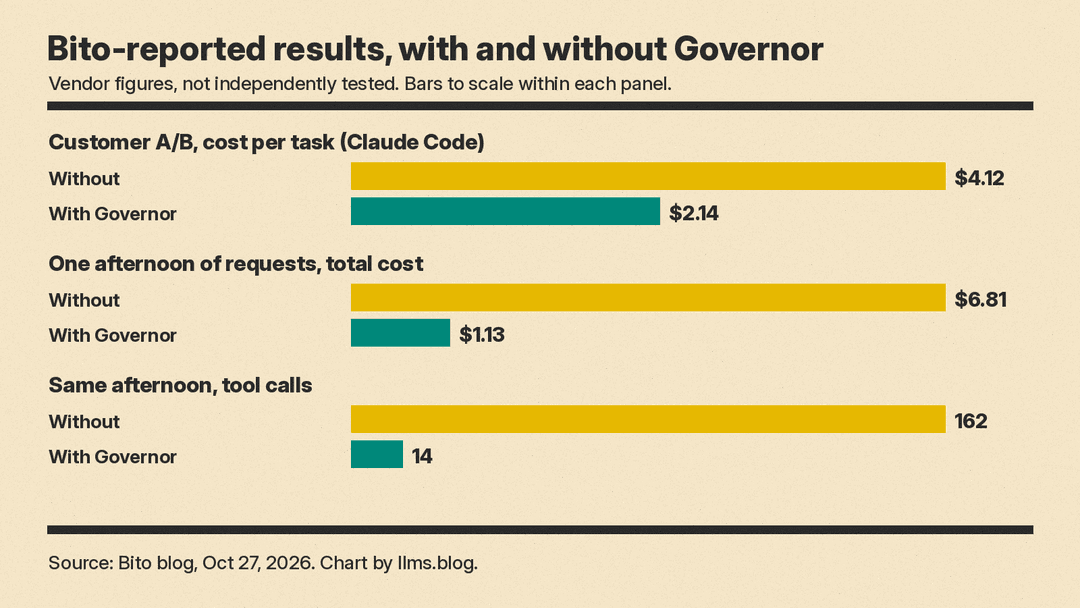
Bito ran one afternoon of real developer requests both ways. Without code context, the agent made 162 tool calls, opened 62 files and took 25 minutes. With Governor it made 14 calls, opened 3 files and took 8.5 minutes. The cost was $1.13 instead of $6.81, and Governor finished every task while the run without it finished 90%.
The headline numbers, and what they cover
Bito reports three sets of results:
- Benchmark: about 30 models on about 2,000 real engineering tasks. Claude Opus 5.5 on every task scored 54.5 out of 60 for $33.22. Keeping Opus 5.5 for planning, code review and risky or vague requests, with GLM 5.3 Flash on the rest, finished the same 90% for $21.27, 36% less.
- Long Claude Code sessions: developers on Opus 5.5 kept the same score at 30-70% lower cost, and sessions finished 26% faster.
- One customer A/B test: in Claude Code, cost per task fell 48%, from $4.12 to $2.14, with task success held at 100% and tasks completed 38% faster. Bito says the same model and agent setup ran with and without Governor.
These are vendor numbers from Bito's own tasks and one unnamed customer. Treat them as a reason to run a trial on your own traffic, not as a forecast.
How setup works
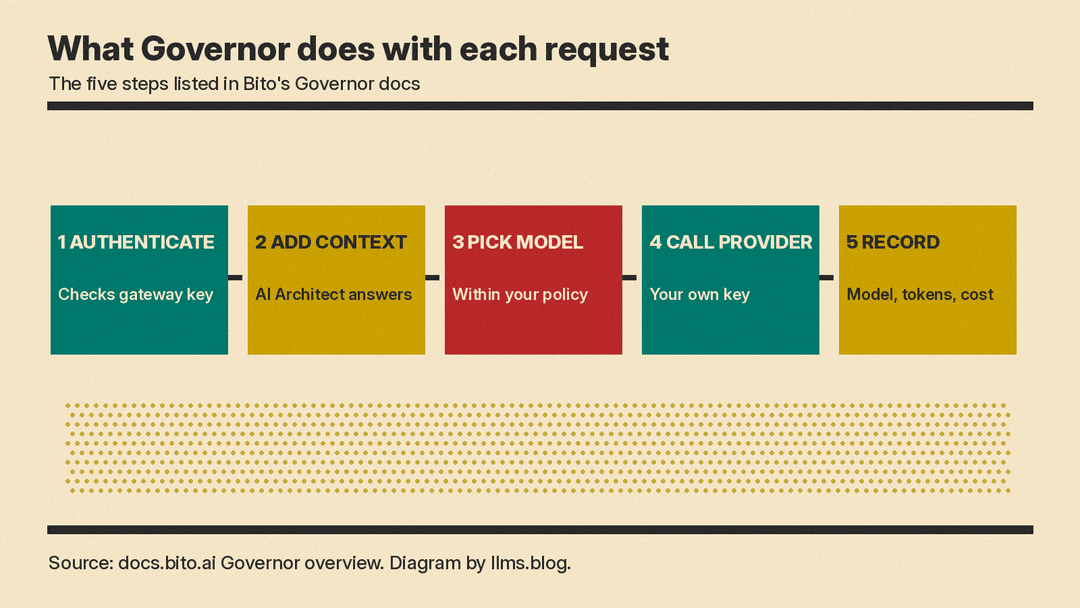
The Governor docs describe it as a drop-in endpoint: "Point your coding tools at Governor with one base URL and one key." Bito's blog says it speaks the Anthropic and OpenAI APIs and runs on the team's own provider keys. The docs list five steps per request: authenticate the gateway key, add context, pick the model, call the provider with the team's credential, and record the model, tokens, status and cost.
The Bito-hosted setup guide says a model with no price set cannot be selected by the router, so teams need to enter token prices for each model they allow.
What it costs
Bito publishes no list price for Governor. The billing docs say it uses usage-based pricing that "scales with the size of your indexed codebase and the volume of routing requests from your coding agents." Model provider costs pass through to the customer, billed on the team's existing provider accounts. Bito's team scopes exact rates in an initial conversation. The pricing page lists two plans, both with a free trial: Professional (Bito-hosted) and Enterprise, which adds custom routing policies, on-prem and self-hosted deployment, and SSO/SAML.
Why it matters
Coding tools already let developers choose a model by hand. GitHub Copilot has a model picker, as in our look at GPT-6.1 Terra in Copilot and Codex, and Cursor is pushing agents into code with its Agent SDK. Governor's bet is that a third-party layer can make that choice per request across these tools, while teams keep using them as they are. The open question is quality on hard work: a router that sends a risky change to a cheap model can cost more than it saves.
