
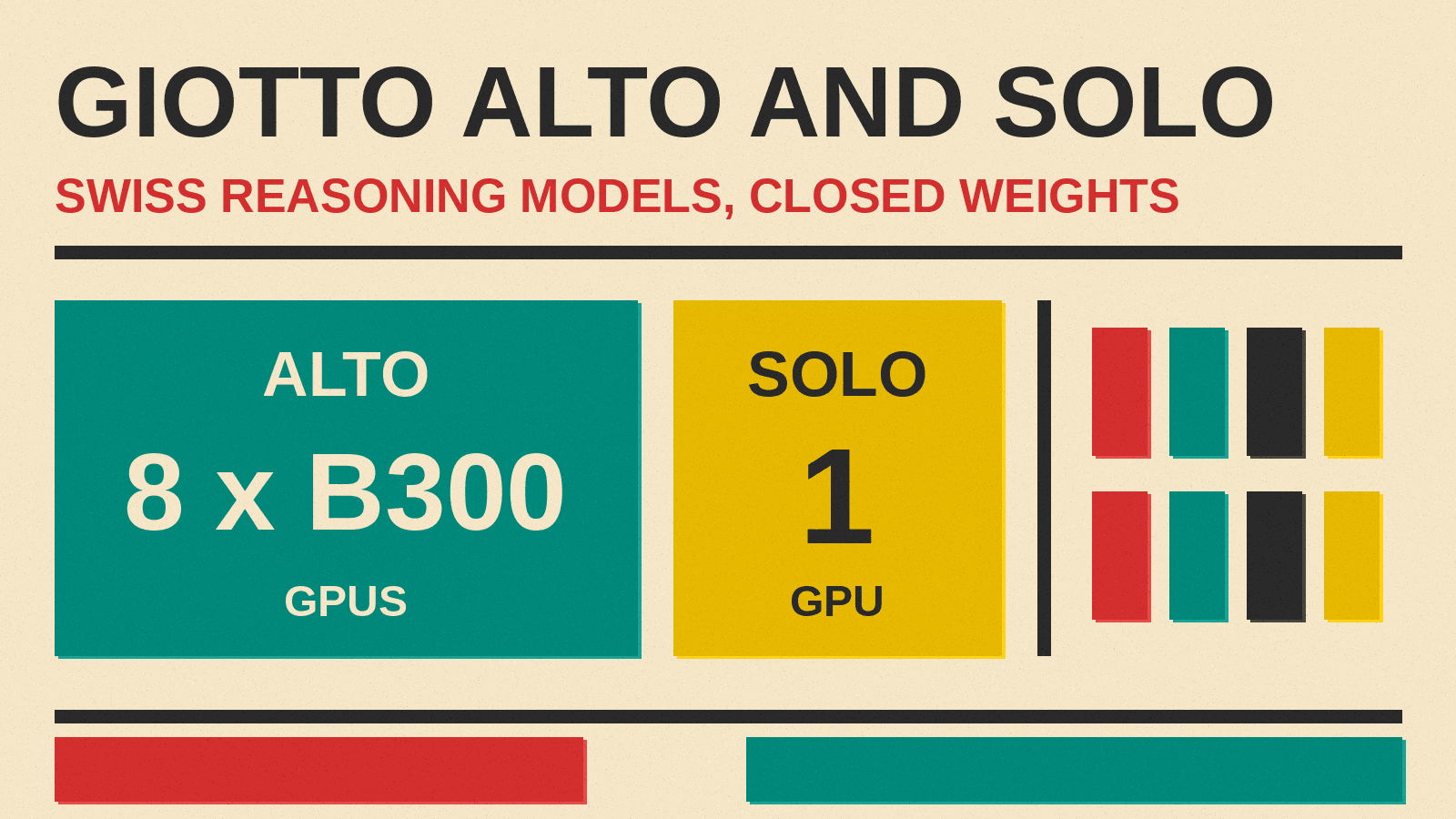
Giotto, a Lausanne AI lab, announced two reasoning models on October 27, 2026: Giotto Alto and Giotto Solo. The company's press release calls them "a new family of Swiss-developed reasoning models designed to run across public cloud, dedicated cloud and compatible on-premises hardware." The pitch is sovereignty: users choose where the model runs and where their data stays.
The weights are not open
The weights cannot be downloaded, so Alto and Solo are not open-weight models. We found no Hugging Face repository from Giotto for either model, no public download link and no open license. A Hugging Face search for "giotto" returns only unrelated user repositories, so there is no weight-upload commit to date.
Giotto's offering page does have a "Download Giotto" option to "Run Giotto on your own GPUs." The press release explains that path: on-premises installation goes "through partner integrators," and on-premises deployments "are licensed annually or over multiple years, with pricing based on the number and type of GPUs where Giotto is deployed."
The company's End User License Agreement describes the model as "Giotto.ai's proprietary AI model and software, consisting of a containerised intelligence." Its key terms:
- The license is "limited, non-exclusive, non-transferable, non-sublicensable and revocable."
- Use is "solely for non-commercial testing and evaluation purposes."
- The free Usage Period starts when the user first uses the model and ends "after 12 (twelve) months," unless terminated earlier. The agreement then renews automatically for further 12-month periods unless either side terminates it.
- Users may not "redistribute, sublicense, rent, lease, lend or transfer the Model" without written permission.
- Users may not "reverse engineer, decompile, disassemble, extract, replicate, reconstruct the Model or attempt in any way to derive the Model source code, parameters or architecture."
The EULA does not set a revenue cap. That is a different setup from a public weight release such as MiniMax M3.1 Flash, where anyone can fetch the files.
Alto and Solo
The press release gives the hardware for each model:
- Giotto Solo "is designed to run on a single GPU." The release does not name the GPU type.
- Giotto Alto, "the family's flagship for demanding reasoning and enterprise workloads, runs on eight B300 GPUs."
The release does not list quantized versions, and the Giotto pages we read give no parameter count or context length for either model. Giotto's home page lists only these two models. It calls Alto "Our most powerful model yet" and Solo "The smartest model running on a single GPU."
On-premises options run "from a one-GPU workstation for Solo to multi-GPU server racks for Alto," according to the release.
Deployment and pricing
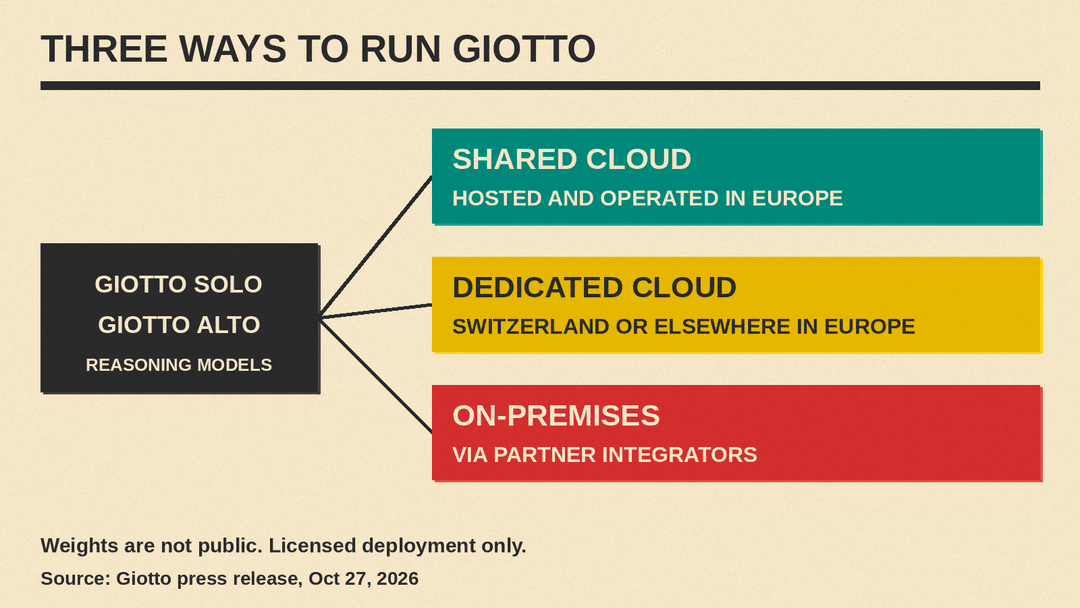
The release lists three deployment options for the family:
- shared cloud, "hosted and operated in Europe"
- dedicated cloud in isolated environments at partner data centers "in Switzerland or elsewhere in Europe"
- on-premises installation on compatible hardware through partner integrators
The release says "Shared cloud access is free." API access on the shared cloud "uses a flat fee for all-you-can-use requests, limited to one concurrent request at a time," with token packages for more concurrency. Dedicated cloud instances start at one GPU, are rented monthly and include the Giotto software licence.
Giotto's API page also lists Giotto Alto API token pricing per 1M tokens: €2.10 input, €10.50 output, €0.21 cache hit and €2.10 cache write.
The release says Giotto is also launching its app for iOS and Android, alongside a free anonymous chat that requires no account. The release says its cloud services "are GDPR-aligned and do not depend on US cloud infrastructure."
Benchmarks, as Giotto reports them
The home page publishes these scores. They are vendor-reported, and the table does not state an effort setting for Alto or Solo, while several rival entries carry labels such as "(max)" or "(xhigh)".
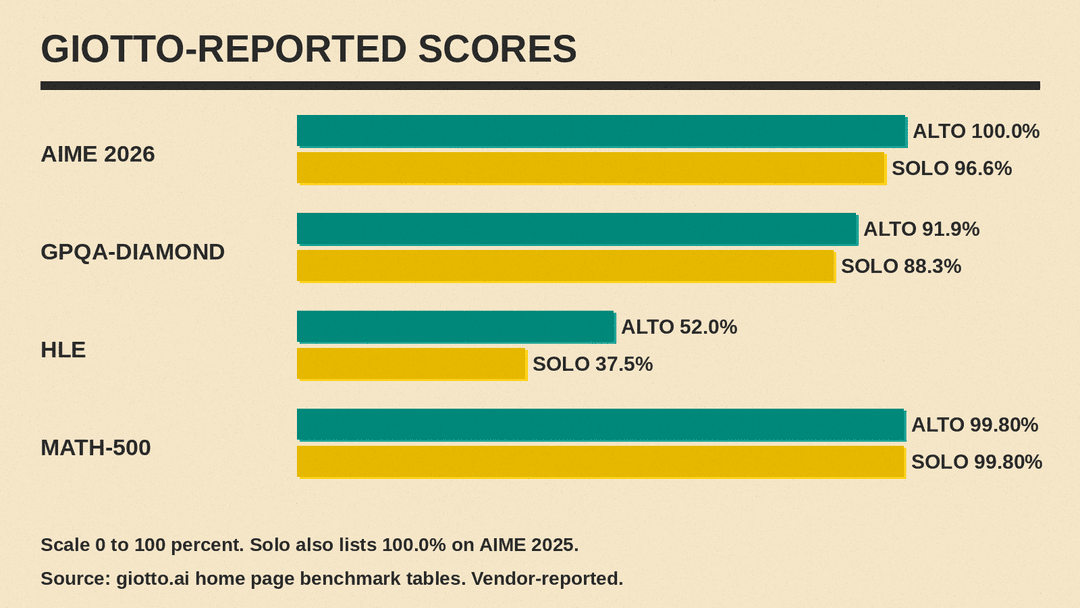
Giotto Alto:
- AIME 2026: 100.0%
- GPQA-Diamond: 91.9%
- HLE: 52.0%
- Math-500: 99.80%
Giotto Solo:
- AIME 2025: 100.0%
- AIME 2026: 96.6%
- GPQA-Diamond: 88.3%
- HLE: 37.5%
- Math-500: 99.80%
Alto does not lead every row in Giotto's own table. On GPQA-Diamond the table lists GPT 6 Astra (max) at 96.1%, Gemini 3.8 Flash (high) at 95.3%, Claude Fable 5.1 (max) at 93.7% and Kimi K3 (max) at 93.5%. On HLE it lists Claude Fable 5.1 (max) at 59.1% and GPT 6 Astra (max) at 54.7%. On AIME 2026, GPT 5.5 (xhigh) and Claude Opus 4.8 (max) also show 100.0%. The table also includes Moonshot's Kimi K3, an earlier model than the Kimi K3.1 Pro we covered, and Mistral Large 4 at 35.0% on HLE.
Solo's table compares it with Gemma 4 31B, GPT-OSS-120B, Nemotron 3 Nano 30B-A3B, R1-Distill-Qwen-32B and Ministral 3 14B. On HLE, Solo's 37.5% sits above Gemma 4 31B at 26.5% and GPT-OSS-120B at 19.0%. We found no third-party reproduction of these results.
Who is Giotto
The release says Giotto was founded in Lausanne in 2017 by EPFL mathematics alumni and has worked on machine-learning interpretability, language models and reasoning systems. In the 2024 and 2025 ARC-AGI competitions, its results "placed 11th and second, respectively, among roughly 1,500 teams."
CEO and co-founder Aldo Podestà said in the release: "Europe must offer more than a different flag on the same dependency." He added that Alto was built around "private, portable European AI, designed to put capability and control in the same hands."
Why it matters
Giotto sells control over where a model runs, not access to the model files. Buyers can host Alto or Solo in Europe or on their own GPUs, but only under Giotto's licences, and the EULA forbids extracting the model's parameters. Readers who want weights they can inspect or fine-tune will not get them here. For Mistral, whose Mistral Large 4 appears in Giotto's HLE row, see our Voxtral 3 explainer.
