
Google DeepMind announced Gemini 4 Carbon on October 28, 2026. It builds on Gemini 4 Argon, which Google says launched "two weeks ago." Google calls Carbon "our strongest model with state-of-the-art cybersecurity and long horizon capabilities." The more unusual part is the rollout. Most people cannot use Carbon yet. Google says it will go first to "a subset of cyber defenders," then to more vetted partners, and only later to developers, businesses and consumers.
Unless noted, the figures below are Google's own, from the launch post by Koray Kavukcuoglu, SVP at Google DeepMind and Chief AI Architect at Google. The exception is the Artificial Analysis Intelligence Index score, which Artificial Analysis reported itself.
Who can use Gemini 4 Carbon
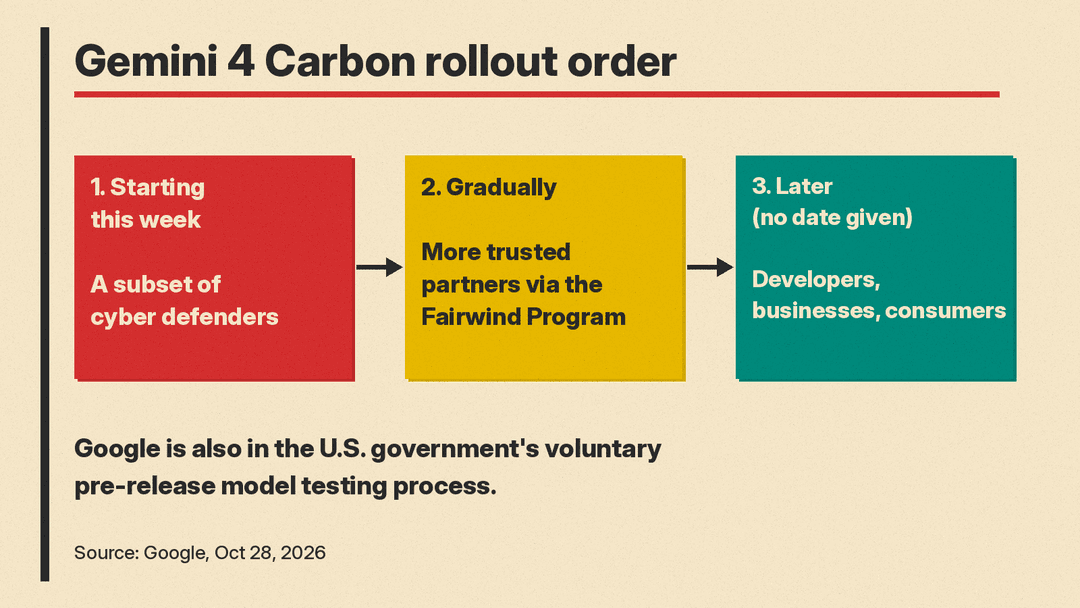
Google says it is "taking a deliberate approach to rollout" and is "actively engaged in the U.S. government's voluntary process for pre-release model testing." The launch post sets out the order:
- Starting this week: "a subset of cyber defenders."
- Next: Google "will gradually phase access to additional trusted partners through our Fairwind Program."
- Later: developers, businesses and consumers "via our product surfaces as soon as possible," after Google gathers feedback and works on guardrails.
Google gives no date for the wider release. The Verge reports: "It's currently only available to a select group of cybersecurity defense companies, but it will eventually expand to other partners in its Fairwind Program."
The Fairwind Program is Google DeepMind's limited-access route for security work. Its page says it gives priority to governments and national cyber authorities, critical infrastructure operators (it names healthcare, telecommunications, energy and financial networks) and core technology platforms. Google says it vets every applicant for "a proven track record of ethical operations and research." Partners must use phishing-resistant multi-factor authentication. They may give model access only to internal cybersecurity, incident response or penetration testing teams, and they may not share or resell access. The page says the program has "over 650 partners globally." Today it describes partner access to Gemini 4 Argon and CodeMender, Google's code security agent. It does not yet describe Carbon.
What Google says Carbon does better
Google says Carbon was "designed to take on much harder, long-horizon engineering problems" and is "built for sustained agentic workflows." Google says its own teams "have seen Carbon run for days" on tasks such as root-causing and patching subtle bugs across large codebases.
The headline numbers in the launch post:
- Artificial Analysis Intelligence Index v5.0: Carbon ranks first with a score of 59. Artificial Analysis reported the same score in its own post, and our post on Intelligence Index v5 covers the full rankings.
- WebDev Arena: up 89 Elo points, to fourth place at 1768.
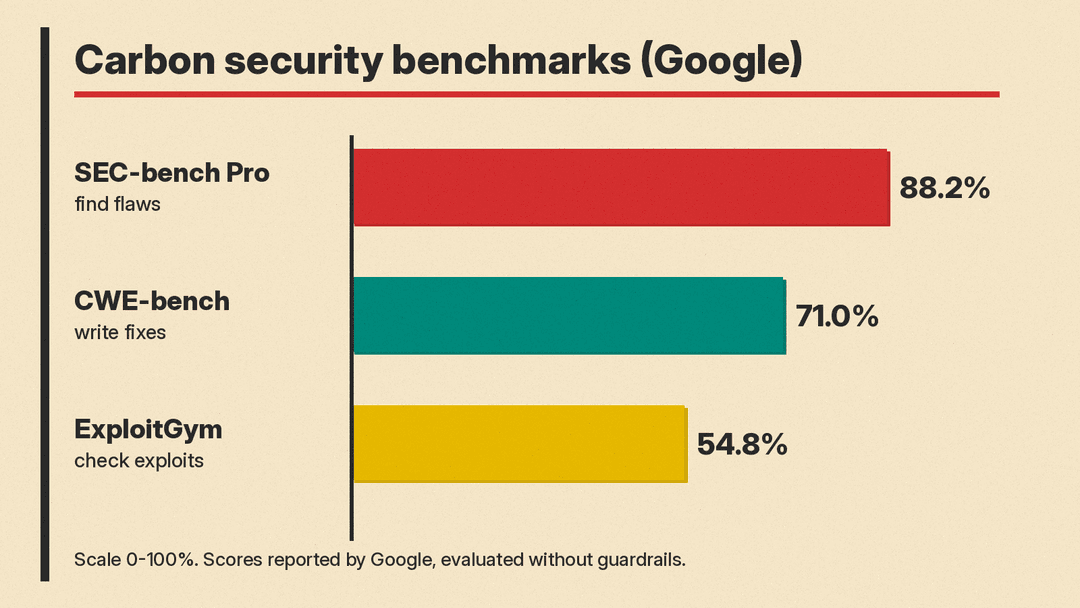
- SEC-bench Pro (finding real vulnerabilities): 88.2%.
- ExploitGym (checking which flaws can be exploited): 54.8%.
- CWE-bench from Collinear (writing fixes): 71.0%.
Google notes that the three security benchmarks were "evaluated without guardrails."
Google also cites internal results. It says Carbon has "more than 2x uplift in success rate for generating secure code over Argon." It says the Chrome team "reported that Carbon performed more than 10X better than another lab's large frontier model when generating high quality patches." Google does not name the other lab or model.
Safety claims
The launch post gives several alignment numbers, all reported by Google:
- On Terminal-Bench 4.0, Google says successful cheating fell to 0.0%, and attempts to cheat fell to 0.4%.
- In live coding work with internal teams, "high-severity misalignment alerts dropped by almost 80%."
- Carbon "cuts unsupported claims by approximately 2x over Argon," Google says.
- Overreach fell by 26% and under-service by 29%. Google reports both under the heading "Following through without overstepping."
- On Gray Swan's Indirect Prompt Injection benchmark, Google says Carbon had a 0.0% attack success rate, down from 0.7% for Argon.
Price
Google says Carbon "will launch at the same introductory price as Argon": $2 per million input tokens and $10 per million output tokens. Cached input tokens cost 95% less than normal input tokens. When the introductory period ends, the price goes up to $4 per million input tokens and $20 per million output tokens. Google does not say when the introductory period ends. For how tokens are counted, see our explainer on tokens. If you use the Gemini API today, also check its new request storage default.
Why it matters
The order of the rollout says the most. Google is putting a frontier model in the hands of vetted security teams before it reaches the public. It also says it is taking part in voluntary U.S. government pre-release testing. The Fairwind page says frontier models can help people quickly find and fix critical vulnerabilities, then adds: "But in the wrong hands, the same capabilities can become an equally powerful threat."
For most readers, nothing changes yet. Carbon is not in the Gemini app or the public API today, and Google has not given a date. If you build on Gemini, keep Argon for now and watch Google's channels for Carbon access.
Two points to keep in mind. First, every benchmark and safety number here except the Artificial Analysis score comes from Google, and some come from internal tests that outsiders cannot run. Second, Google's security scores were measured without guardrails. The model that developers and consumers get may act differently.
Outside testers and developers reacted on launch day. Our roundup of what people are saying about Gemini 4 Carbon covers the leaderboard results and the complaints about access.
For how Carbon's prices, specs and Artificial Analysis scores compare with GPT-6 Astra and Claude Opus 5.5, see our three-way comparison.
