
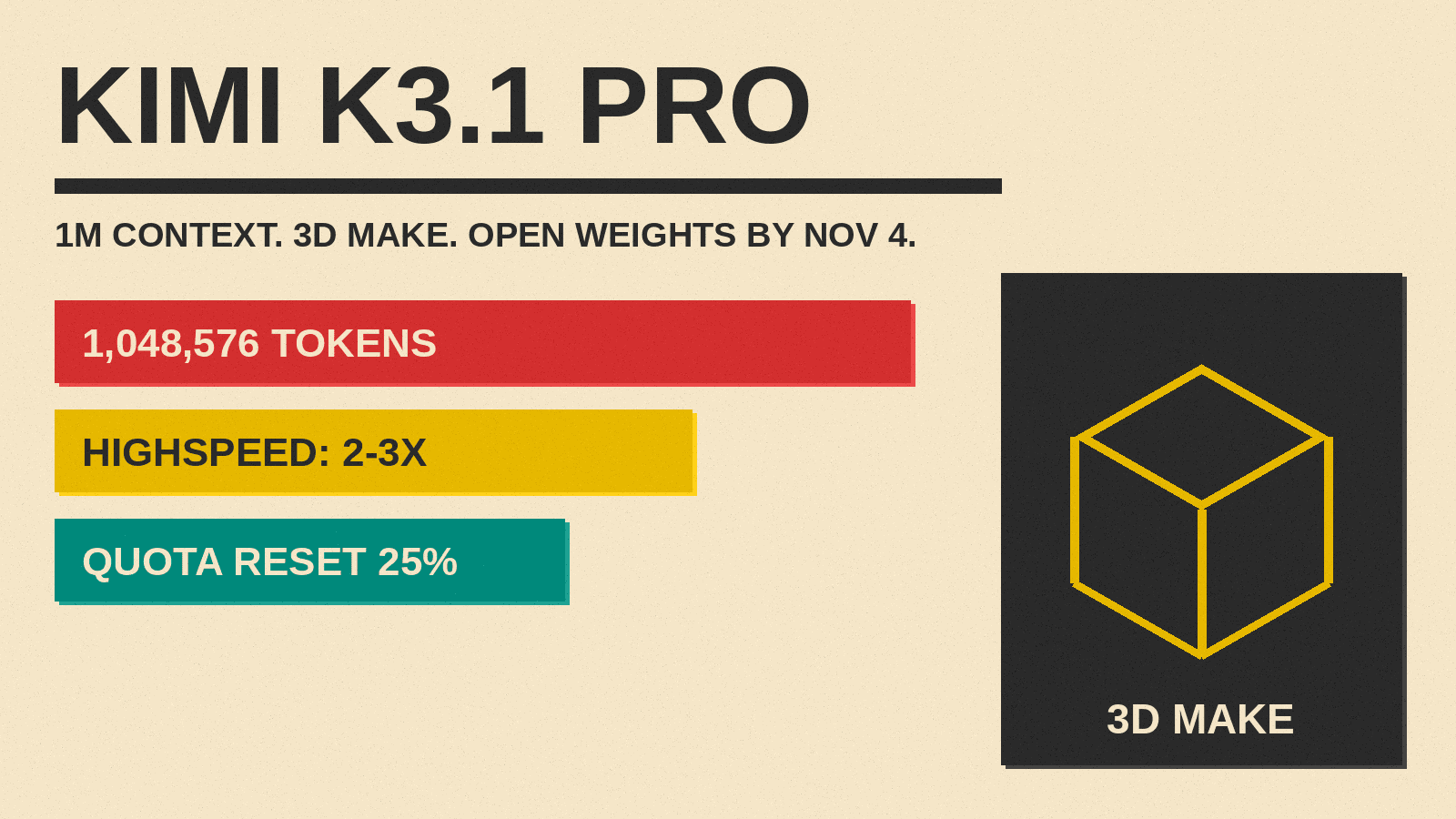
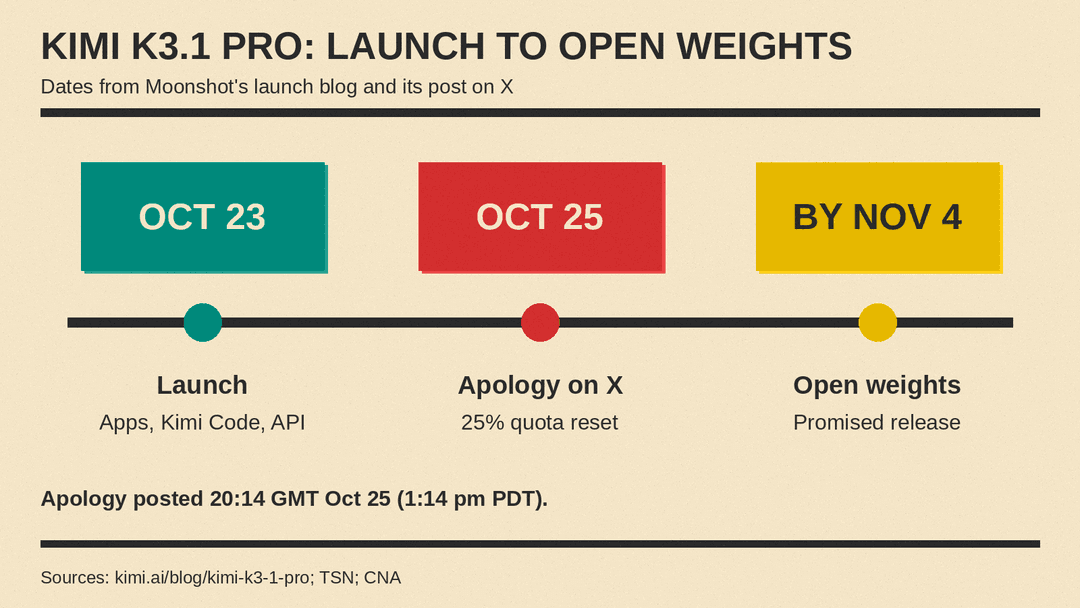
Moonshot AI released Kimi K3.1 Pro on October 23, 2026, and three days later it said sorry to the people paying to use it. The launch put a 1-million-token model with promised open weights into Kimi's apps and API. The apology, posted on the Kimi account on X on October 25 (early on October 26 in Beijing), admitted rate limits and wasted quota on the subscription plan and gave every subscriber part of a month back.
Here is what the model is, what it costs, what Moonshot's own numbers say, and what changed after the complaints.
What Kimi K3.1 Pro is
In its launch blog, Moonshot calls K3.1 Pro "the first model in our new K3.1 series and our most capable 3T-class open-weight model to date." It is not a new base model. Moonshot says it is "a post-trained version of Kimi K3, with substantially larger post-training compute," and describes that work as large-scale reinforcement learning. Our Kimi K3 launch report covers the base model.
Key facts from the blog:
- Context window: 1 million tokens. The pricing page lists 1,048,576 tokens for both API models.
- A second variant, K3.1 Pro Highspeed, which Moonshot says "delivers 2-3× the speed of K3.1 Pro."
- Where it runs: Kimi.ai, the Kimi mobile apps, the Kimi Work desktop app, Kimi Code and the Kimi API.
- Open weights: "The full model weights will be released by Nov 4, 2026." Until then, TSN notes, the model can be used only through Kimi's own services.
- Enterprise: Kimi Enterprise administrators must switch it on. Access is off by default.
The 3D Make feature
The new consumer feature is 3D Make, which Moonshot says is "now live on kimi.ai and the Kimi app." Users can preview and edit 3D models online, download them for 3D printing, or export them as videos or Live Photos.
Moonshot says the model can build 3D assets from a text brief, sketch or reference image, and can write and run scripts for tools such as Blender and CAD software. On BenchCAD, a test of rebuilding 3D objects from multi-view images through CAD code, Moonshot reports 92.7% with tools, against 96.2% for Claude Opus 5.5 and 95.9% for GPT-6 Astra. Those are Moonshot's figures from its launch blog. Its footnotes say open models were tested on a 1,000-case subset of the full dataset, while the Claude and GPT scores were taken from those companies' own reports.
Benchmarks, as Moonshot reports them
All figures below come from Moonshot's launch blog, at maximum reasoning effort unless noted. They are Moonshot's own numbers.
- Terminal-Bench 4.0 (coding agents on terminal tasks): 65.7%, ahead of GPT-6 Astra at 58.2% and behind Claude Opus 5.5 at 66.4%. Kimi ran its model in the Claude Code harness.
- Kimi Code Bench 3.0 Long-horizon, an internal Moonshot test: 61.2%, up from 55.95% for K3.
- OfficeQA Pro v2 (financial document analysis): 64.4, which Moonshot calls state of the art.
- Kimi Hallu Bench Hard, an internal stress test: claim-level hallucination rate fell from 23.4% for K3 to 8.3%. Moonshot notes the test is built to provoke errors and the rates "do not represent overall error rates in daily use."
Two of these are internal benchmarks that outsiders cannot run. Treat them as Moonshot's claims, not as rankings.
Cyber controls before the open release
The blog has a section on cybersecurity. Moonshot says vulnerability research performance kept improving as post-training scaled, and it traced this to cyber-related content in its mid-training data and RL tasks, so for the open-weight release it removed that data from both mid-training and reinforcement learning.
On its in-house xdev-bench-hard test of exploit development, Moonshot says a checkpoint without these controls solved 90.5% of problems (pass@3), while the final K3.1 Pro solved 81.0%. The company says the model's offensive cyber capability "remains behind that of frontier proprietary models that have been publicly available for at least three months," and that it aims not to release open weights that "would extend the absolute frontier of cyber capability."
Pricing
According to Kimi's pricing page, with rates the page says were checked on October 24, 2026:
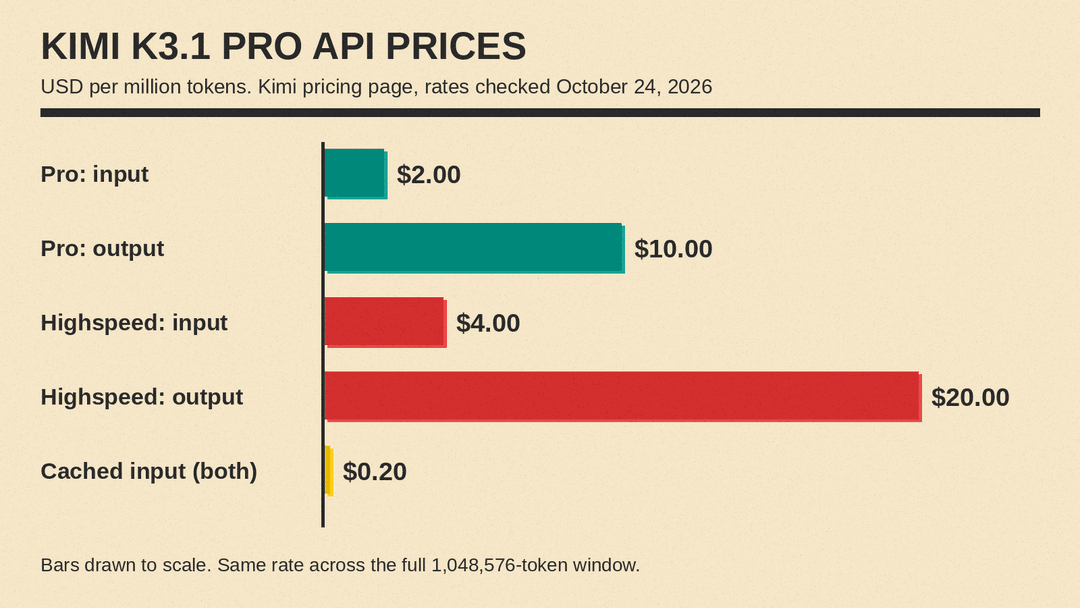
- kimi-k3.1-pro: $2.00 per million input tokens, $10.00 per million output tokens, $0.20 per million cached input tokens.
- kimi-k3.1-pro-highspeed: $4.00 input, $20.00 output, $0.20 cached input.
- No context-length tiers: the same rate applies across the full window.
For consumers, the same page lists Plus at $15, Pro at $31, Max at $79 and Ultra at $159 per month on annual billing. Free users get "limited usage" of K3.1 Pro on the web and Kimi Work. Highspeed starts at the Pro tier.
TSN reports the API price is below the $3 input and $15 output it lists for K3.
The rate limit apology
Within days, users complained about high costs and rate limits, as the Weekly Dose of China Tech newsletter reported. On October 25 at 20:14 GMT (1:14 pm PDT), the Kimi account on X posted: "We're sorry for the rate limits and unnecessary quota consumption on the K3.1 Pro subscription plan. These were our issues, and we should have fixed them sooner," as quoted by TSN.
The remedy, per TSN and CNA:
- Every subscriber on every plan gets a one-time reset restoring 25% of their monthly quota, which Kimi said equals one week of usage.
- Subscribers who had used less than 25% reset to zero.
- Kimi changed the plan's settings to cut unnecessary subagent calls (where the model hands parts of a task to helper agents) and to shorten output length, so quota lasts longer.
Moonshot did not say what the new settings are, how long the limits had been in place, or how many subscribers were affected. Reuters, in a report carried by CNA, notes that Moonshot had computing capacity problems after the K3 launch too, and that Chinese AI labs face compute shortages under US chip export controls.
Why it matters
Moonshot says K3.1 Pro "matches or approaches the strongest proprietary models" across coding, agentic and knowledge benchmarks, and it plans to publish the weights. The quota episode shows the cost side: Moonshot changed the plan's settings so quota lasts longer, and TSN notes that trimming subagent calls and output length may also change how the model behaves on long tasks. For other open-weight models you can run today, see our best open-source LLMs guide.
Three things to watch next:
- Whether the full weights ship by November 4, as promised.
- Whether independent leaderboards confirm Moonshot's Terminal-Bench and BenchCAD figures.
- How the open release fits China's proposed AI export controls. Under the draft rules, as llms.blog reported, work already made public through open source is not covered, and future open-source releases get "automatic licensing", a registration step rather than a ban.
Sources
- Kimi K3.1 Pro launch blog (Moonshot AI)
- Kimi K3.1 Pro pricing page
- TSN: Kimi K3.1 Pro launches, weights due by 4 Nov, with Oct 26 update
- CNA: Moonshot resets subscriber quotas after Kimi K3.1 Pro launch issues
- Weekly Dose of China Tech, Oct 26, 2026
- AI Affairs: Moonshot AI apologises for Kimi K3.1 Pro rate limits
