
AI data centers have flipped the flash memory market. Demand from AI hyperscalers has quintupled flash prices in the past year, according to research firm TechInsights, and the buyer that long set the terms, Apple, now pays far more for the same chips. The Wall Street Journal reported the shift on October 28, in a story by Rolfe Winkler built on TechInsights estimates, the Journal's own analysis and people familiar with Apple's procurement.
Flash is the storage chip (NAND) that holds photos, apps and music on a phone. AI data centers buy it too. That shared supply is the point of the story: when hyperscalers bid for it, phone makers pay the new price.
The numbers
All figures below come from the Journal's report, which cites TechInsights estimates unless noted.
- Prices: demand by AI hyperscalers has quintupled flash prices in the past year.
- Who buys: two years ago, Apple bought nearly twice the flash storage of Microsoft, Amazon, Meta and Google combined. Hyperscalers are now buying double Apple's share.
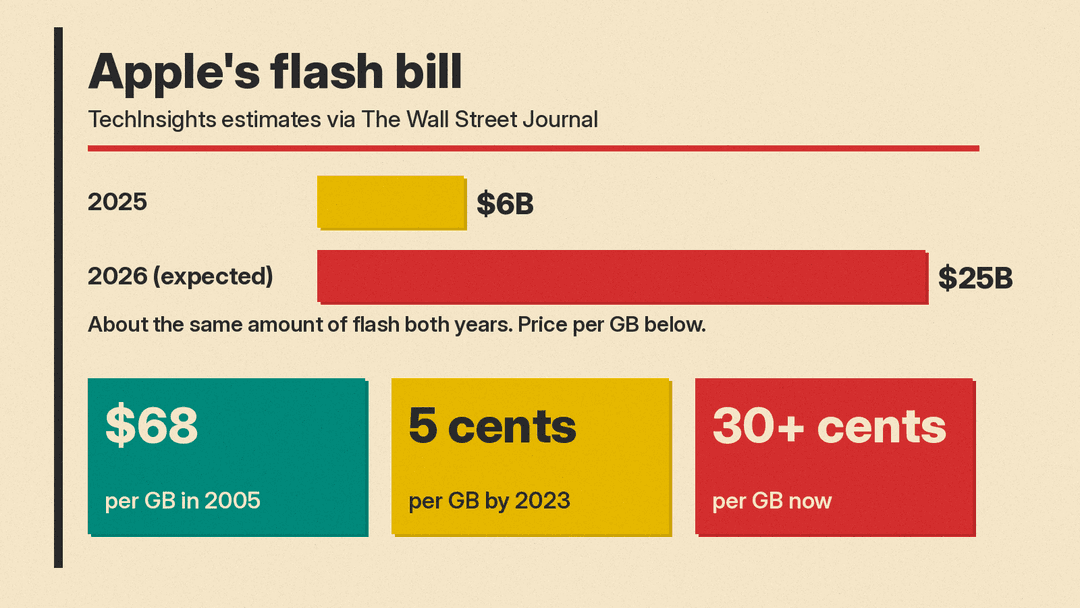
- Apple's bill: Apple is expected to spend $25 billion on flash storage this year for about the same amount it bought for $6 billion in 2025.
- Price per gigabyte: flash that cost $68 a gigabyte in 2005 had fallen to a nickel by 2023. AI demand has lifted it to more than 30 cents a gigabyte, which the Journal calls a 550% jump.
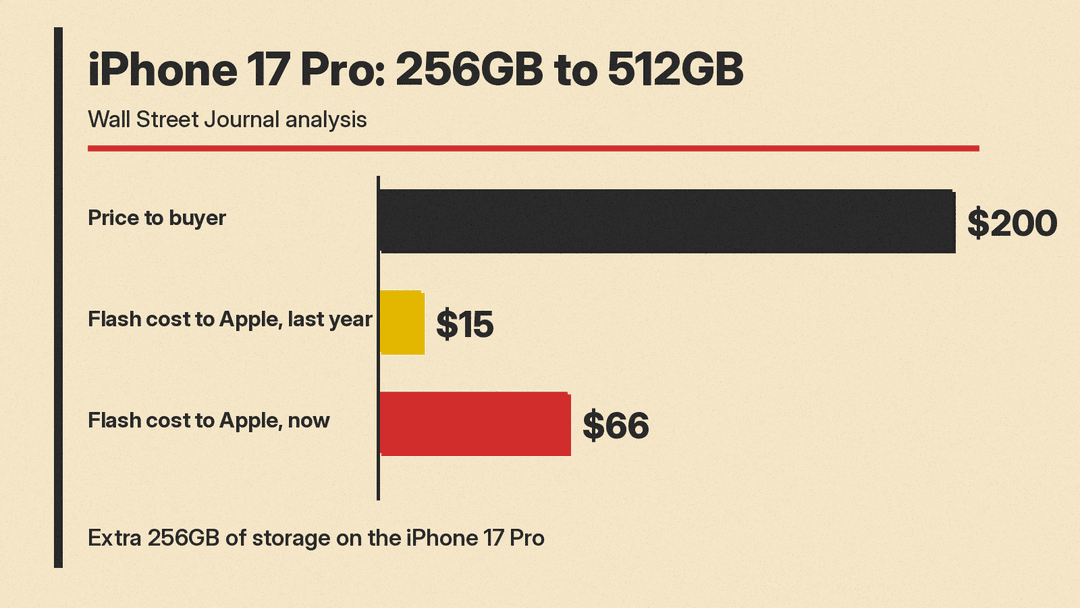
- One iPhone upgrade: buyers of the iPhone 17 Pro paid Apple $200 last year for double the storage of the 256-gigabyte base model. That extra storage cost Apple $15 at the time and has since shot up to $66, according to the Journal's own analysis.
Why hyperscalers can outbid Apple
The Journal gives two reasons. Flash storage is a smaller part of building a data center than making an iPhone. And accounting rules let companies spread the cost over years.
The big buyers have also locked in supply. Meta, Microsoft and Amazon signed contracts with Kioxia this year to secure long-term supply by committing to higher prices, the Journal reported. Those contracts protect Kioxia's profits if the market turns. Kioxia declined to comment.
This matches what memory makers said in their own results this week. Samsung said its 2027 HBM supply is sold out, and SK hynix said its long-term deals with 14 major customers cover more than half of its 2027 and 2028 production capacity. HBM is a different memory product from NAND flash, but the pattern is similar: large AI buyers lock in supply years ahead, and other customers compete for what is left.
How Apple held the leverage before
For years the balance went the other way. As the iPhone took off, Apple staked a claim on more than a fifth of the world's flash supply, spending $3 billion to $4 billion a year, according to TechInsights, and became the world's largest buyer.
The Journal describes several tactics, citing people familiar with Apple's procurement practices and agreements:
- Flash makers typically had to name Apple a "most favored customer," which guaranteed that no other buyer got a lower price. Apple could audit suppliers' books to check.
- Apple caught Micron selling flash at cheaper prices to another customer and won an arbitration settlement worth tens of millions of dollars more than a decade ago, people familiar with the dispute told the Journal.
- After ordering flash at rock-bottom prices, Apple would at times refuse delivery if prices were falling, leaving suppliers with unsold chips.
The executive behind that strategy was Tony Blevins, Apple's head of procurement, who left Apple in 2022.
"Apple has historically driven a very hard bargain with memory suppliers," Walt Coon, an analyst at TechInsights, told the Journal. "And there's no shortage of satisfaction among suppliers now that the balance of power is shifting."
Apple said in a statement: "We've worked with many of our suppliers for decades, and we deeply value their partnership over the years. We look forward to continuing our important work together."
What it costs Apple and its buyers
Storage upgrades have long been very profitable for Apple. The Journal found Apple recorded an average gross profit of more than 80 cents for every dollar it charged iPhone and iPad buyers for extra storage, from the first release of those devices through 2025. Roughly 100 million iPhone buyers paid for storage upgrades last year, according to IDC estimates cited by the Journal.
That margin is now under pressure. The $200 storage step on the iPhone 17 Pro carried $15 of flash last year and would carry $66 at current costs, by the Journal's analysis. Tim Cook, Apple's executive chairman, compared escalating memory chip prices to a "100-year flood." The Journal also reported that Apple had ignored analysts' warnings and was caught off guard, according to people familiar with its procurement practices.
In recent months Apple raised prices for nearly all of its products, the Journal reported. iPhone prices rose an average of 13%, and the increase included older models, which typically get a price cut.
Why it matters
The AI build-out is no longer only a story about GPUs and power. It now reaches the parts list of consumer devices. When hyperscalers sign multi-year contracts at higher prices, they take supply that Apple used to get cheaply, and the cost shows up in what people pay for storage.
The Journal frames the open questions this way. For Apple, it is whether consumers react to higher prices by keeping their iPhones longer or keep buying at their usual pace. For flash makers, it is when, or if, Apple will regain its leverage in the flash market.
"It's been a love-hate relationship between Apple and the flash industry," Mark Newman, an analyst with Bernstein Research, told the Journal.
Sources
- The Wall Street Journal: The Beleaguered Chip Sellers Getting Their Revenge on Apple
- Yonhap News Agency: Korean summary of the Journal report
- Kanebridge News: the Journal report, republished
- llms.blog: Samsung Q3, HBM4 Sales Triple, 2027 HBM Sold Out
- llms.blog: SK hynix Q3, Revenue Tops 100 Trillion Won on HBM4
