
Liquid AI has released LFM3, a new family of small open-weight models built to run on phones, laptops and other edge devices. The launch post on Hugging Face, published October 27, 2026, describes six models in the 2B class: one for text, one for vision, one for audio, one omni model that handles all three, and two "decision" models. All six branch from a single 1.7B base model, and the weights are in the LFM3 collection on Hugging Face.
The pitch is not that LFM3 beats frontier models. It is that a small model can be cheap to fine-tune on one GPU and then run where your app runs, with no cloud call.
What is in the family
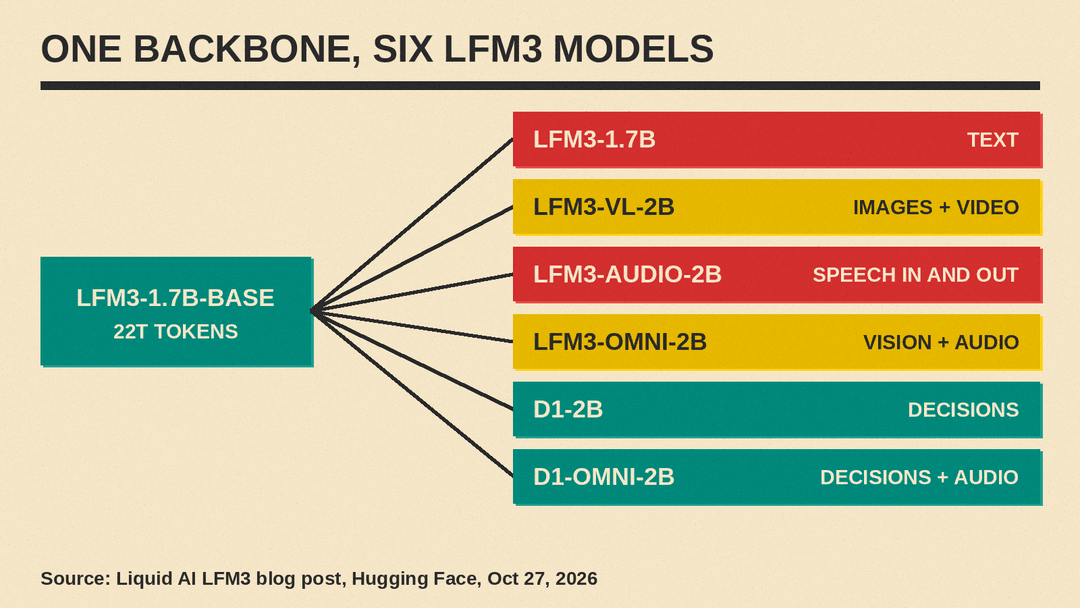
Liquid lists six models, all built from LFM3-1.7B-Base:
- LFM3-1.7B: text in, text out. Aimed at local agents, tool calling and structured outputs.
- LFM3-VL-2B: text, images and video in, text out. It is the first Liquid vision model that takes video.
- LFM3-Audio-2B: text or audio in, text or speech out. Liquid says it covers voice chat, speech recognition, speech synthesis and translation across 18 languages.
- LFM3-Omni-2B: text, images, video and audio in, text and speech out. This is Liquid's first omni model.
- d1-2B and d1-omni-2B: decision models. You give them a situation, such as a support ticket or a photo, plus a list of questions, and they answer all of them in one forward pass, each with a calibrated probability.
The omni model is the most practical idea here for app builders. Liquid says it can replace a stack of a separate speech recognition model, vision-language model, LLM and text-to-speech model with one on-device model that sees, listens and talks back.
What changed under the hood
LFM2, the previous generation, mixed short convolutions with attention to stay fast on devices. For LFM3, Liquid says it used its hardware-in-the-loop architecture search across 14 device and backend combinations, from phones and a Raspberry Pi 5 to laptops, cloud CPUs, GPUs and the Qualcomm Hexagon NPU.
The result is what Liquid calls a tri-hybrid layout. The 24-layer base model has 13 gated short convolution layers, 5 sliding-window attention layers with a 256-token window, and 6 global attention layers. Other changes include a sigmoid gate on each attention head (which Liquid says can help suppress activation outliers that hurt quantization), partial RoPE on the global attention layers, and normalization on both the input and output of each block.
The base model was pre-trained on 22T tokens. The last 3.5T tokens were a mid-training stage with more agentic traces and tool calls, which also extended the context window to 256K tokens. Liquid says the text model fits in about 1 GB at 4-bit precision.
On speed, Liquid says that per parameter LFM3-1.7B matches LFM2-1.2B on short prompts across edge devices and is about 25% faster with 8K tokens in context.
The numbers Liquid reports
All of the figures below come from Liquid's own launch post. No independent evaluation was available at the time of writing.
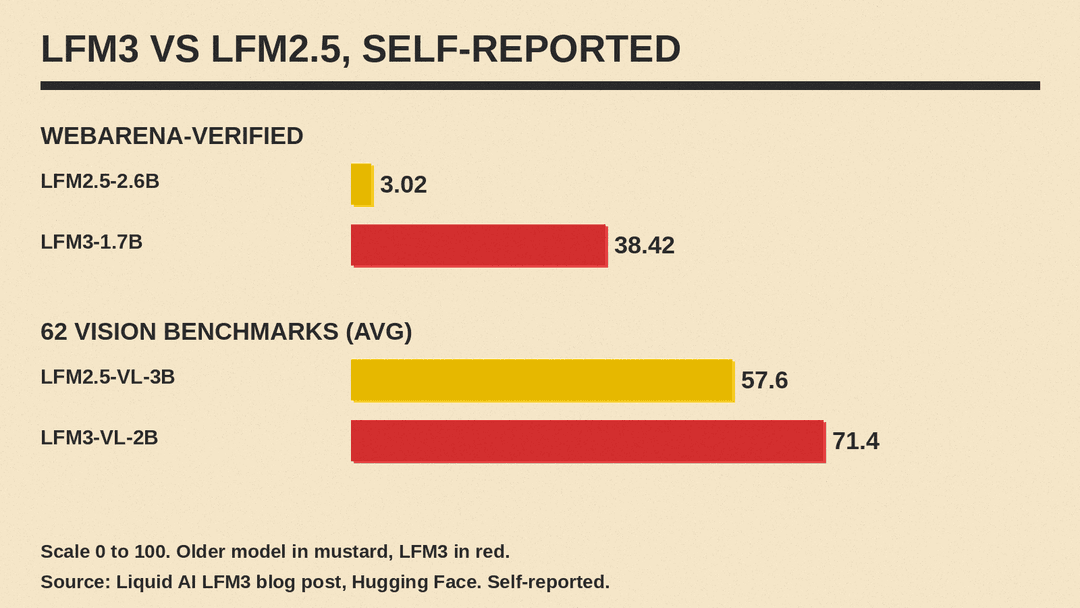
- LFM3-1.7B scores 38.42 on WebArena-Verified, against 3.02 for LFM2.5-2.6B, while using 35% fewer parameters. Liquid also says it beats Qwen3.5-9B on long tasks in browsers and business apps.
- LFM3-VL-2B (1.9B parameters) raises the average across 62 vision benchmarks from 57.6 for LFM2.5-VL-3B (3.1B parameters) to 71.4. Liquid says that puts it on par with Gemma 4 12B.
- LFM3-Audio-2B scores 3.83 on the UTMOSv2 speech quality measure, against 3.22 for LFM2.5-Audio-1.5B.
- LFM3-Omni-2B, Liquid says, beats models up to 10.7B parameters, such as Qwen2.5-Omni-7B, on Daily-Omni, WorldSense and AV-SpeakerBench.
- d1-2B scores 75.5 on ImajevBench against 64.0 for the older d1-3B, with a third fewer parameters.
Liquid also built new encoders. Its 164M-parameter vision encoder, it says, uses 3x less compute than the SigLIP2 encoder in earlier LFM vision models. The audio encoder is fully causal, so the model can start processing while you speak, with time to first token as low as 50 ms. A new audio tokenizer, LiquidCodec, turns tokens into speech at about 87x real time on a single CPU thread on an Apple M4 Max, according to the post.
How to run and fine-tune it
Each model runs in Hugging Face transformers, and the model cards list other supported engines. Liquid has already posted GGUF and MLX builds in its Hugging Face account, which matters for people who run models locally with llama.cpp-based apps or on Macs.
Liquid frames LFM3 as a starting point for specialized models. It says every model can be fine-tuned on a single GPU, and it published Colab notebooks for tasks such as extracting JSON from messy documents, tool calling in a 108-tool phone app, and teaching the text model a new language (Turkish) from raw text.
One thing to check before you ship: the license. The model metadata on Hugging Face lists the license as "other," with the name lfm1.0, not a standard open-source license such as Apache 2.0 or MIT. Read the license file on the model page before commercial use.
Why it matters
Most open-model news is about ever larger models that need a rack of GPUs. LFM3 goes the other way. If Liquid's numbers hold up in independent tests, a 2B-class model that handles voice, vision and tool calls on a laptop or phone would let developers build private, offline assistants without a server bill. The one-backbone design also means a team can fine-tune the same base for several input types instead of juggling unrelated models.
The caveats are the usual ones for a launch day: every benchmark is self-reported, and the custom license needs a careful read.
