
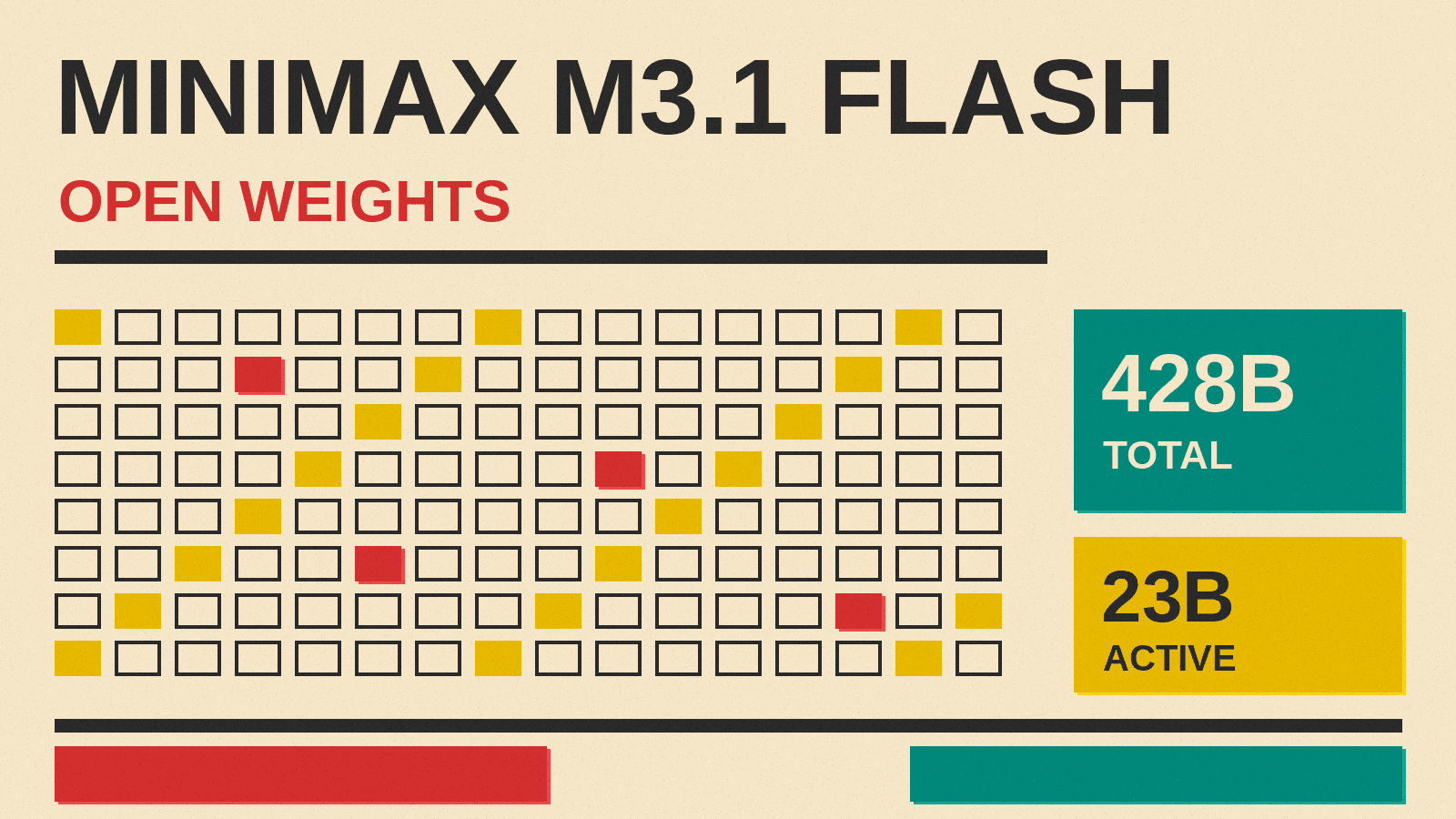
MiniMax has put the full weights of MiniMax M3.1 Flash on Hugging Face. When we covered the launch on October 19, the model was API-only and the weights were "coming later." The repository's first commit is dated October 23, 2026 (UTC), and the download is not gated: there is no access form to fill in.
The release matters for two reasons. It is a 428B-parameter agent model you can now host yourself, and it ships under a custom license that is free for non-commercial use but adds conditions for businesses. "Open weights" here means you can download the model, not that you can use it however you like.
What the model is
According to the model card, M3.1 Flash is a native multimodal mixture-of-experts (MoE) model built for coding, agent workflows, computer use and cybersecurity.
- About 428B total parameters, with 23B active per token.
- Text, image and video input; text output.
- A context window of up to 1M tokens.
- MiniMax Sparse Attention in every layer. The card says the first three full-attention layers from MiniMax M3 were replaced with sparse attention.
- Quantization-aware training: the routed experts and attention paths were quantized during training to cut memory use.
- A built-in DSpark draft head for speculative decoding, a way to generate tokens faster. It replaces the earlier MTP approach.
The config file lists 60 layers and 128 experts, with 4 experts plus 1 shared expert used per token.
The benchmarks
All scores below come from MiniMax's own table on the model card. Nobody has independently reproduced them yet. The table compares M3.1 Flash with DeepSeek V4.1 Flash-1017, DeepSeek V4.1 Flash, Kimi K3, GLM-5.3, GPT-5.6 Sol and Claude Opus 5.
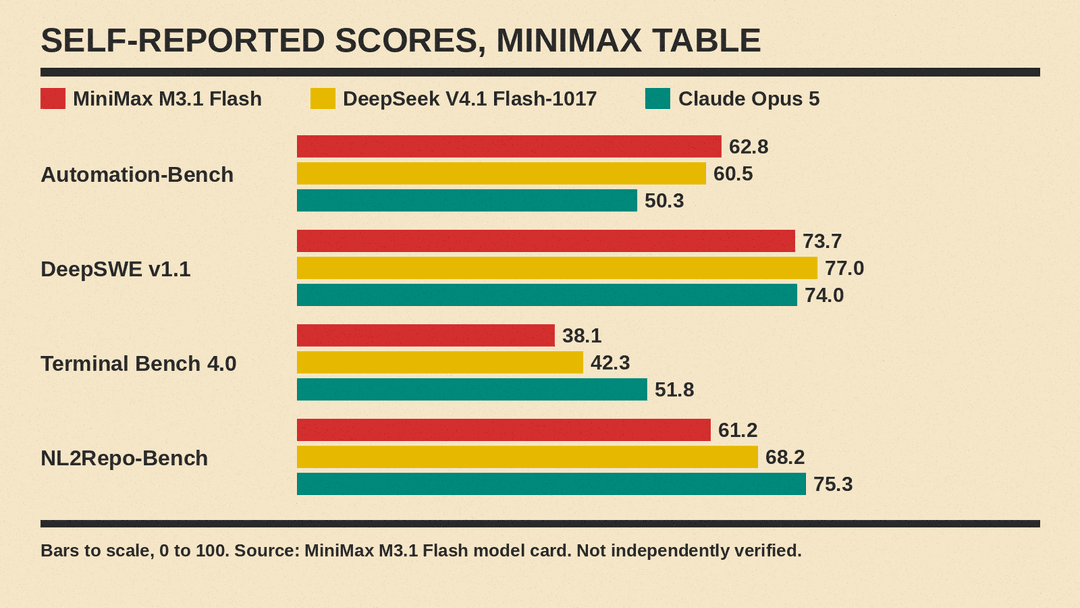
- Automation-Bench v1.0.6: 62.8, the top score in the table. DeepSeek V4.1 Flash-1017 has 60.5 and Opus 5 has 50.3.
- DeepSWE v1.1: 73.7, behind DeepSeek V4.1 Flash-1017 (77.0), DeepSeek V4.1 Flash (74.2) and Opus 5 (74.0).
- Terminal Bench 4.0: 38.1, behind DeepSeek V4.1 Flash-1017 (42.3), GPT-5.6 Sol (39.9) and Opus 5 (51.8).
- NL2Repo-Bench: 61.2, against 68.2 for DeepSeek V4.1 Flash-1017 and 75.3 for Opus 5.
- OSWorld 2.0 (computer use): 61.7, against 65.7 for GPT-5.6 Sol and 70.6 for Opus 5.
- BankerToolBench: 76.2, the same score as Opus 5.
The picture is a strong agent model that leads on some automation tests and trails the best closed model on most coding ones. The card also notes that its results are "for the official weights; third-party quantizations may differ."
What it takes to run
This is not a laptop model. By our sum of the file sizes listed on Hugging Face, the weight files come to about 252 GB. The vLLM recipe says the checkpoint stores MXFP8 dense layers and NVFP4 experts, and lists these setups:
- NVIDIA Blackwell (GB200, GB300, B200 or B300): 4 GPUs with tensor parallelism.
- AMD MI355X: 4 GPUs, with ROCm 7.2 or later.
- NVIDIA Hopper (H100 or H200): a full node of 8 GPUs.
MiniMax recommends SGLang, vLLM and TokenSpeed for serving. It says support in Transformers, KTransformers, unsloth and ATOM is "in progress." The card recommends a temperature of 1.0 and top_p of 0.95, and lets you set reasoning effort from low to max in the chat template. It also says usable context length and speed depend on GPU memory and the serving setup, so the 1M-token window is a ceiling, not a guarantee.
The license is the catch
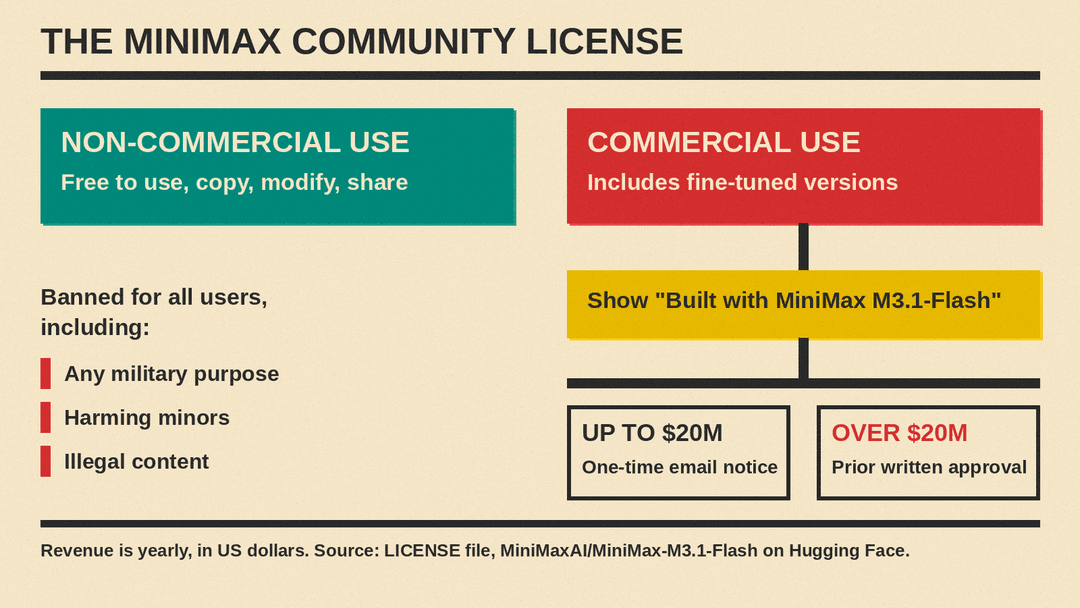
The MiniMax Community License grants rights to use, copy, modify and share the model "for non-commercial purposes." Commercial use is allowed only with conditions:
- You must "prominently display 'Built with MiniMax M3.1-Flash'" on a related website, interface, blog post, about page or product docs.
- If your products or services make more than 20 million US dollars a year, you need "separate, prior written authorization" from MiniMax.
- At or below that, you send MiniMax a one-time notice by email.
The license defines commercial use broadly. It covers paid products that rely on the model, commercial use of APIs built on it, and commercial deployment of fine-tuned or otherwise modified versions. A fine-tune does not escape the terms. An appendix also bans uses that include any military purpose and harming minors.
This follows a pattern on our beat. Mistral's Timestral license also draws its line at 20 million dollars, though per month. By contrast, Nanbeige shipped its 33B coding model under plain Apache 2.0 this week.
Who should care
- Researchers and hobbyists with big GPUs: free to use, study and fine-tune for non-commercial work.
- Startups: usable in a product, but you must show the credit line and send the notice. Have someone read the license file first.
- Large companies: above 20 million dollars in yearly revenue, plan on a conversation with MiniMax before you ship.
- Local LLM users: wait for smaller quantized versions and for the integrations MiniMax lists as in progress. Even then, a model this size needs far more memory than a typical desktop.
