
An AI voice generator turns typed text into speech that sounds like a person reading it. The same idea covers very different products: a studio app for YouTube voiceovers, a reading app that speaks your PDFs aloud, a cloud API that a developer calls from code, and a free model you run on your own computer. Picking the wrong type costs more than picking the wrong brand.
This guide sorts eight text-to-speech (TTS) tools by the job they do best. Prices and limits come from each maker's own pricing page, as of October 2026. Prices change often, so check the linked page before you pay.
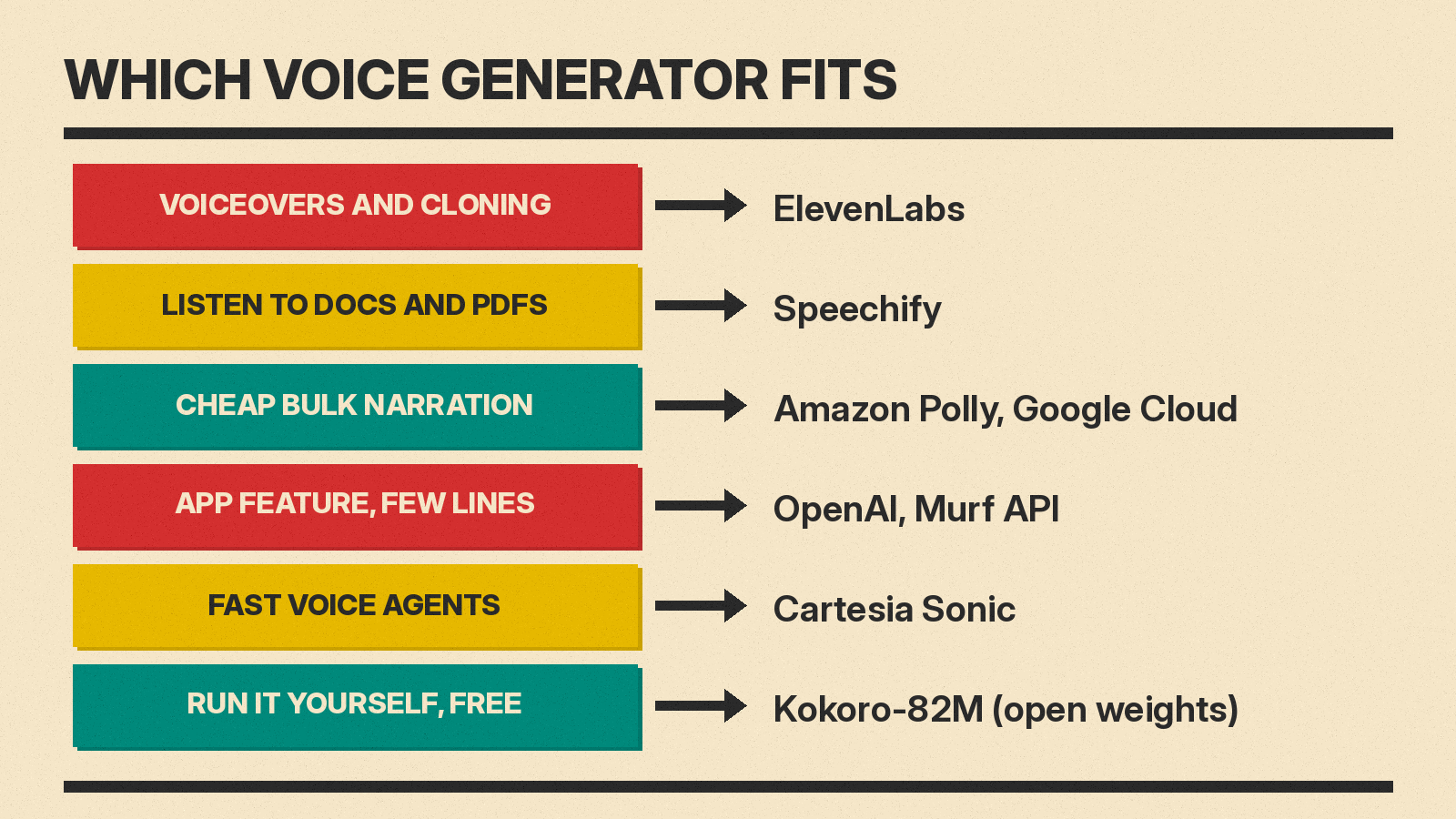
Quick picks
- Voiceovers, audiobooks and voice cloning: ElevenLabs
- Listening to documents, web pages and PDFs: Speechify
- Cheap narration at volume: Amazon Polly or Google Cloud Text-to-Speech
- Adding a voice to an app with a simple API: OpenAI or Murf
- Real-time voice agents: Cartesia
- Free, open weights you run yourself: Kokoro-82M
Apps for creators and listeners
ElevenLabs
ElevenLabs is an AI voice studio, and its pricing page now leads with Eleven v4, which the company calls "our most emotive model yet." One credit pool covers text to speech, speech to text, sound effects, music and dubbing, and text to speech uses about 1 credit per character on its standard models.
- Free: 10,000 credits a month, about 10 minutes of text to speech, with no commercial license.
- Starter: $6 a month for 30,000 credits. It adds a commercial license and Instant Voice Cloning. A pricing-page offer cuts the first month to $1 until November 1.
- Creator: $22 a month ($11 for the first month) for 121,000 credits, and it adds Professional Voice Cloning.
- Pro: $99 a month for 600,000 credits, with 44.1kHz PCM output through the API.
- Scale and Business: $299 and $990 a month for teams.
Unused credits on paid plans roll over for up to two months. We covered the company's agent voices in Eleven Realtime explained and its new caption timing model in ElevenLabs Cue.
Good for: YouTube narration, podcasts, audiobooks, and anyone who wants to clone their own voice. Watch for: the free plan has no commercial license, so a monetized video needs at least Starter.
Speechify
Speechify solves a different problem: it reads things to you. Its free plan offers speeds up to 1.5x and "10 robotic sounding voices." The paid plan costs $29 a month, or $139 billed yearly, and Speechify lists 1,000+ voices, 60+ languages, 5x listening speed, Scan & Listen for printed pages, AI summaries and chats, and Google Drive, Dropbox and OneDrive integrations. The paid plan also lists voice typing and AI podcasts.
Good for: students, people with reading difficulties, and anyone who wants to listen to articles and documents. Watch for: this plan is for listening. Speechify sells voiceover tools as a separate product, Speechify Studio.
Cloud APIs for developers and bulk narration
All of these charge by the amount of text you send, so a long audiobook and a short app prompt cost what their length says. Amazon's own pricing examples put 1 million characters at about 23 hours of speech.
Amazon Polly
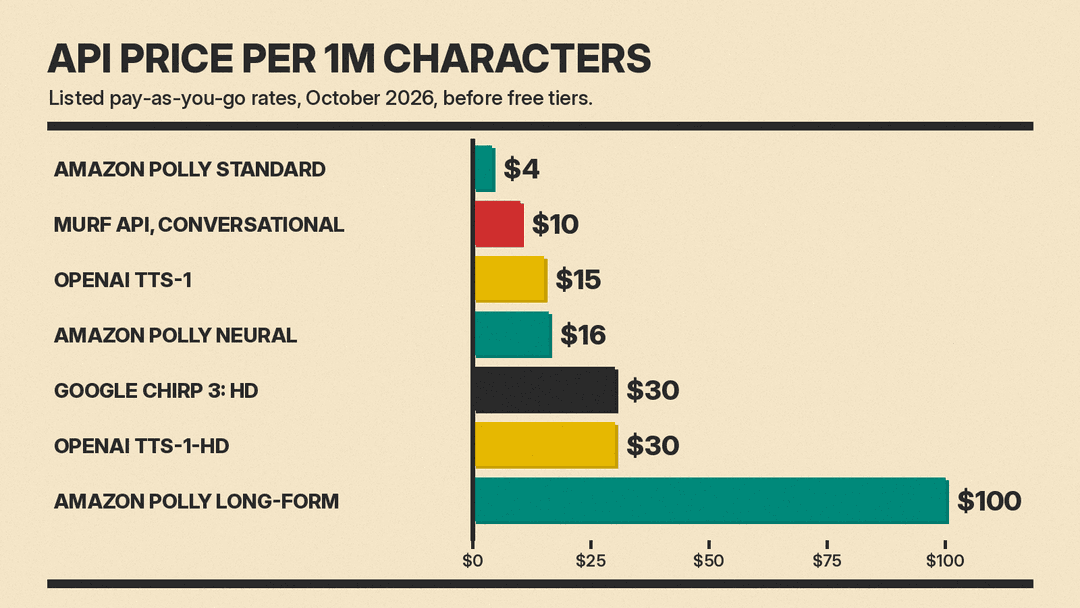
Amazon Polly has four voice types with four prices per 1 million characters: Standard $4, Neural $16, Generative $30 and Long-Form $100. The free tier includes 5 million Standard characters a month, and for the first 12 months 1 million Neural, 500,000 Long-Form and 100,000 Generative characters a month. AWS also says new customers since July 15, 2025 get up to $200 in Free Tier credits that can go toward Polly. Amazon's own example prices Charles Dickens' "A Christmas Carol" (about 165,000 characters and 3 hours 50 minutes of audio) at $4.95 with Generative voices.
Good for: large volumes of narration at a low, predictable price. Watch for: you need an AWS account and some setup.
Google Cloud Text-to-Speech
Google Cloud lists three groups of voices. Its legacy Standard and WaveNet voices cost $4 per 1 million characters after 4 million free characters a month. Chirp 3: HD voices cost $30 per 1 million characters after a free 1 million characters a month, and Instant custom voice costs $60 per 1 million characters. The newer Gemini-TTS models are billed in tokens and steered with text prompts. Gemini 3.8 Flash TTS (Preview) costs $0.50 per 1 million text tokens in and $9 per 1 million audio tokens out through December 31, 2026, and Google lists those rates doubling to $1 and $18 on January 1, 2027. Google counts 25 audio tokens per second, so $9 works out to about 1.4 cents per minute of audio before the text input charge.
Good for: apps already on Google Cloud, and creators who want to steer delivery with a written prompt. Watch for: the Gemini 3.8 TTS models are previews, and their listed price rises in January.
OpenAI
OpenAI's API lists three text-to-speech models. tts-1 costs $15 per 1 million characters and tts-1-hd costs $30. gpt-4o-mini-tts is billed in tokens: $0.60 per 1 million text tokens in and $12 per 1 million audio tokens out.
Good for: developers who want one vendor for text and voice. Watch for: there is no free tier on the pricing page and no consumer app for making voiceovers.
Murf
Murf is a voiceover studio with an API. The API tab of its pricing page lists two text-to-speech rates: $0.01 per 1,000 characters for a model "optimized for conversational AI and real-time voice agents with time-to-first-audio under 100ms," and $0.03 per 1,000 characters for "studio-quality speech synthesis." That is $10 and $30 per 1 million characters.
Good for: teams that want both a studio editor and an API from one company. Watch for: studio plans and API rates are priced separately, so check the tab that matches your use.
Cartesia
Cartesia builds the Sonic voice models for real-time voice agents. Its plans are Free (20,000 credits a month), Pro at $5 (100,000 credits, commercial license and instant voice cloning), Startup at $49 (1.25 million credits and pro voice cloning) and Scale at $299 (8 million credits). Sonic uses 1 credit per character, which Cartesia puts at about 750 to 800 credits per minute of audio, so Pro covers about 133 minutes of Sonic-3.6 speech.
Good for: phone agents and assistants that must start speaking fast. For other agent-focused voices, see our posts on AssemblyAI-TTS-1 and Deepdub Phantom Z 4.0. Watch for: paid overage rates run from $38 to $65 per 1 million credits, depending on plan.
Free and open: Kokoro-82M
Kokoro-82M is an open-weight TTS model with 82 million parameters and Apache-licensed weights, so you can use it in commercial projects. Version 1.0, released January 27, 2025, covers 8 languages and 54 voices. Its model card says it was trained only on permissive or non-copyrighted audio, and that hosted Kokoro APIs charged under $1 per million characters as of April 2025. The model card shows it running from a few lines of Python.
Good for: developers and hobbyists who want zero per-character cost and full control. Watch for: it ships with a fixed set of voices (54 in version 1.0) and no studio editor. Our open-source TTS comparison covers Kokoro next to F5-TTS, StyleTTS 2 and Fish Speech, and newer open models such as Hurston-1 target specific accents.
How to choose
- Decide if you are making a file or listening. Voiceovers and audiobooks need a generator with a commercial license (ElevenLabs Starter or above, Murf, or an API). Listening to your own reading needs an app like Speechify.
- Estimate your length. Count characters, not words. Using Amazon's examples, a typical news article is about 6,500 characters and a 224-page novel is about 600,000.
- Check the license. ElevenLabs' free plan has no commercial license, and Cartesia's starts at Pro. Read the plan page before you publish or monetize.
- Clone only voices you have the right to use. ElevenLabs and Cartesia include voice cloning on paid plans. Clone your own voice, or one you have written permission to use.
- Listen before you commit. Every tool here has a free tier, a demo or a pay-as-you-go option. Run the same paragraph through two or three and compare.
For a wider price table that also covers AI music tools, see AI voice and music pricing compared. If you need the opposite direction, speech into text, see the best AI transcription tools.
