
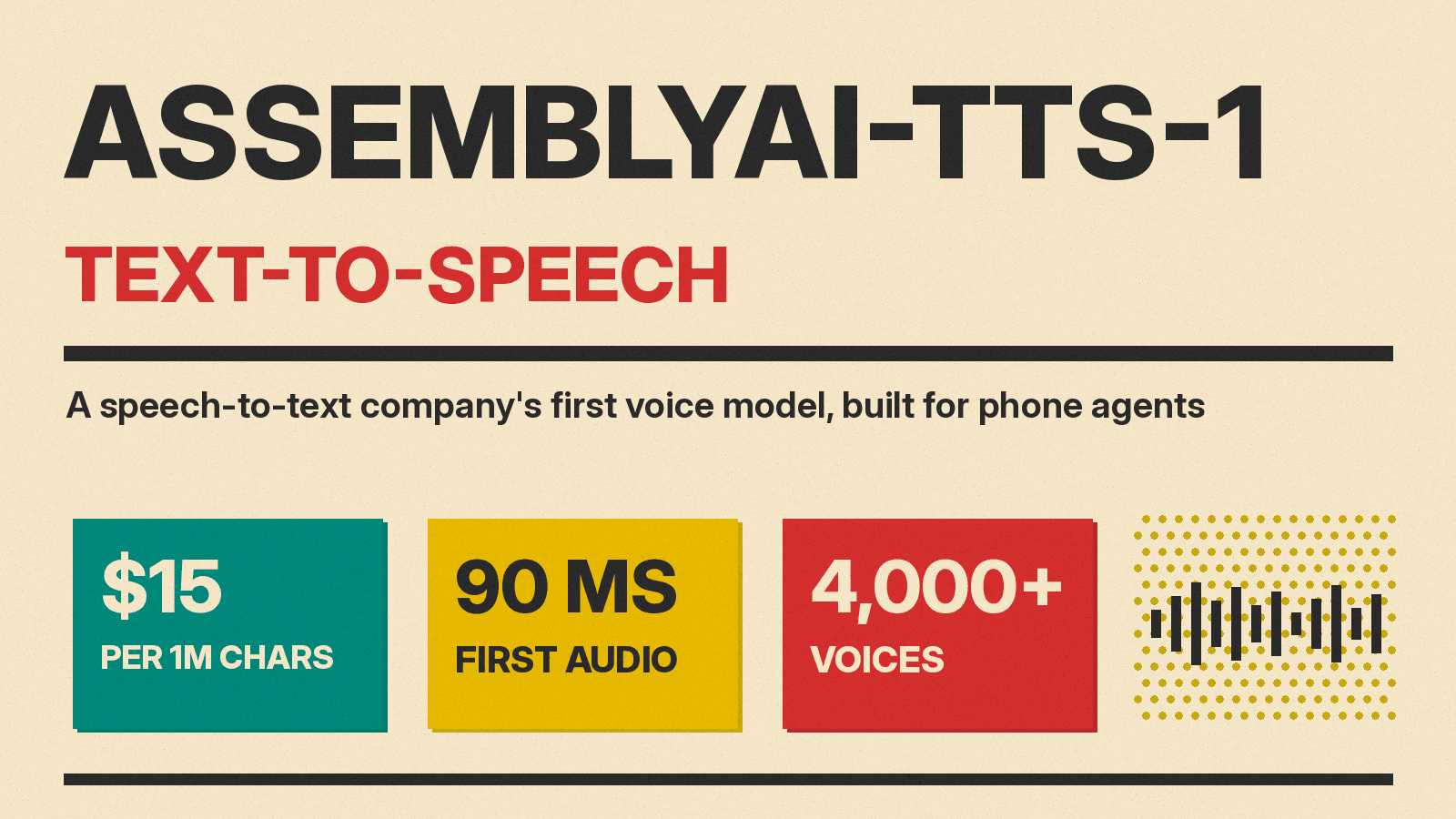
AssemblyAI, which sells AI that turns speech into text, now sells the reverse. On October 27, 2026 it made AssemblyAI-TTS-1 generally available: its first text-to-speech model, built for voice agents that answer phone calls. The pitch rests on three numbers: audio that starts in 90 ms, a list price of $15 per 1M characters, and unlimited concurrency with no annual contract.
Here is what the model does, how AssemblyAI's own benchmarks stack up against ElevenLabs, Cartesia and Inworld, and what is still missing at launch.
What AssemblyAI launched
AssemblyAI-TTS-1 is an API model. Developers send text and get audio back, either streamed over a WebSocket connection or as a full file from an HTTP endpoint. AssemblyAI says it built the model for voice agents on live calls, to keep callers on the line as businesses move phone traffic to AI agents.
The launch post frames the problem plainly. In AssemblyAI's words, "the moment they suspect they're talking to an IVR phone tree, they pound the 0 key and repeat 'representative.'" Its answer is a voice that sounds natural and starts speaking fast, priced low enough that the voice bill does not eat the business case for the agent.
Key facts from the launch post:
- Price: $15 per 1M characters of input text, billed on the characters sent, including spaces and punctuation. Every voice, every language, instant cloning, word timestamps and both data regions are included at that one rate. AssemblyAI says that is "about half of what you pay today." Its pricing page lists the same rate.
- Speed: 90 ms time to first audio in production. In a lab test, the median time to first byte was 47 ms. AssemblyAI's model guide calls the 90 ms figure an estimate that it will revisit as real traffic comes in.
- Concurrency: unlimited on pay-as-you-go. No spend commitment and no concurrency tier to buy. Volume pricing is available for committed usage.
- Voices: a library of more than 4,000 voices, plus instant voice cloning. The clone shown in the post was made from 24 seconds of audio. The model guide says most library voices are English.
- Languages: English, Spanish, French, German, Italian and Portuguese, with a range of accents in each. More languages and accents are promised "in the coming weeks."
- Data residency: US or EU, at the same price.
How it works
AssemblyAI says the model was trained on millions of hours of audio, including real conversational data. Its main technical claim is about how audio is represented. According to the company, many text-to-speech models turn audio into discrete tokens, which it says lowers quality and adds delay. AssemblyAI-TTS-1 instead "operates directly on continuous audio representations," which the company says improves realism and cuts the time to the first spoken sound.
For developers, the model streams audio from the first byte, supports a cancel message for barge-in (when the caller interrupts), and returns word timestamps. AssemblyAI publishes reference agents for LiveKit and Pipecat, two open-source voice agent frameworks, so teams can swap the TTS stage of an existing pipeline.
AssemblyAI's benchmarks
AssemblyAI tested its model against Cartesia Sonic 3.6, Inworld TTS-2, Inworld TTS-2 Flash, ElevenLabs v4 and ElevenLabs Flash v2.5. Every model spoke through the same pool of 50 cloned voices, so the company says differences come from the models, not the voices. These are the vendor's own figures, from an eval dated October 28, 2026.
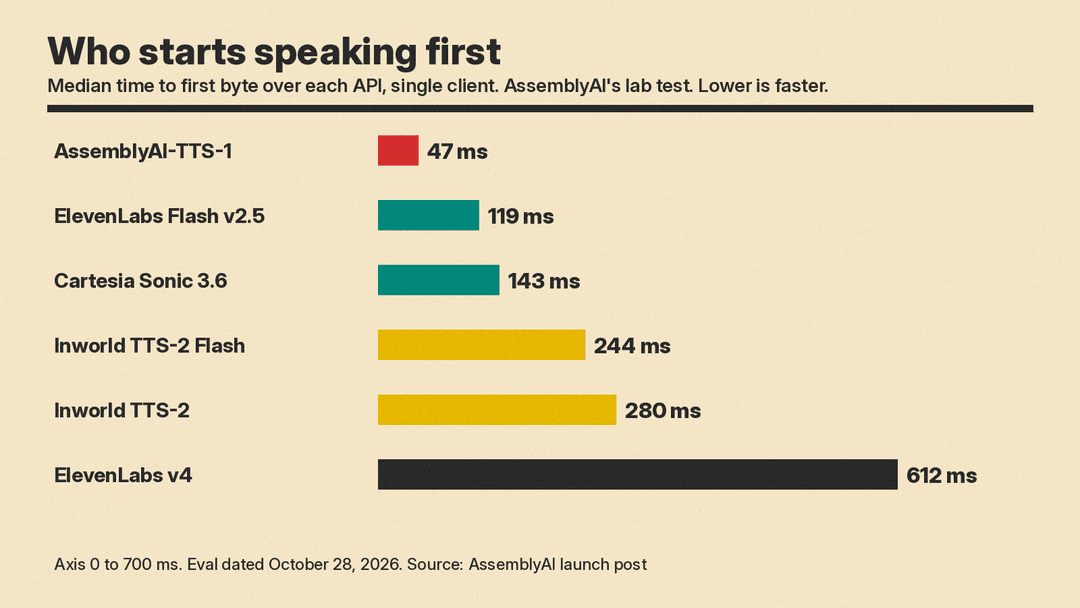
Speed. Measured from a single client, one request at a time, AssemblyAI-TTS-1 returned its first byte of audio in 47 ms at the median. ElevenLabs Flash v2.5 came next at 119 ms, then Cartesia Sonic 3.6 at 143 ms, Inworld TTS-2 Flash at 244 ms, Inworld TTS-2 at 280 ms and ElevenLabs v4 at 612 ms. AssemblyAI notes that this is a single-client lab measurement and that its 90 ms figure is the production number, with headroom for real network conditions.
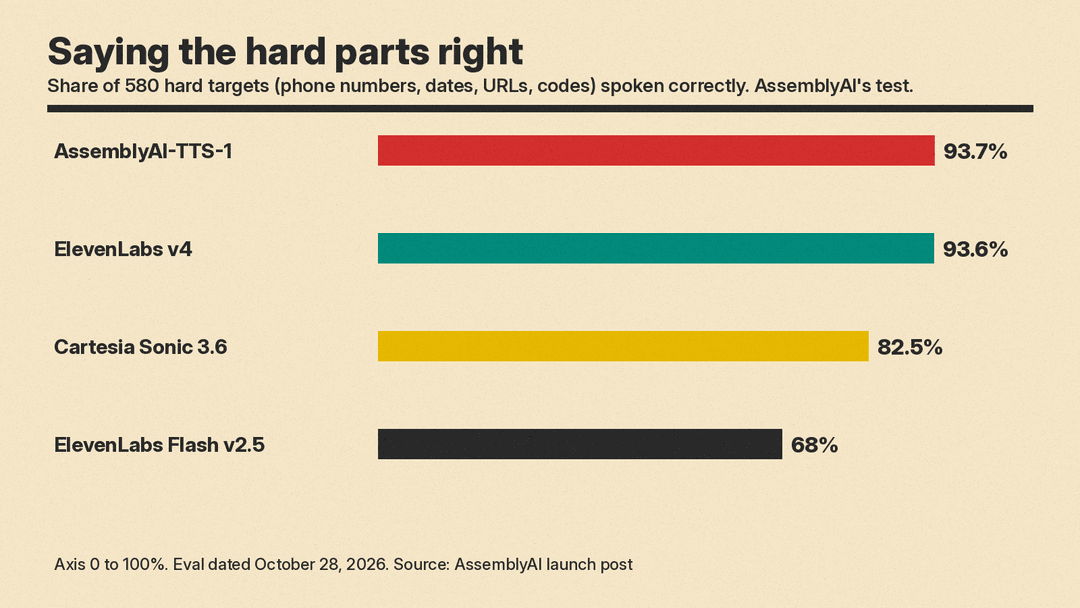
Hard words. For a phone agent, a wrong digit in a confirmation number means the caller has to ask again. AssemblyAI built a set of 580 sentences, each with one hard target such as a phone number, a date, a URL or a confirmation code. Its model said 93.7% of those targets correctly, against 93.6% for ElevenLabs v4, 82.5% for Cartesia Sonic 3.6 and 68.0% for ElevenLabs Flash v2.5. On plain sentences it scored 99.0% word accuracy.
Naturalness. Using automated predictors of listener ratings on a 1 to 5 scale, AssemblyAI-TTS-1 scored 3.85. Cartesia Sonic 3.6 scored 3.82, ElevenLabs Flash v2.5 3.70 and ElevenLabs v4 3.67. Inworld TTS-2 Flash scored slightly higher, at 3.88.
What outside tests say
AssemblyAI also points to three independent leaderboards. On Cekura's text-to-speech benchmark, which reads 104 agent sentences through 27 models, AssemblyAI says its model ranks first on phone numbers and codes at 91.7% and fourth on naturalness. Cekura's page for the model confirms first place on codes and addresses (92%) and fourth of 27 on naturalness (4.50), and also ranks it fourth of 27 on start time, at a 171 ms median. On Coval's leaderboard, which re-measures models daily, AssemblyAI reported a 1.7% word error rate at launch, three tenths of a point behind the leader. On October 28 the board showed 1.5% against 1.2% for the leader, and placed the model 15th of 30 on 95th-percentile time to first audio, at 332 ms. On Artificial Analysis's controlled-voice leaderboard, where listeners compare models speaking through the same cloned voices, it says the model debuts in the top ten, ahead of ElevenLabs v3. On October 28 that leaderboard listed it 10th, with Eleven v3 15th.
Not every outside read is as kind. FrameSignal reports that one outside firm that tests voice models daily ranks it at the top so far, level with a Cartesia model, for saying words correctly, but only in the middle of the pack for time to first sound, and slower than AssemblyAI's own figure. FrameSignal adds that the ranking rests on about a week of tests and could still move.
What is missing at launch
AssemblyAI lists the gaps itself:
- No "Pro" (fine-tuned) voice cloning yet. Only instant cloning.
- No custom pronunciation dictionaries or emotion tags yet; both are "coming soon."
- No SSML and no speed parameter today.
The model does read punctuation as written. A question mark gets a rising tone, an ellipsis gets a pause, and a written "um" is spoken as one. AssemblyAI suggests prompting the agent's language model to write pauses or hesitations into its replies.
Why it matters
Voice agents are a crowded field this month. Rime just shipped Prism, a speech-to-speech model you can fine-tune, and Deepdub launched Phantom Z 4.0 for low-latency agents. AssemblyAI's stack follows the cascaded approach, where separate models listen, think and speak (we explain the trade-offs in speech-to-speech vs cascaded voice agents). AssemblyAI already sells the speech-to-text half, so a team can now buy both ends of the pipeline from one vendor.
The price and concurrency terms are the firmest parts of the launch. The quality claims are still mostly the vendor's own. AssemblyAI itself says the final test is production calls, and suggests running the model on a slice of live traffic next to your current voice and comparing completion rates. Developers can try it in the text-to-speech playground with an existing API key.
Sources
- AssemblyAI: Introducing AssemblyAI-TTS-1
- AssemblyAI: Pricing
- AssemblyAI: Model guide (models.md)
- FrameSignal: AssemblyAI now makes AI voices, built to keep callers from hanging up on phone bots
- Cekura text-to-speech benchmark
- Cekura: AssemblyAI TTS 1 model page
- Coval text-to-speech leaderboard
- Artificial Analysis: controlled-voice text-to-speech leaderboard
- AssemblyAI LiveKit reference agent
- AssemblyAI Pipecat reference agent
