
A subtitle that shows up a second late feels broken. So does a transcript that highlights the wrong word while the audio plays. On Oct 28, 2026, ElevenLabs published a blog post on Cue, the model it uses to fix that timing problem. ElevenLabs calls Cue "a forced alignment model that places every character in an audio file on a precise timeline."
This explainer is for creators, podcasters, video editors and developers. It covers what forced alignment is, where Cue sits in the ElevenLabs stack, why character-level timing matters, the numbers ElevenLabs reports, and what those numbers do not prove.
What forced alignment is
Forced alignment starts with two things you already have: an audio file and its text. The aligner matches each word to the moment it is spoken. ElevenLabs gives a simple example: "When you click a word in an ElevenLabs transcript and the player jumps to that exact spot, an aligner is doing the work."
The name can confuse. Forced alignment has nothing to do with AI alignment, the work of making AI systems behave the way people want. In the ElevenLabs post's words: "With forced alignment, we're talking just about lining up text and sound."
Where Cue fits after Scribe
ElevenLabs describes Cue as "the last step in the speech-to-text pipeline." Scribe, its speech-to-text model, writes the transcript. Cue then sets the timing. Per the post, "Every Scribe request passes through it."
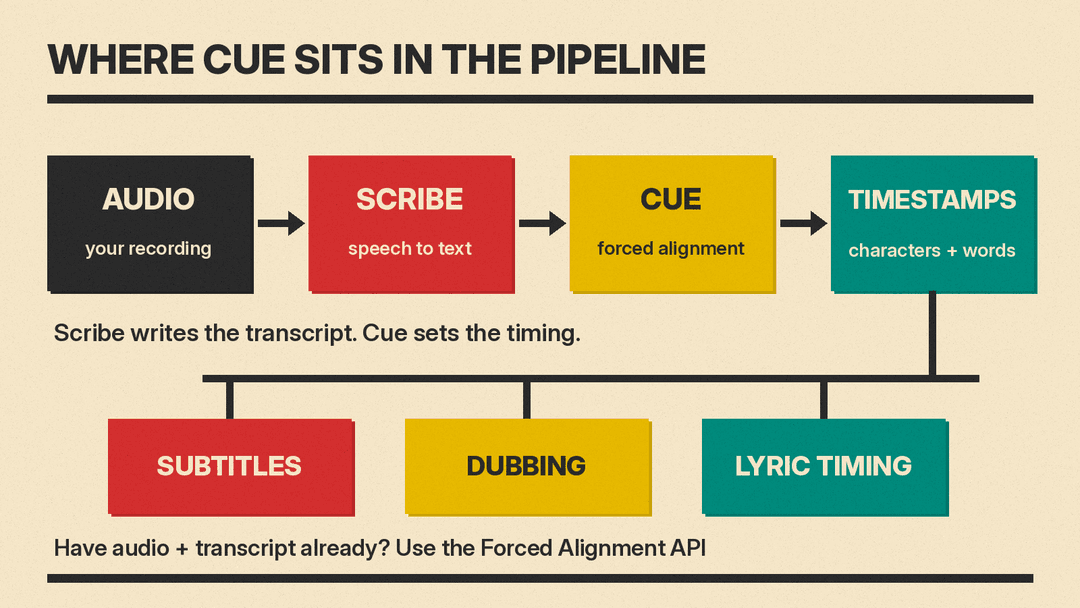
The same model also powers subtitles, dubbing and lyric timing for music at ElevenLabs. Developers can call it on its own through the Forced Alignment API. That route is for when you already have a transcript and only need the timing.
If you want background on the transcription step itself, our post on NVIDIA's Nemotron 3.5 Transcribe covers an open speech-to-text model.
Why character-level timing matters
Cue places each character, not only each word, on the timeline. The API returns both: a list of characters and a list of words, each with a start and end time in seconds, plus a loss score that the API reference calls an alignment "loss/confidence score."
Here is what that timing data feeds:
- Captions and subtitles: each line appears when the words are spoken, not a beat later.
- Click-to-seek transcripts: click a word, and the player jumps to it.
- Karaoke and lyrics: words light up as they are sung.
- Dubbing: ElevenLabs says the same model powers its dubbing.
The ElevenLabs docs list two uses by name: "Matching subtitles to a video recording" and "Generating timings for an audiobook recording of an ebook."
Researcher Danila Kozlov explained why fine timing is hard: "Humans are quite good at aligning media, at the word level at least. We often have the inherent feel of where a word is beginning, but at the character level and with sub-millisecond precision, it's a lot harder."
The numbers ElevenLabs reports
ElevenLabs says Cue is more accurate on real-world recordings than every aligner it tested, in all 29 languages of its benchmark. The post makes these claims:
- Length: Cue handles recordings of any length in a single pass. The post says many aligners work well on clips of about 30 seconds and need longer files cut into chunks, which can add timing error at each seam.
- Full recordings: Cue's average timing error is 179 ms. The open-source tools tested ranged from 283 ms to more than 6,000 ms.
- Noisy English audio: Cue's average error is 57 ms, against 65 ms to 920 ms for the others.
- Speed: the post says Cue aligns an hour of audio in less than a second, and in around half a second on ElevenLabs' production GPU. It says the next fastest tool, Qwen3-ForcedAligner, takes nearly 2 seconds.
- Size: Kozlov said Cue is smaller than the previous ElevenLabs aligner.
Songs and lyric timing
Singing stretches and blurs words. ElevenLabs tested Cue on a subset of songs from the Creative Commons-licensed JamendoLyrics MultiLang dataset, in English, French, Spanish and German.
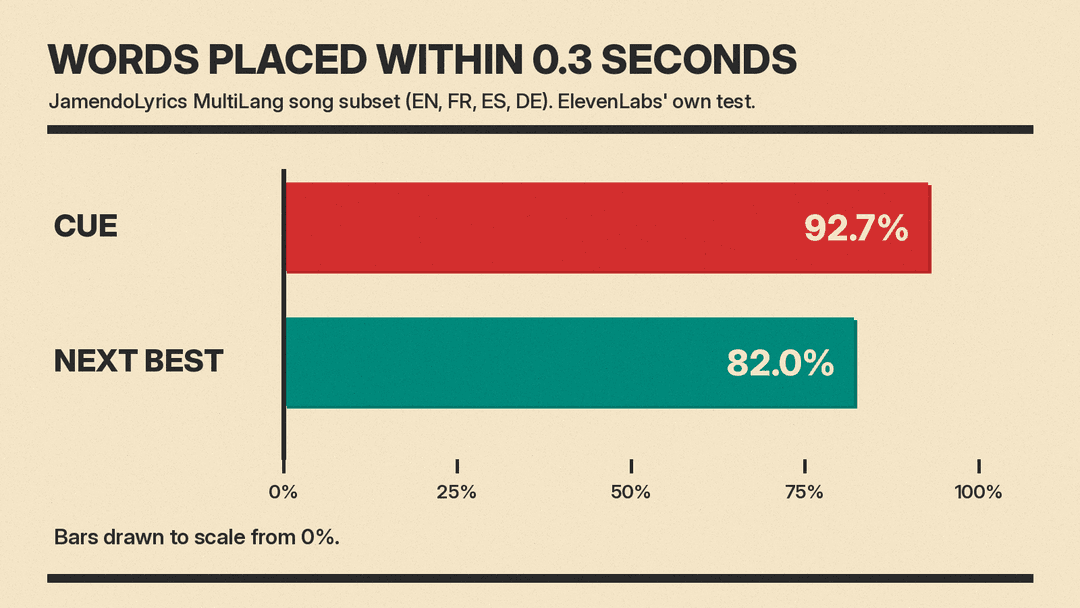
On that subset, per ElevenLabs:
- Cue placed 92.7% of words within 0.3 seconds of the label, against 82.0% for the next best tool.
- Cue's average start error was 0.82 seconds, about half that of the closest competitor.
- Cue was more accurate than every other tool on at least 19 of the 22 songs.
For music creators, this is the step that turns lyrics into synced, word-by-word timing. If you make songs with AI tools, our Suno prompts guide covers the writing side.
Limits and what to check
Read these results with care:
- It is the company's own benchmark. ElevenLabs built it from real-world requests, used its previous aligner as a baseline, and scored every tool the same way, counting any word a tool failed to place as an error. The post cites no independent test.
- The song test is small: a subset of one dataset, four languages and 22 songs.
- Word-level scoring of a character-level model. ElevenLabs says it had to use word-level benchmarks, so it believes the scores "likely understate its precision." That is the company's view, not a measured result.
- No speaker labels. The docs say diarization is not supported and that diarized text "will produce unexpected results." Send a plain transcript.
- Size limits differ between pages. The Forced Alignment overview lists a 3 GB file limit, 10 hours of audio and 675,000 characters of text. The API reference says the file must be under 1GB. Check both before you plan very large uploads.
- Pricing: the docs say forced alignment costs the "Same rate as the Speech to Text API." The ElevenLabs API pricing page lists Speech to Text (Scribe v2) at $0.22 per hour of audio. Languages: the Forced Alignment docs list 29 supported languages, while the blog says Cue covers more than 90 benchmark languages. Check the docs list for your language.
The post also says that after launch a customer reported weaker results in Georgian and a couple of other lower-resource languages, and the team trained and released a fixed version in less than 24 hours. If you work in a less-covered language, test with your own audio first.
Why it matters
Timing is the part of a transcript that viewers notice when it goes wrong. Scribe decides what was said. Cue decides when each word and character appears. For anyone who ships captions, synced lyrics or dubbed audio, that is the layer to test. ElevenLabs already runs it behind every Speech to Text transcription, and developers can call it directly.
For another recent ElevenLabs launch, see our explainer on Eleven Realtime v1 Mini and v1 Max.
