
ElevenLabs launched Eleven Realtime on October 20, 2026. It is a pair of models for voice agents: v1 Mini for low-cost conversation and v1 Max for harder, tool-heavy tasks. The pitch is simple. Instead of picking a speech recognizer, an LLM, and a text-to-speech model yourself, you pick one model and ElevenLabs manages those settings.
This explainer covers what the two models are, the benchmark figures ElevenLabs published, how to switch an agent over, what it costs, and the limits in the docs. It also covers one detail worth knowing before you build: ElevenLabs markets Eleven Realtime as "Speech to Speech," but its own docs say the models are cascaded.
What ElevenLabs launched
The launch post calls Eleven Realtime "a new class of Speech to Speech models" where "each model is a complete voice agent." Both models support more than 90 languages and can use any of the 17,000+ voices in the ElevenLabs library.
- Eleven Realtime v1 Mini is "for natural conversations at low cost." ElevenLabs calls it the best choice for AI assistants, teachers, and interactive characters, and says it "will be sufficient for most use cases."
- Eleven Realtime v1 Max is "for complex tasks." ElevenLabs says it is ideal for customer support, lead qualification, and multi-step workflows "where the agent has to follow a process and reason through steps."
The Realtime models docs add that Mini is the default Realtime model with the lowest latency and cost, and that Max "reasons before it responds."
The problem ElevenLabs names is configuration. In its words, a natural-sounding agent depends on "small judgment calls," such as how long to wait after a pause before answering and how to recover when the user interrupts. The product page says that with a Realtime model, transcription, turn-taking, and voice "are already configured." The docs add that conversation flow settings such as turn eagerness, timeouts, and interruptions still apply, so you can still adjust them.
The benchmark numbers
ElevenLabs says Artificial Analysis evaluated both models on three public benchmarks. These are the figures from the launch post:
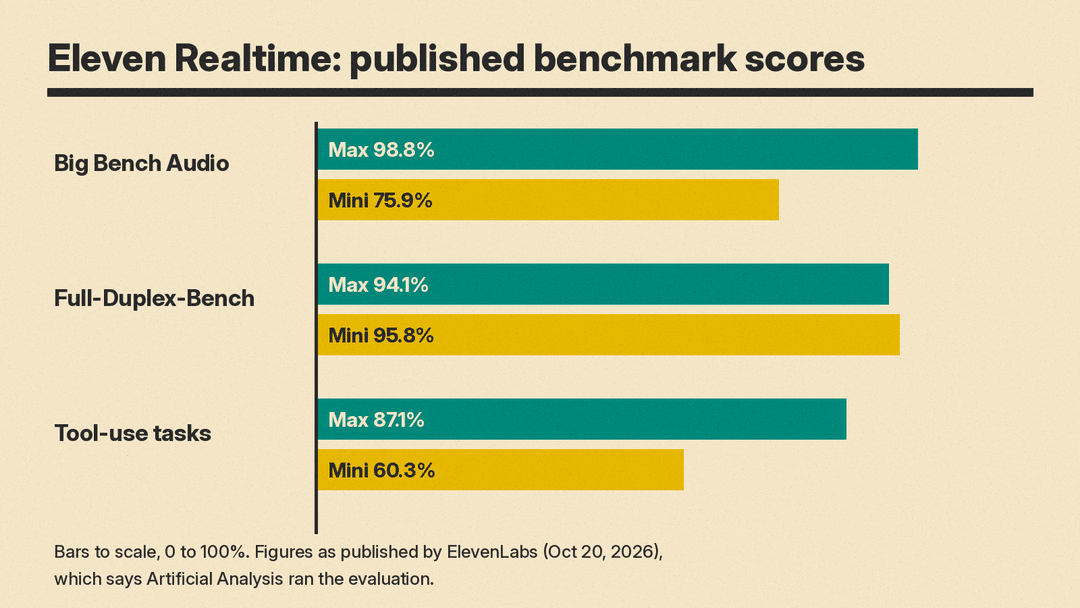
- Big Bench Audio (1,000 reasoning questions asked by voice): v1 Max 98.8%, v1 Mini 75.9%.
- Time to first speech: v1 Max starts speaking in 0.57 seconds on average, v1 Mini in 0.62 seconds.
- Full-Duplex-Bench (pauses, turn-taking, interruptions, and backchannels): v1 Mini 95.8%, v1 Max 94.1%.
- Speech Agent Arena (blind live conversations judged by people): v1 Max 998, v1 Mini 988.
- Tool-use tasks: v1 Max completed 87.1%, v1 Mini 60.3%.
The pattern explains the split. Mini is close to Max on conversation flow and slightly ahead on Full-Duplex-Bench, but far behind on reasoning and tool use. ElevenLabs says the tool-use gap "is why we recommend Max for use cases with heavy tool calling." These are vendor-published results, so test both models on your own calls before you commit.
Speech to Speech, or cascaded?
In our explainer on speech-to-speech vs cascaded voice agents, the core difference was whether the agent decides from the audio or from a transcript. Eleven Realtime sits in between, and the labels can mislead.
The marketing calls the models Speech to Speech. The FAQ in the OpenAI Realtime API compatibility guide is direct: "Eleven Realtime v1 mini and max use a cascaded architecture, optimized end-to-end." Asked whether they are fused models, it answers "No," and says each component "is a distinct model." It also says the specifics of the underlying models "aren't public."
So the practical reading is this: Eleven Realtime is a managed, jointly tuned pipeline behind a speech-in, speech-out interface. The Eleven Realtime product page says speech recognition, turn-taking, LLM, and voice are all "tuned end-to-end." If your use case depends on the model hearing tone directly rather than reading a transcript, ElevenLabs has not said Eleven Realtime does that.
How to use it
There are two routes.
In ElevenAgents (recommended by ElevenLabs). Open an agent, go to the Agent tab, and set Voice mode to Realtime. The agent switches to v1 Mini. Pick v1 Max from the Model list if you need it, then publish. The API field is realtime_model, with the values eleven_realtime_v1_mini and eleven_realtime_v1_max. Setting it back to Custom restores your stored LLM, TTS, and speech recognition settings. You keep ElevenAgents features such as phone, web, WhatsApp, and CCaaS channels, workflows, a knowledge base, guardrails, testing, and monitoring.
Through the Realtime API. ElevenLabs says its Realtime API uses the same wire protocol as OpenAI's Realtime API, so existing code can point at wss://api.elevenlabs.io/v1/convai/realtime and change the model name. Some caveats from the launch post and docs:
- It connects over WebSocket only. A WebRTC integration has to move to WebSocket first.
- Over WebSocket, you capture and play PCM16 audio at 24kHz yourself.
- The published guide covers the browser flow, where your backend mints a short-lived client secret. Docs for server-side OpenAI Realtime SDKs "aren't published yet."
- The Realtime API runs separately from ElevenAgents, so channels and the knowledge base are not included there.
What it costs
On the ElevenLabs API pricing page, as of October 21, 2026, both models list "$0.08 + LLM usage" per minute. The Realtime API table shows:
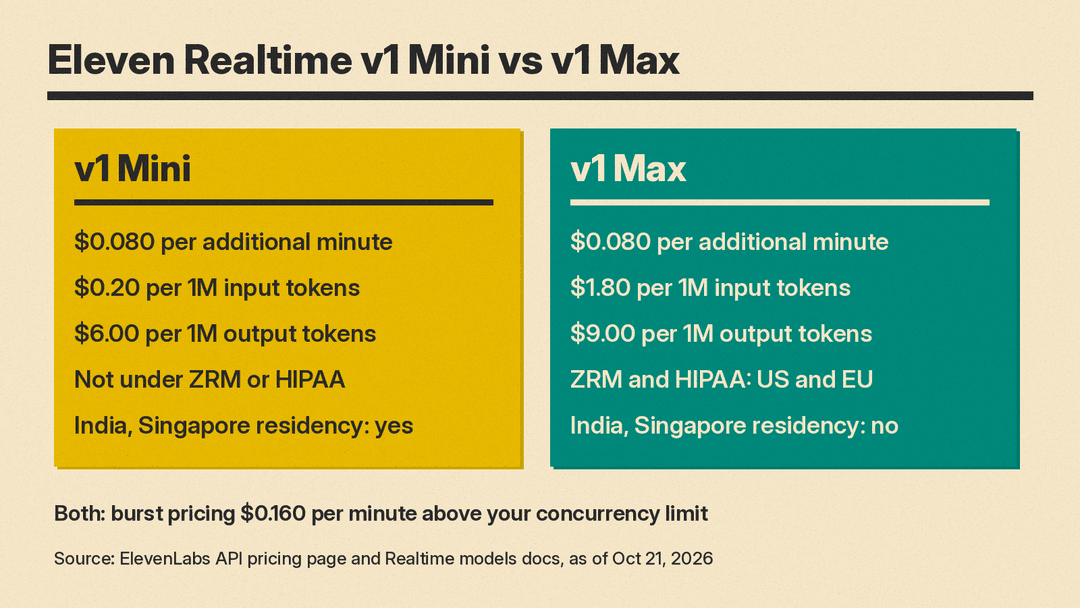
- v1 Mini: $0.080 per additional minute of connected audio, $0.20 per 1M input tokens, $6.00 per 1M output tokens.
- v1 Max: $0.080 per additional minute of connected audio, $1.80 per 1M input tokens, $9.00 per 1M output tokens.
- Both: burst pricing of $0.160 per minute for connected audio above your concurrency limit.
The page says included minutes "are estimates based on typical token usage" and vary with conversation length and tool use. In ElevenAgents, the docs say a Realtime agent is billed the standard ElevenAgents per-minute rate plus tokens at the Realtime model's rates. For other ElevenLabs voice and music prices, see our AI voice and music pricing comparison.
Limits to check first
The Realtime models docs list several rules:
- Gradual rollout. If Voice mode does not appear on your agent, Realtime models are not yet available for your workspace.
- Compliance. Mini is not available under Zero Retention Mode or HIPAA. Max is, in the US and EU.
- Data residency. Max is not available in the India and Singapore data residency environments. Mini is.
- No custom LLM. Realtime mode does not work with a custom LLM or Amazon Bedrock. You also lose the choice of a specific LLM or TTS model.
- Token limit. Max needs a token limit of 1,024 or more, or no limit.
- Transfers. A Realtime agent can only transfer to and from other Realtime agents. Mini to Max transfers work.
- Fallback. If the Realtime model does not respond in time or returns an error, the agent falls back to backup LLMs.
Why it matters
ElevenLabs names pause timing and interruptions as the hard judgment calls. Our guide to voice activity detection and turn-taking covers the parts of that layer you tune when you build it yourself. Eleven Realtime ships with turn-taking already configured and hands the LLM, TTS model, and speech recognition choices to ElevenLabs. The cost is control over which LLM and TTS model run underneath.
The OpenAI-compatible API also lowers switching costs. A team already on OpenAI's Realtime API can try a second vendor by changing an endpoint and a model name, as long as it is on WebSocket. For teams already on ElevenAgents, the choice is now between Custom mode, with full control, and a Realtime model that ElevenLabs tunes. For one example of voice agents on sales calls, see our monday.com Harmony explainer.
The simple rule from ElevenLabs' own numbers: start with Mini for conversation, move to Max when the agent calls tools or follows a long process, and check the compliance table before either.
