
Destined AI, a small team in Atlanta, has released Hurston-1, an open text-to-speech (TTS) model built to speak Southern American English and seven regional African English accents. The weights are on Hugging Face under the Apache-2.0 license, and the model has a "phone mode" that outputs audio in the format telephone systems use. Its creator, posting as Gcarter08, announced it in a Show HN post on Hacker News.
Here is what Hurston-1 does, how Destined AI tested it, what it cannot do yet, and who it is for.
What Hurston-1 is
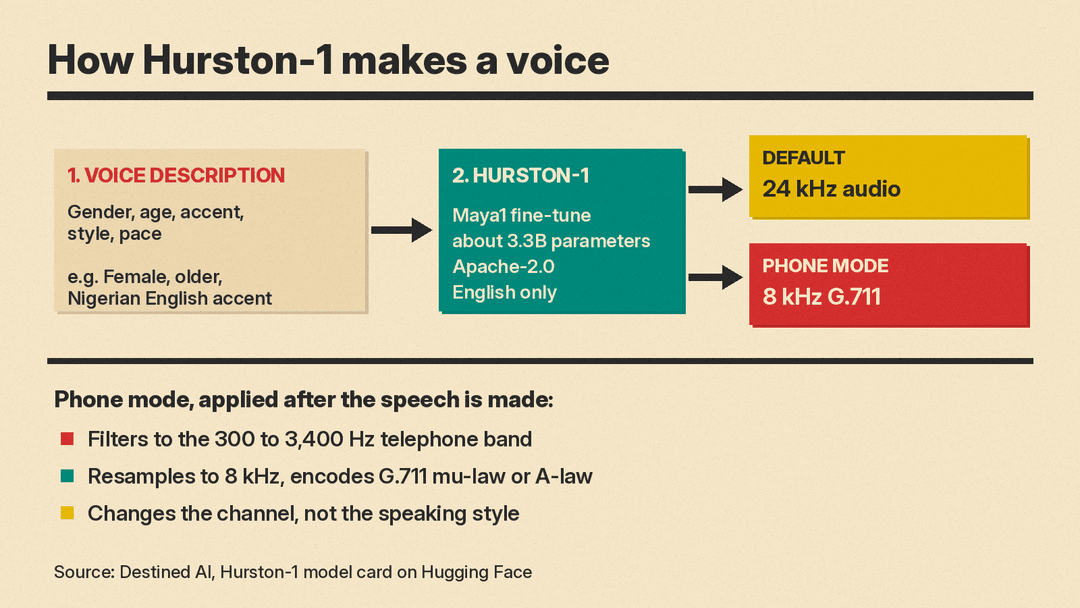
The model card describes Hurston-1 as "accented English text-to-speech built for the phone, steered by a plain-language voice description." It is a fine-tune of Maya1, an Apache-2.0 TTS model from Maya Research. Destined AI says it built Hurston-1 "to speak English accents that most TTS systems handle poorly."
Key facts from the model card and the Hugging Face file listing:
- Base model: Maya1, fine-tuned with a rank-64 LoRA for 2,000 steps.
- Size: about 3.3 billion parameters in BF16, in two weight files of 4.99 GB and 1.61 GB.
- License: Apache-2.0 for the weights, derived from Maya1 (also Apache-2.0).
- Language: English only. No child voices.
- Output: 24 kHz audio by default, or 8 kHz G.711 phone audio in phone mode.
- Family: the first open model in Destined AI's ClarityVoice family.
The model is named for the writer and anthropologist Zora Neale Hurston. The card says the name "is a tribute; it does not imply any endorsement by her estate."
The nine accents
You do not pick a voice from a list. You write a short description in the form "Gender, age, accent, style, pace," and the model makes a new voice that fits it. The card lists these accent values:
- American accent
- Southern American accent
- Nigerian English accent
- Nigerian (Yoruba) English accent
- Nigerian (Igbo) English accent
- West African English accent
- East African English accent
- East African (Swahili) English accent
- Southern African English accent
The other fields are gender (Female, Male), age (adult, middle-aged, older), style (clear conversational, casual conversational, or clear audiobook narration) and pace (natural, measured, slow or fast). The card says the model follows pace labels "approximately, not exactly."
On Hacker News, a commenter asked if the African labels mean Nigerian, Kenyan and South African. The creator replied: "Yes those are the ones for this model that performed consistently well." He also said the labels "were not a catch all for black americans," and that the Southern American label covers White Southern voices too.
Built for the phone line
Destined AI calls Hurston-1 an NB-TTS (narrowband TTS) model. The idea is to make speech for the place a caller will hear it: a phone line, not a studio.
- Trained on real calls. About 10 hours of the training audio (7,600 turns from 250 contributors) is phone-quality speech from real calls with full-duplex AI voice agents.
- Phone mode. The
--phoneoption filters output to the 300 to 3,400 Hz telephone band, resamples it to 8 kHz and encodes it as G.711 mu-law or A-law, which the card says are "the formats phone networks, SIP and Twilio use." - Ready to stream. A
ulaw_encode()function returns raw mu-law bytes, the payload the card says Twilio media streams expect.
Phone mode is a filter applied after the speech is made. The card is clear that it "changes the channel, not the speaking style." The model does not yet do call-style turn-taking or backchannels such as "mm-hm."
If you want background on how voice agents use TTS, our explainer on speech-to-speech vs cascaded voice agents compares the two designs.
How Destined AI tested it
All numbers below are Destined AI's own tests, reported on the model card. No outside group has published an evaluation yet.
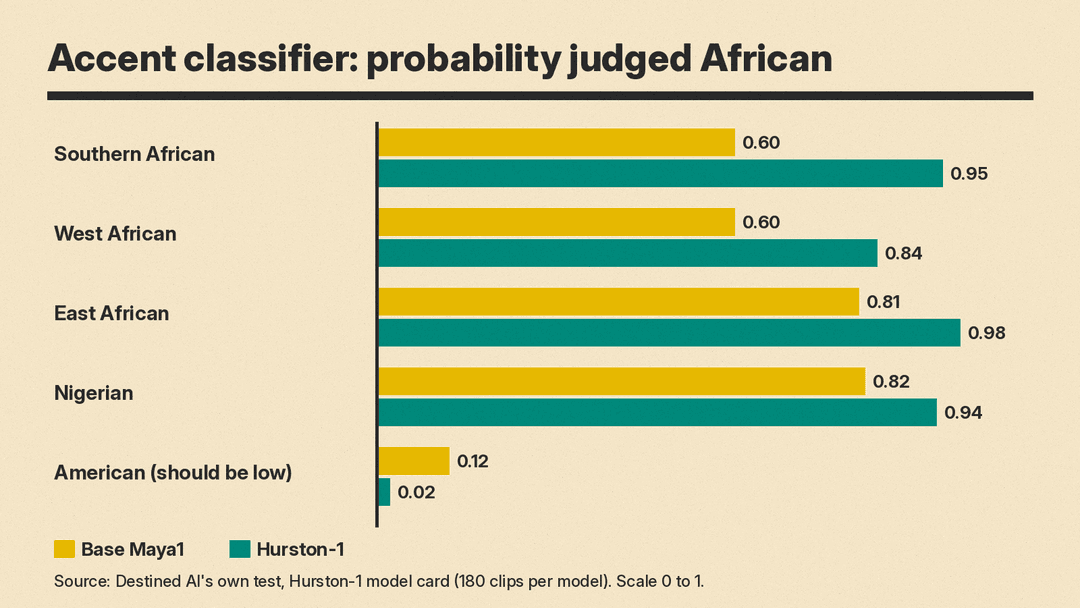
Accent strength. Destined AI compared Hurston-1 with base Maya1 on the same 10 sentences and 18 voices (180 clips per model). An accent classifier trained on real speakers scored how often each voice group was judged African. Selected results, base Maya1 first:
- Southern African: 0.60 vs 0.95
- West African: 0.60 vs 0.84
- East African: 0.81 vs 0.98
- Nigerian: 0.82 vs 0.94
- American (should be low): 0.12 vs 0.02
The card notes the classifier "cannot tell Southern American from general American English," so that accent "was checked by listening."
Intelligibility. Destined AI measured word error rate (WER) with Whisper large-v3-turbo. On everyday sentences, mean WER was 0.02 for Maya1 and 0.03 for Hurston-1. On a harder set of 510 clips, Hurston-1 scored 0.145 in a single take and 0.062 with the --check option, which retries takes that Whisper cannot follow or where the voice changes.
Blind listening. In 54 comparisons, testers picked Hurston-1 as more like a real person with the requested accent 78% of the time, and base Maya1 6% of the time. The rest were ties or neither.
Training data and consent
The card lists about 190 hours of training speech:
- About 136 hours from Destined AI's own accented English corpus, "from consented, paid contributors," including the roughly 10 hours of real phone calls.
- About 46 hours of LibriTTS-R (CC BY 4.0).
- About 10.5 hours of Mozilla Common Voice English from African-accented speakers (CC0).
Destined AI says it has recorded contributors since 2021 and that the full corpus is over 1,800 hours. The full corpus is not part of this release. In the Show HN post, the creator wrote that he has collected "fully consented voice data from over 20,000 people, 1M audio recordings." He also wrote that he has used the model "to support customers such as Amazon and Salesforce and generated over half-mill revenue with it." Neither company has commented in the sources we found.
What it cannot do yet
The model card lists its limits plainly:
- No consistent voice. Each call makes a new voice. Long text is split into chunks of about 40 words, so the voice can change between chunks. The creator wrote that this is fine for many uses "but maybe not so - if you're creating podcasts."
- No voice cloning. The card says it "does not clone voices and was not trained to reproduce any real person."
- Names, dates and amounts are the weakest content. WER for names and numbers was 0.17 even with
--check. - The generic "African English accent" label is weaker (WER 0.26). The card says to use a specific region instead.
- Occasional bad takes. It can produce a garbled or overlong take, or the voice can shift mid-take.
Consistent named voices and a call-style speaking mode are on the roadmap, with no date given.
How to try it
The repository is gated: you must log in to Hugging Face and agree to share your username and email to download the files. One Hacker News user reported that the in-page audio would not play. The creator pointed people to a Hugging Face Space demo. The card shows a hurston.py script that runs from the command line with an accent, a gender and a line of text.
The card's suggested uses include test data for speech recognition, simulated callers for testing voice agents and phone menus, training data augmentation, phone announcements, listening practice, read-aloud tools, and draft voices for games and media "labeled as synthetic." Its responsible use section says: "Do not use Hurston-1 to impersonate real people, deceive listeners, or commit fraud. Tell listeners when speech is synthetic."
Why it matters
Open speech models keep arriving, from Ant Group's Ming-3.0-audio to commercial voice agent models such as Eleven Realtime. Hurston-1 is different in focus. It is permissively licensed and aimed at accents and phone audio rather than studio voices or general quality.
For teams that build voice agents or speech recognition, a direct use is the one Destined AI points to first: generating the same sentences in nine accents to see where a system breaks before real callers hit it. One Hacker News commenter, islewis, wrote that "American south accents are really poorly represented in mainstream Speach-To-Text models" in their experience, which is the gap this kind of test data targets.
The open questions are the usual ones for a first release. All test results are self-reported, the voice changes on every call, and the demo files on the model page are behind a login gate. For a voice model that takes the opposite approach, trained only on human speech and built for live conversation, see our look at Block Dessa.
