
AI engineer, machine learning engineer and data scientist are three job titles that people often mix up. This page compares them using each role's own source: the US Bureau of Labor Statistics (BLS) for data scientists, Google Cloud and AWS for ML engineers, and Microsoft Learn, roadmap.sh and the Latent Space essay that argues for the AI engineer title.
We read each page in November 2026. Where a page says something, we quote or closely follow it. Where we draw a conclusion of our own, we mark it as "our reading." Titles also differ from one employer to the next, so treat the definitions below as starting points, not rules.
The short answer
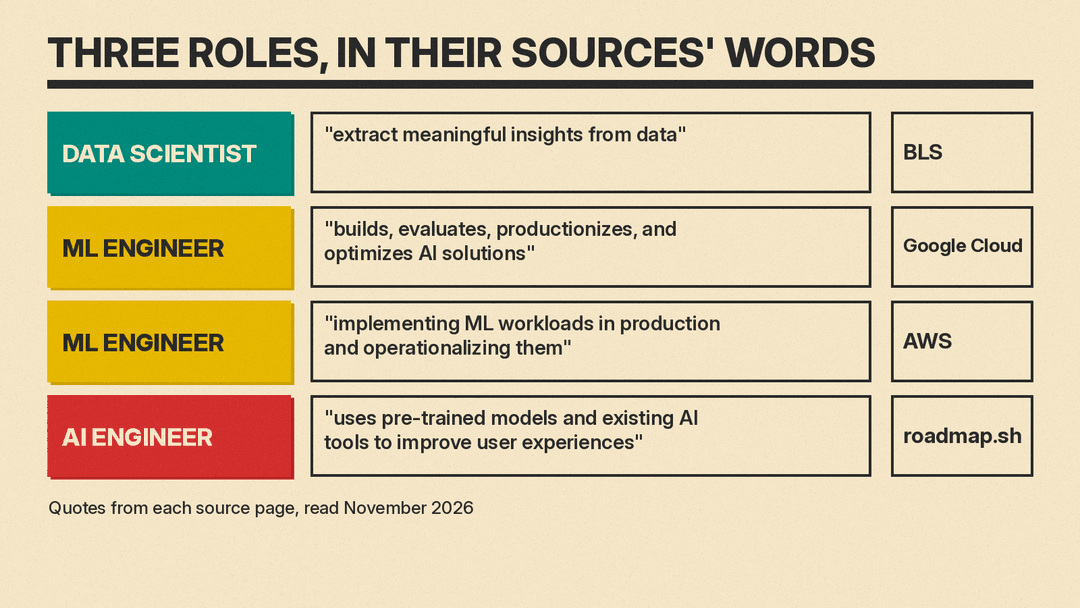
- Data scientist: BLS says data scientists "use analytical tools and techniques to extract meaningful insights from data." The output is analysis, models and recommendations.
- ML engineer: Google Cloud says a Professional Machine Learning Engineer "builds, evaluates, productionizes, and optimizes AI solutions." The output is models that run reliably in production.
- AI engineer: roadmap.sh says an AI engineer "uses pre-trained models and existing AI tools to improve user experiences" and works "without building models from scratch." The output is a product or feature built on top of existing models.
Our reading: the three titles sit at different points along one pipeline. Data scientists work closest to the data and the question. ML engineers work on getting a model into production and keeping it there. AI engineers work closest to the product and build with models that someone else trained.
Data scientist: BLS says analysis and models
BLS publishes an Occupational Outlook Handbook page for data scientists. It lists these typical duties:
- Determine which data are available and useful for the project.
- Collect, categorize, and analyze data.
- Create, validate, test, and update algorithms and models.
- Use data visualization software to present findings.
- Make business recommendations to stakeholders based on data analysis.
The page also says data scientists "must 'clean' the raw data," meaning they structure it so software can read it, and that they use machine learning "to classify or categorize data or to make predictions related to the models."
The numbers on the page, for the United States:
- Median pay was $120,230 per year in May 2025.
- Data scientists held about 275,600 jobs in 2025.
- BLS projects 35% employment growth from 2025 to 2035, and describes that as much faster than the average for all occupations.
- A bachelor's degree is the typical entry-level education, in "mathematics, statistics, computer science, or a related field." Some employers require or prefer a master's or doctoral degree.
These figures are for data scientists only. We did not find an official BLS page with pay or growth for ML engineers or AI engineers, so we do not give a pay figure for those two titles here.
Note that BLS does not describe a data scientist as a person who only analyzes. It says data scientists who "have a strong coding or engineering background may develop or recommend systems, build machine learning algorithms, and devise ways to enhance web-browsing functions." So the data scientist title can reach into engineering work.
For how to get there, see our guide How to Become a Data Scientist: Skills, Pay, Free Courses and the two foundations pages, Statistics for Machine Learning: 9 Resources to Start and Math for Machine Learning: Free Courses, Books, Videos.
ML engineer: Google Cloud and AWS say production
Google Cloud's page for the Professional Machine Learning Engineer certification defines the role this way: it "builds, evaluates, productionizes, and optimizes AI solutions using Google Cloud capabilities and knowledge of conventional ML approaches." It goes on to say the ML engineer "handles large, complex datasets and creates repeatable, reusable code" and "designs and operationalizes AI solutions based on foundational models."
The skills the page names include model architecture, data and ML pipeline creation, MLOps (machine learning operations, the practice of running models in production) and metrics interpretation. The verbs it uses for the work are "training, retraining, deploying, scheduling, tuning, monitoring, and improving traditional and generative AI (gen AI) models."
The exam topics on the same page make the production focus plain. The exam assesses your ability to architect low-code AI solutions, collaborate within and across teams to manage data and models, scale prototypes into ML models, serve and scale models, automate and orchestrate ML pipelines, and monitor AI solutions.
AWS describes its Certified Machine Learning Engineer Associate credential in similar terms. The page says it "validates technical ability in implementing ML workloads in production and operationalizing them." The AWS page also lists an updated exam, MLA-C02, and says it reflects "the broadened scope of the ML engineer role," with additions that include generative AI implementation (Amazon Bedrock, RAG architectures), agentic AI, and fine-tuning of foundation models. The page says the last day to take the current English exam, MLA-C01, was September 28, 2026, so check the page before you plan to sit the exam.
Our reading: two cloud vendors describe the ML engineer's job as running models in production, and both now include generative AI in the role. That puts the ML engineer closer to infrastructure than to analysis. The role is less about asking what the data says and more about keeping a model working after it ships.
Two cautions from Google's own page. First, the exam is a certification, not a degree or a job requirement; the page lists no prerequisites and recommends 3+ years of industry experience including 1 or more years designing and managing solutions on Google Cloud. Second, the note on the page says the exam "does not directly assess coding skill," though it expects minimum proficiency in Python and SQL to read the code snippets. For a wider view of credentials, see Best AI Certifications Worth Getting in 2026.
For the concepts behind this role, our explainers on neural networks and fine-tuning cover the model side.
AI engineer: a newer title, defined by building on models
This is the youngest of the three titles, and its definition comes from a few sources rather than one official page.
The roadmap.sh AI Engineer roadmap says an AI engineer "uses pre-trained models and existing AI tools to improve user experiences," and that the role "is different from AI Researchers and ML Engineers, who focus more on creating new models or developing AI theory."
The essay that argues for the title is The Rise of the AI Engineer, published by Latent Space on June 30, 2023. Its author calls the role the "emerging (and least cringe)" version of a new kind of software engineer who works on applications of AI. The essay quotes Andrej Karpathy: "One can be quite successful in this role without ever training anything." It is an opinion and trend piece from 2023, not a job standard, and it made predictions that we cannot confirm from the page, so we cite it for the definition only.
Microsoft Learn describes a close relative on its Azure AI Engineer Associate page: "As a Microsoft Azure AI engineer, you build, manage, and deploy AI solutions that leverage Azure AI." It lists responsibilities across requirements definition and design, development, deployment, integration, maintenance, performance tuning and monitoring, and says the engineer works with solution architects and with data scientists, data engineers and software developers. The same page says this certification and its renewal assessment are retired, so we use it only as a role description.
Our reading: across these sources, the AI engineer is a software engineer first. The model is one component, often reached through an API, and the job is to make it useful inside a product. That fits the retrieval, agent and embedding techniques that appear in AI products. For background, see our explainers on RAG, embeddings and AI agents.
For a staged plan, see How to Become an AI Engineer in 2026.
Where the roles overlap
The sources themselves show the lines blur:
- BLS says some data scientists "build machine learning algorithms."
- Google Cloud says an ML engineer is "familiar with the foundational concepts of prompt and context engineering, application development, infrastructure management, data engineering, and data governance."
- Microsoft Learn says an Azure AI engineer works with data scientists and data engineers.
- roadmap.sh says an AI engineer works without building models from scratch, and the Latent Space essay says AI engineers can "go left to finetune/host models."
Our reading: in a small team one person may do all three jobs, and in a large company the same work may be split across several teams. When you read a job posting, look at the duties listed, not only the title.
Which one fits you
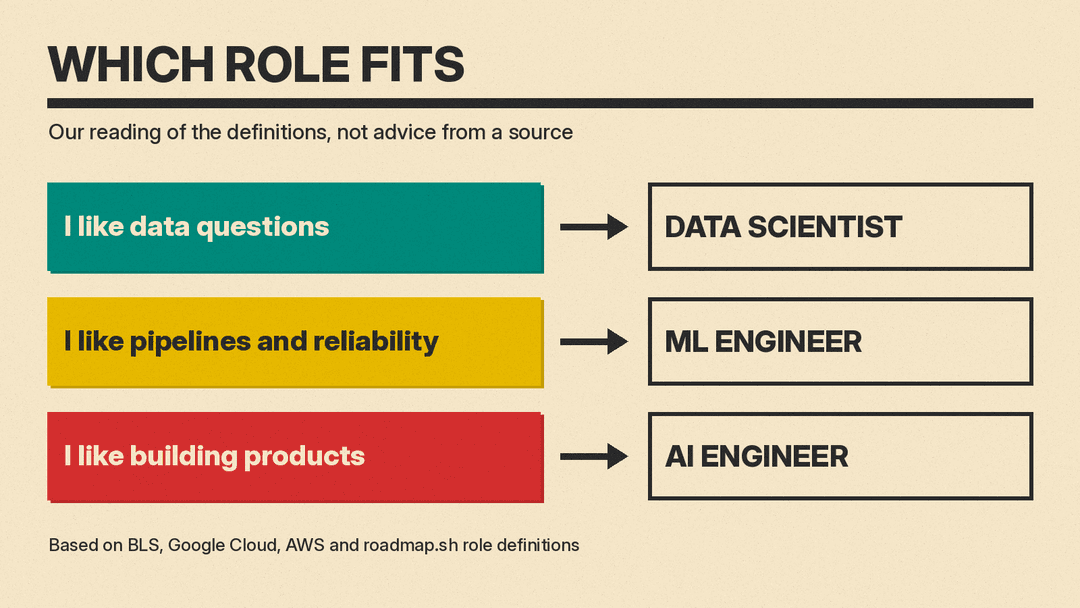
These are our own suggestions based on the definitions above, not advice from the sources.
- If you like asking questions of data and explaining the answer: data scientist. The BLS duty list is mostly analysis, testing and communication.
- If you like making systems reliable: ML engineer. The Google and AWS pages stress deployment, serving, monitoring and operations.
- If you like building products with software: AI engineer. The definitions stress using existing models in applications.
If you are not sure, a portfolio helps you test your fit. Our page How to Build an AI Portfolio That Gets Interviews covers projects to build, and AI Jobs Without a CS Degree: What Hiring Data Shows covers the education question. For the broader terms, AI vs Machine Learning vs Deep Learning: The Difference explains how the fields relate.
Common questions
Which role pays the most? We cannot say from official sources. BLS gives a median of $120,230 for data scientists in May 2025, but we did not find an official figure for ML engineers or AI engineers, so any ranking would be a guess.
Do you need a degree? BLS says a bachelor's degree is typical for data scientists. For ML engineers and AI engineers, we did not find an official statement of a required degree on the pages we read. The Google Cloud page lists no prerequisites for its exam.
Is "AI engineer" just a rebranded ML engineer? Our reading of the sources is no: roadmap.sh and the Latent Space essay define it by building on top of existing models, while Google Cloud and AWS define the ML engineer by training and operating models. The AWS page, though, shows ML engineer scope growing to cover generative AI, so the overlap is real.
Can a data scientist become an ML engineer? The AWS page lists "data scientist" among the candidate roles for its ML engineer exam, so AWS counts data scientists among the people the exam is for. We did not find a source that measures how often people make that move.
Sources
- US Bureau of Labor Statistics: Data Scientists, Occupational Outlook Handbook
- Google Cloud: Professional Machine Learning Engineer certification
- AWS: Certified Machine Learning Engineer Associate
- Microsoft Learn: Azure AI Engineer Associate (retired)
- roadmap.sh: AI Engineer roadmap
- Latent Space: The Rise of the AI Engineer
