
Google DeepMind and the education non-profit Fab AI have announced a partnership to build teacher tools on open Gemma models in Kenya, Ghana and South Africa. Google announced it on November 4, 2026, in a post on its Africa blog. The work is funded jointly by Google.org and the Gates Foundation. Google says Fab AI will lead a cohort of local innovators, and that the resulting datasets, evaluation suites and open-source models will be shared publicly.
This is a pilot with targets, not results. The numbers below are Google's goals for the program, and the announcement does not say when the tools will reach classrooms.
What Google announced
The post is written by Benson Kinoti, Google for Education lead for Sub-Saharan Africa. It opens with a statistic: Google says more than 60 percent of the region's population is under 25, which it calls more young learners than anywhere else on the continent.
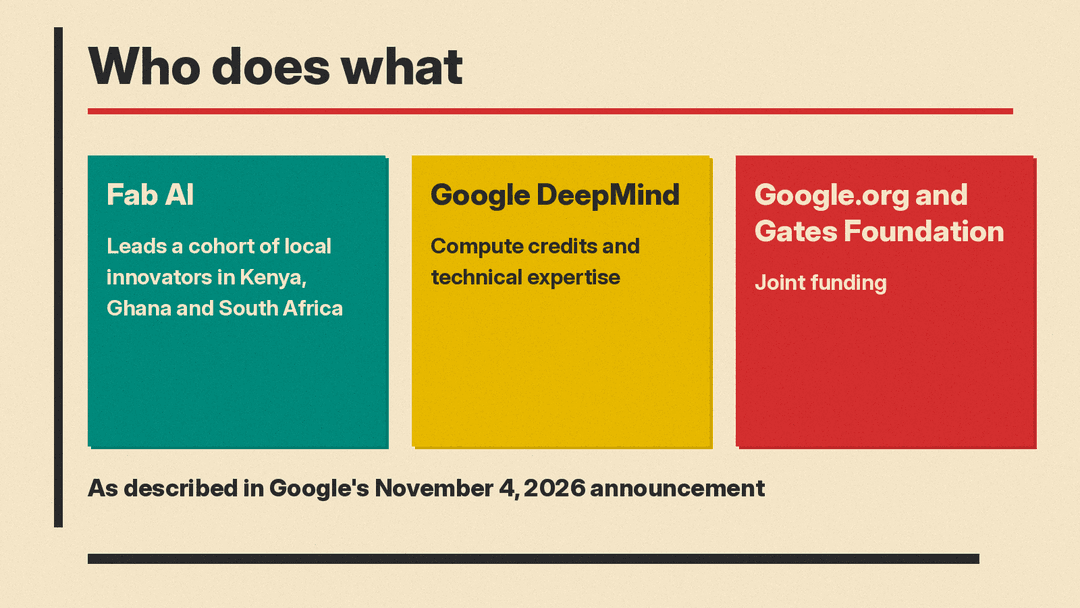
The partnership itself has three parts, according to Google:
- Fab AI, which Google describes as a non-profit dedicated to education in low- and middle-income countries, leads the cohort of local innovators.
- Google DeepMind provides compute credits and technical expertise.
- Google.org and the Gates Foundation provide joint funding.
The cohort will build what Google calls bespoke AI tools on open Gemma models.
Why small models
Google gives its reasoning in the post. In large, resource-constrained classrooms, it says, generative AI tools that run on small language models can offer a workable option. Google says these models can operate on low-cost devices and adapt directly to local languages and national curricula.
The post does not name which Gemma model or which languages the cohort will use. It also does not describe the devices.
Three areas for teachers
Local developers will focus on three areas that Google says support educators:
- planning high-quality, curriculum-aligned lessons
- giving timely diagnostic feedback and assessment
- offering practice-based teacher coaching
Google says DeepMind will support the work in areas where AI has the potential to support teachers in areas proven to positively impact learning outcomes. The post does not list specific tools or products, so what the cohort ships will depend on what the local teams build.
The numbers, and who made them
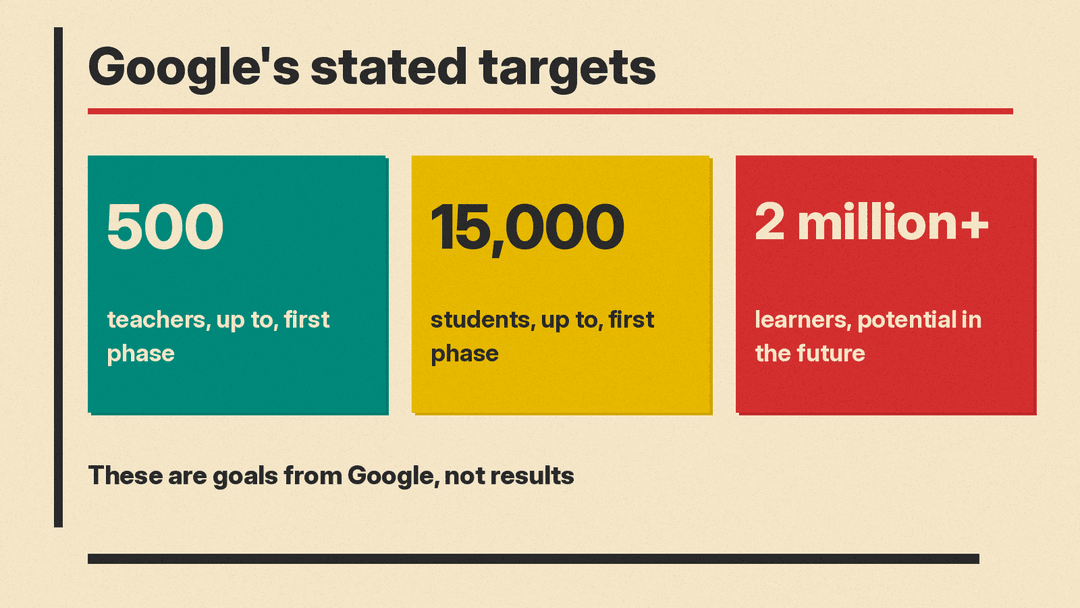
All three figures come from Google's announcement and are targets or ambitions.
- Up to 500 teachers in the first phase.
- Up to 15,000 students in the first phase.
- Potentially more than 2 million learners in the future.
The 2 million figure is a "potential" in Google's wording, not a commitment, and the post gives no timeline for it.
What Google.org said a day earlier
On November 3, Google.org published a separate post saying it is providing over $9.5 million in funding across five organizations building with and for educators. Fab AI is one of the five. Google describes its role there as collaborating with Google DeepMind and the Gates Foundation to build open models that help teachers plan lessons and support early reading.
That post gives one total for all five organizations. It does not say how much goes to Fab AI, and the Africa post says nothing about the size of the Gates Foundation's contribution either. Treat any per-organization dollar figure as unreported for now.
Earlier work with Fab AI
Fab AI is not new to Google's education work. In a May 19, 2026 post, Google described an eight-week pre-registered randomized controlled trial in Sierra Leone, run with Fab AI and local teachers. Google said it randomly assigned 48 math classrooms, nearly 1,800 students in Grades 7 and 8, to use Guided Learning or to continue regular classwork.
Google reported that students who used the tool raised their scores on externally validated assessments by 0.26 standard deviations, which it says is roughly 1.2 to 1.7 years of typical learning progress in low- and middle-income countries. These are Google's reported results.
That trial used Gemini's Guided Learning, not Gemma. The new partnership is a different kind of project: open models built by local teams. Guided Learning is also the feature Google is bringing into Classroom assignments elsewhere.
Training for teachers in South Africa first
The second half of the Africa post covers people rather than models. Google is expanding its free Google AI Educator Series across Sub-Saharan Africa, beginning with teachers in South Africa, in partnership with the South African Council for Educators.
Google says the sessions run both virtually and in person, are designed by educators for educators, and let teachers earn micro-credentials. It plans to expand the series to Nigeria, Kenya and Ghana in 2027, working with partners including Ubuntu Hub. The post gives no start dates or sign-up details.
What the announcement leaves open
Several details are not in Google's post:
- which Gemma model the tools will use
- which local languages and national curricula come first
- how many teachers and students each country will get
- when classroom use starts
- how the datasets and evaluation suites will be released, beyond "publicly"
Google has said the datasets, evaluation suites and open-source models will be shared publicly. The post does not say when.
Where this fits
Google made several education announcements on November 3 and 4. On November 3 it said it is turning Gemini and Search off by default for K-12 student accounts until school administrators turn them on, covered in our post on the K-12 default change. The Africa partnership is a separate announcement about open Gemma models built by local developers.
Sources
- Empowering Educators and Learners in Sub-Saharan Africa, Google, November 4, 2026
- Google.org funds AI tools for teachers, Google, November 3, 2026
- Measuring the impact of AI on teaching and learning, Google, May 19, 2026
