
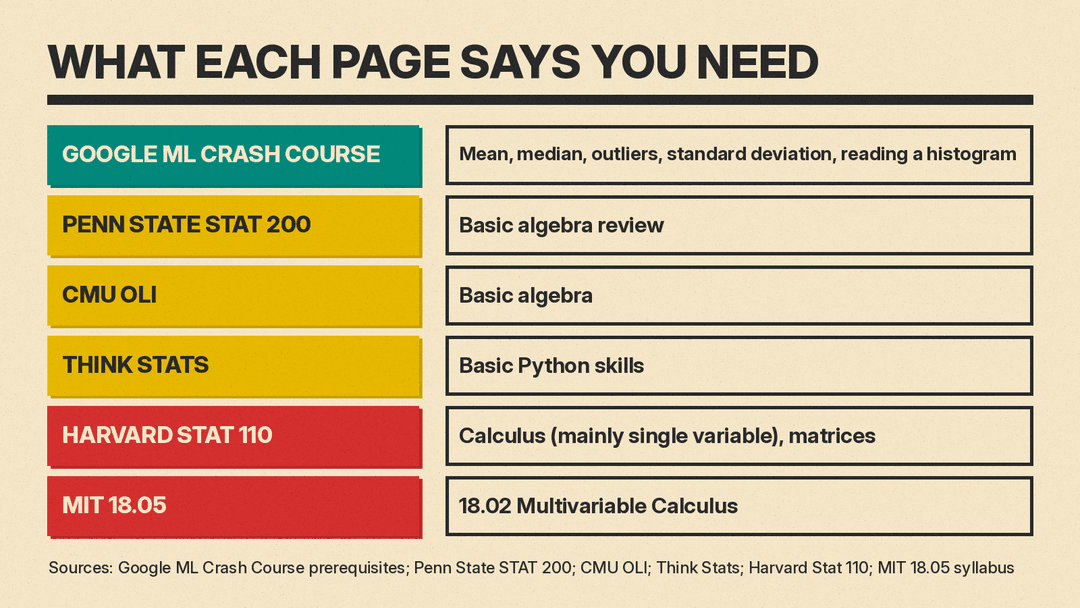
Google's Machine Learning Crash Course does not ask for much statistics. Its prerequisites page says: "You must be comfortable with variables, linear equations, graphs of functions, histograms, and statistical means." Under its statistics heading it lists "mean, median, outliers, and standard deviation" and being able to read a histogram.
Our reading: that is a short list, so you can start machine learning early and add statistics as you go. If you want to go further, for example to understand why a model overfits or what a confidence interval says, the courses and books below are places to learn it.
This page lists 9 statistics resources. For each one we give who it is for, what it covers, and what the page says about prerequisites and cost. We read each provider's own page in November 2026. Seven of the nine have a page that says free, open or no cost, and we quote it. For Seeing Theory and ISL, the pages we read do not state a price, so we do not call them free. Where a page did not say a thing, we left it out.
If you are new to AI as a whole, start with our 12-week plan to learn AI from scratch. For the algebra, linear algebra and calculus side, see Math for Machine Learning: Free Courses, Books, Videos. This page covers statistics and probability only.
The 9 picks at a glance
- Khan Academy, Statistics and probability: a course with 16 topics that starts from categorical data.
- Penn State STAT 200: free course notes for elementary statistics.
- CMU Probability & Statistics, Open & Free: an interactive course for independent learners.
- OpenIntro Statistics: a textbook with a free PDF, plus videos, slides and labs.
- Think Stats (3rd edition): a free online book for people who can write basic Python.
- Seeing Theory: visual chapters on probability and statistics.
- MIT 18.05, Introduction to Probability and Statistics: an undergraduate course with readings and problem sets.
- Harvard Stat 110, Probability: 34 lecture videos and a free online book.
- An Introduction to Statistical Learning (ISL): the book that connects statistics to machine learning methods.
If you are new to statistics
Khan Academy: Statistics and probability
Khan Academy's Statistics and probability course is the first pick here. Its own help center says: "All of Khan Academy’s library of trusted, standards-aligned videos, articles, practice questions, and lessons are completely free for anyone who wants to use them."
- What it covers: the Khan Academy blog lists 16 topics under Statistics and probability. They run from analyzing categorical data and summarizing quantitative data through probability, random variables, sampling distributions, confidence intervals and significance tests. The last ones are chi-square tests, advanced regression and analysis of variance.
- Format: the blog says each curriculum is built out with free videos, articles and practice exercises.
- Our note: Khan Academy's own course page would not load for our checker, so the topic list above comes from its blog.
Penn State: STAT 200 Elementary Statistics
Penn State's STAT 200 course notes were written by the university's Department of Statistics. The page says: "These notes are free to use under Creative Commons license CC BY-NC 4.0."
- Prerequisites: the prerequisite skills lesson says: "This is not a mathematics course." It lists basic linear equations, summations, exponents, square roots and basic arithmetic.
- What it covers: Lesson 1 is about collecting data, including samples, bias, experiments and confounding variables. Lesson 2 covers describing data: mean, median, standard deviation, percentiles, z scores and the five number summary.
- Time and software: the course page says most students require 8 to 16 hours per week to be successful in the course. The prerequisite lesson calls Minitab required software for STAT 200 online. The pages we read do not say whether Minitab is free for people outside Penn State.
- Credit: the page points to the World Campus website for enrolling in the course for credit. The notes themselves are the free part.
CMU Open Learning Initiative: Probability & Statistics, Open & Free
Carnegie Mellon's Probability & Statistics course is labeled "Free for independent learners."
- Prerequisites: the page says: "The course does not assume any prior knowledge in statistics and its only prerequisite is basic algebra."
- What is included: the page says the Open & Free version includes all expository text, simulations, case studies, interactive learning exercises and the StatTutor labs. It omits the scored tests and instructor tools.
- Software: to do the activities you need your own copy of Microsoft Excel, Minitab, the open source R software, a TI calculator or StatCrunch, according to the page. The page calls R open source.
OpenIntro Statistics
OpenIntro Statistics says it "is recommended for college courses and self-study." The page offers a free book PDF, and it lists videos, slides and labs for the chapters.
- What it covers: the chapters run from intro to data, summarizing data, probability and distributions to foundations for inference, inference for categorical and numerical data, linear regression, and multiple and logistic regression.
- Why it matters for machine learning: our reading is that the last two chapters line up with two models in Google's crash course, linear regression and logistic regression. The labs list software choices that include R and Python.
If you code in Python
Think Stats (3rd edition)
Think Stats by Allen B. Downey says: "Think Stats is an introduction to Probability and Statistics for Python programmers." It adds: "If you have basic skills in Python, you can use them to learn concepts in probability and statistics and practical skills for working with data."
- Format: the page links 14 chapter notebooks that run on Google Colab, plus an introduction to Jupyter for people who have not used notebooks.
- What is free: the page says the book "is available under a Creative Commons license" and that you are free to copy, distribute and modify it if you credit the source and do not use it for commercial purposes.
- What it covers: the page says it focuses on simple techniques for exploring real datasets, with case studies using data from the National Institutes of Health and other sources.
If you learn by seeing
Seeing Theory
Seeing Theory, a site hosted at brown.edu, is "A visual introduction to probability and statistics." It has six chapters: Basic Probability, Compound Probability, Probability Distributions, Frequentist Inference, Bayesian Inference and Regression Analysis.
- Cost: the page we read does not state a price or a license.
- Good to know: the page says "This site is archived for reference." It is still readable, but do not expect updates.
- What it covers: the chapters include set theory, counting, conditional probability, random variables and the central limit theorem.
- Our reading: it works best next to a course, because the site is a set of chapters rather than a graded course.
If you want probability in depth
MIT 18.05: Introduction to Probability and Statistics
MIT OpenCourseWare 18.05 describes itself this way: "This course provides an elementary introduction to probability and statistics with applications." Topics include combinatorics, random variables, probability distributions, Bayesian inference, hypothesis testing, confidence intervals and linear regression.
- Prerequisites: the syllabus lists 18.02 Multivariable Calculus. Our reading: that is a step up from the beginner courses above.
- What you get: the course lists assignments, problem set solutions, readings, lecture notes and exams. The syllabus says computation, simulation and visualization using R and applets are used throughout the course.
- Cost: the page says the same materials, including interactive components, are on MIT’s Open Learning Library, "which is free to use." It says you can enroll to track progress or use the materials without enrolling.
Harvard Stat 110: Probability
Joe Blitzstein's Statistics 110 course is described on its about page as an "introduction to probability as a language and set of tools for understanding statistics, science, risk, and randomness."
- Prerequisites: the about page says: "The prerequisites are calculus (mainly single variable) and familiarity with matrices."
- Lectures: the about page says the lecture videos are available on iTunes U and YouTube, and the YouTube page lists 34 lectures, from sample spaces and Bayes' rule through the central limit theorem to Markov chains.
- Book: the course page says a free online version of the second edition of Introduction to Probability by Blitzstein and Jessica Hwang is available.
If you want the machine learning link
An Introduction to Statistical Learning (ISL)
An Introduction to Statistical Learning by Gareth James, Daniela Witten, Trevor Hastie, Rob Tibshirani and, for the Python edition, Jonathan Taylor says it "provides a broad and less technical treatment of key topics in statistical learning." The site links PDF downloads of the first and second editions with R and the edition with Python. The page does not use the word free or state a license, so check the terms on the download pages.
- What it covers: the page lists regression, classification, resampling methods, linear model selection and regularization, tree-based methods, support vector machines, deep learning, survival analysis, unsupervised learning and multiple testing.
- Labs: each edition has a lab at the end of each chapter, in either R or Python.
- Prerequisites: the page does not list any, so check the first chapters before you commit. Our reading: it fits after one of the beginner courses.
How to choose
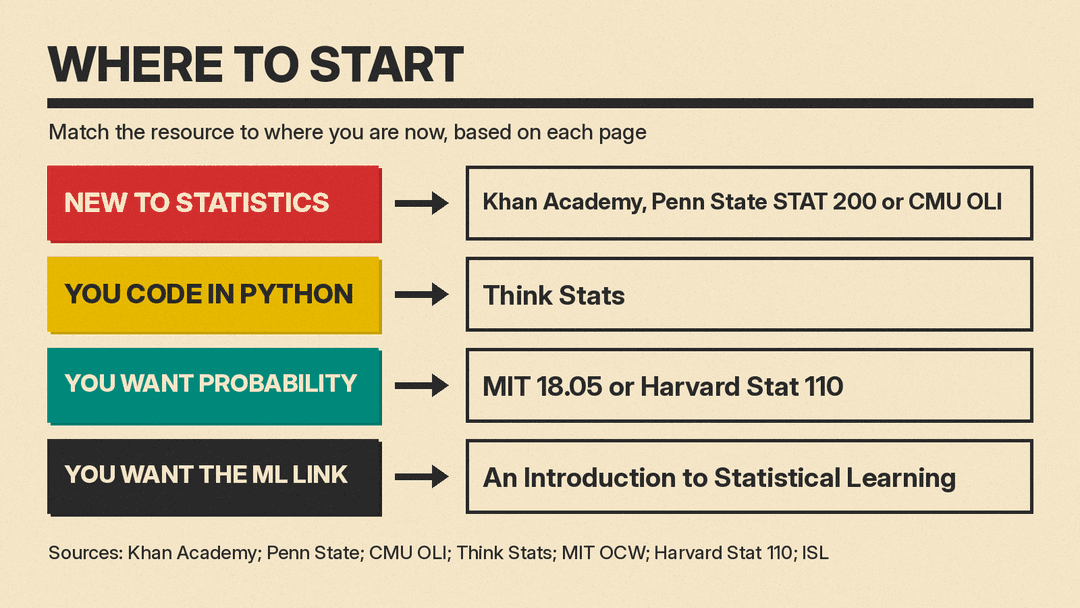
- You want a gentle start with practice: Khan Academy or CMU OLI. Both say they are free, and CMU says its only prerequisite is basic algebra.
- You want course notes and can get Minitab: Penn State STAT 200, though check the software note above.
- You want a free textbook plus slides and labs: OpenIntro Statistics.
- You write Python already: Think Stats, in Colab notebooks.
- You like pictures: Seeing Theory, next to another course.
- You have calculus: MIT 18.05 or Harvard Stat 110.
- You want to see the methods used in machine learning: ISL.
Where this fits in an AI learning path
Statistics sits next to the other foundations. After a beginner course, try Google's Machine Learning Crash Course, which says it does not require prior machine learning knowledge. Our free LLM courses list has courses on large language models. For the difference between the terms you will meet, read AI vs machine learning vs deep learning, and for jobs that use this material see how to become a data scientist.
Bottom line
Google's own list of statistics prerequisites for its machine learning course is short: mean, median, outliers, standard deviation and reading a histogram. The 9 resources above go further. Khan Academy, CMU OLI and Penn State's notes are written for beginners, and each page says what it needs. Think Stats is for people who code, MIT 18.05 and Stat 110 ask for calculus, and ISL ties statistics to machine learning methods. Check each provider's page before you rely on a link, because courses move and terms change.
Sources
- Google Machine Learning Crash Course: Prerequisites and prework
- Google Machine Learning Crash Course
- Khan Academy: Statistics and probability
- Khan Academy Help Center: Does it cost money to use Khan Academy?
- Khan Academy Blog: Get Free Math Curriculums from Kindergarten to Calculus
- Penn State STAT 200
- Penn State STAT 200: Prerequisite Skills
- Penn State STAT 200: Lesson 1
- Penn State STAT 200: Lesson 2
- CMU OLI: Probability & Statistics, Open & Free
- OpenIntro Statistics
- Think Stats, 3rd edition
- Seeing Theory
- MIT OpenCourseWare 18.05
- MIT 18.05 syllabus
- Harvard Statistics 110: Probability
- Harvard Stat 110: About
- Harvard Stat 110: YouTube lectures
- An Introduction to Statistical Learning
