

CoreWeave reports third-quarter results on November 10, and the market is already treating its debt as a problem. The cost of insuring its bonds against default sits near levels that credit analysts call distressed, and its stock fell again after the November midterm elections. This piece lays out what the numbers are, what the company says back, and what the earnings call can and cannot settle.
What the credit market is pricing
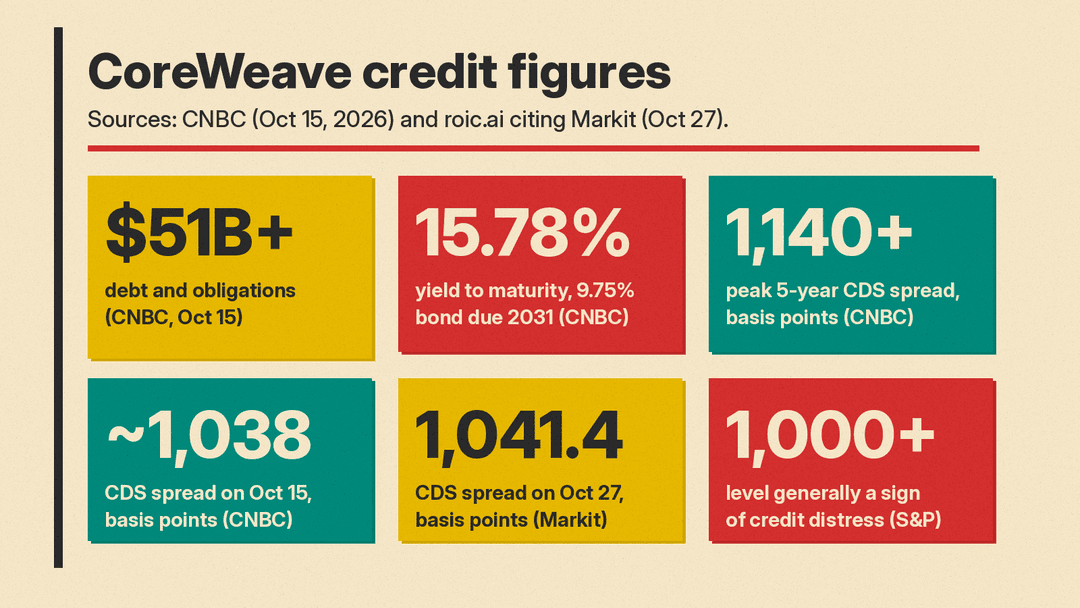
CoreWeave is a neocloud, a company that rents GPU capacity to AI customers. CNBC reported on October 15 that it had taken on more than $51 billion of debt and obligations to fund its build-out. The yield to maturity on its 9.75% bond due in 2031 reached 15.78%, and the spread on its five-year credit default swaps (CDS), which are insurance against default, rose above 1,140 basis points at one point. It last stood at nearly 1,038 basis points, up 16% in a week and 164% from a year earlier.
A spread of 1,000 basis points or above is generally a sign of credit distress, according to Gavan Nolan of S&P Global Market Intelligence, quoted by CNBC. The Evercore ISI trading desk said the market was "basically saying 'no mas' to AI debt without operating cash flow support."
The pressure has not gone away. roic.ai, citing Markit data, reported that the spread narrowed to 1,041.4 basis points on October 27, the lowest in more than a week, and still above 1,000.
What CoreWeave says back
Nolan told CNBC that no one is questioning whether demand for CoreWeave's services is real, since the company has contracts with all the big hyperscalers. The question, he said, is whether the cash flows will arrive. He called free cash flow "heavily negative" at the moment.
CEO Mike Intrator answered in a memo that CNBC obtained: "We are confident in our backlog which more than supports all of our debt obligations." CNBC cited a Deutsche Bank note putting that backlog at over $100 billion, with around two-thirds of it held by investment-grade counterparties including Microsoft, Meta, IBM and Caterpillar.
So the two sides agree on demand and disagree on timing. CoreWeave points to signed contracts. Lenders and analysts point to the gap between spending now and cash arriving later.
The debt schedule
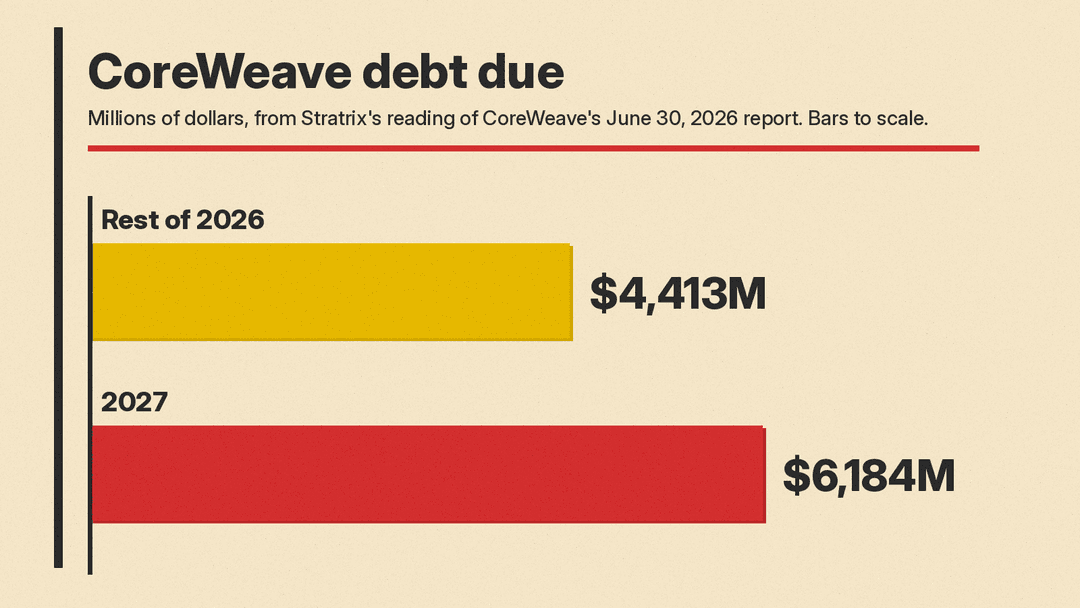
The research firm Stratrix read CoreWeave's filings and published these figures on November 1. At June 30, 2026, CoreWeave owed $35,551 million. Second-quarter revenue was $2,575 million, and interest due that quarter was $592 million, or 23% of revenue. CoreWeave has $4,413 million to repay in the rest of 2026 and $6,184 million in 2027. These are Stratrix's figures from the company's quarterly report, so check them against the filing.
Stratrix also found that the largest customer paid 36% of second-quarter revenue, down from 71% a year earlier, and that the top two paid 62%. It noted that CoreWeave's loan signed in August costs 5.50% over the benchmark rate, against 4.50% for the one signed in May.
The roic.ai report adds a spending view, citing a full-year capital expenditure plan of $35 billion to $39 billion and $5.5 billion in cash on June 30. It also cites FactSet analysts expecting negative free cash flow of about $10.1 billion for the third quarter. Treat these as secondhand until CoreWeave reports.
Why the midterms made it worse
On November 4, CoreWeave fell again after Democrats won the midterms. Business Insider listed CoreWeave down 9.2%, Nebius down 6% and Iren down 11%. The fear is that Democratic wins slow the pace of data center building. Benzinga, citing CNBC, said Texas accounts for 27% of planned data center gigawatts, per Wells Fargo, and that the new Texas governor campaigned for tougher limits on data center development, including an immediate moratorium.
CNBC's November 5 analysis adds a financing angle. JPMorgan's James Sullivan told CNBC that debt-funded neoclouds face much higher borrowing costs than hyperscalers. Nomura said the bigger impact may hit from 2028, because much of the capacity due from 2027 is already under construction.
For the stock move itself, see our earlier report on how the midterms hit AI stocks. For the earlier slide in neocloud shares, see Microsoft capacity delays and CoreWeave, Nebius stocks.
What to watch on November 10
CoreWeave's investor relations page lists the call for 5:00 PM Eastern on November 10, 2026. The sources above point to three things worth reading in the results.
- Cash use. The roic.ai report says investors will scrutinize cash consumption, financing plans, and whether revenue growth turns into better cash generation.
- Financing terms. The August loan priced a full point above the May loan. A new loan priced lower would be a sign that lenders are easing. Stratrix named a price below 4.0% over the benchmark as the level that would change its view.
- Customer concentration. Stratrix said that if the largest customer fell below 20% of revenue, the business would rest on many customers rather than a few anchors. It was 36% at June 30.
The earnings report cannot settle the political question. Nomura, quoted by CNBC, puts the bigger impact of tighter data center rules from 2028. The report can show whether CoreWeave is covering its interest and whether new lenders are still willing to fund it.
Sources
- CNBC: CoreWeave credit default swaps hit distress levels as investors sour on AI debt (October 15, 2026)
- roic.ai: CoreWeave CDS narrows to lowest in over a week, but credit stress persists
- Stratrix: Lenders aren't betting on the AI clouds. They're betting on their customers (November 1, 2026)
- Business Insider: The midterms' blue wave is hammering neocloud stocks like CoreWeave
- Benzinga: CoreWeave, peers fall after Democrats sweep midterms
- CNBC: How the midterms could fuel the K-shaped AI trade (November 5, 2026)
- CoreWeave investor relations: Third Quarter 2026 earnings call
