
An AI product manager is a product manager whose product depends on AI, or who uses AI tools heavily to do the job. The title has no single official definition. This page reads what the sources say, lists the courses and guides that exist for the role, and ends with a plan for switching in from another field.
We read each page in November 2026. Where a page says something, we quote it or follow it closely. Where we draw a conclusion of our own, we mark it as "our reading." Courses change their dates, prices and content, so check each provider's page before you enroll.
What an AI product manager does
There are two useful definitions, and they differ.
IBM's AI Product Manager Professional Certificate page says: "AI Product Managers are responsible for driving the success of AI products by combining expertise in product management principles with a deep understanding of AI technologies and their applications." That is a product manager for AI products.
Arize, a company that sells observability and evaluation tools for AI teams, gives a wider picture in its guide to the AI product manager role, updated August 4, 2026. It names three archetypes:
- AI Product PM: integrates AI directly into user-facing products, with a focus on UX/UI and customer value.
- AI Platform PM: manages infrastructure, reliability, security and scalability of AI models and services.
- AI Powered PM: uses AI tools extensively for rapid prototyping, prompting and speeding up product workflows.
Arize also says AI product managers "navigate probabilistic outcomes" where it says traditional product outcomes are often deterministic, and that "Evals replace traditional PRDs for AI products." A PRD is a product requirements document. An eval is a test that scores a model's outputs against criteria you set. The page also says the distinction between AI PMs and other PMs "may be short-lived as all product managers embrace AI tools."
Our reading: the title covers at least three different jobs. Before you pick a course, decide which of the three archetypes you want, because a platform PM and an AI-powered PM need different skills.
The skills the sources point to
No single source gives an official skill list for this role, so we pulled the skills that the course pages and guides name.
- How machine learning works, without coding. Duke's program says its courses "focus on the intuition behind these technologies, with no programming required."
- Running an ML or AI project. Duke's second course covers the steps of a project "from how to identify good opportunities for ML through data collection, model building, deployment, and monitoring and maintenance of production systems."
- Core product management. IBM's first course covers "the end-to-end product management lifecycle and the role the product manager plays that drives product success."
- Generative AI and prompting. IBM's certificate lists prompt engineering and foundation models among what you learn.
- Evals. OpenAI's guide says that evaluations "test model outputs to ensure they meet style and content criteria that you specify."
- Human-centered design for AI. Google's PAIR guidebook and Microsoft's HAX Toolkit, both covered below, are written for people who design and plan AI products.
- Responsible AI. Duke's third course analyzes "the relevant ethical and privacy considerations" of a project, and IBM lists Responsible AI among its skills.
If any of the terms are new, our AI glossary defines 50 of them, and our explainers on embeddings and fine-tuning cover two ideas that come up in product discussions with engineers.
Two certificate programs for product managers
Both programs below sit on Coursera. We compare what each page states about content, level and time.
Duke: AI Product Management
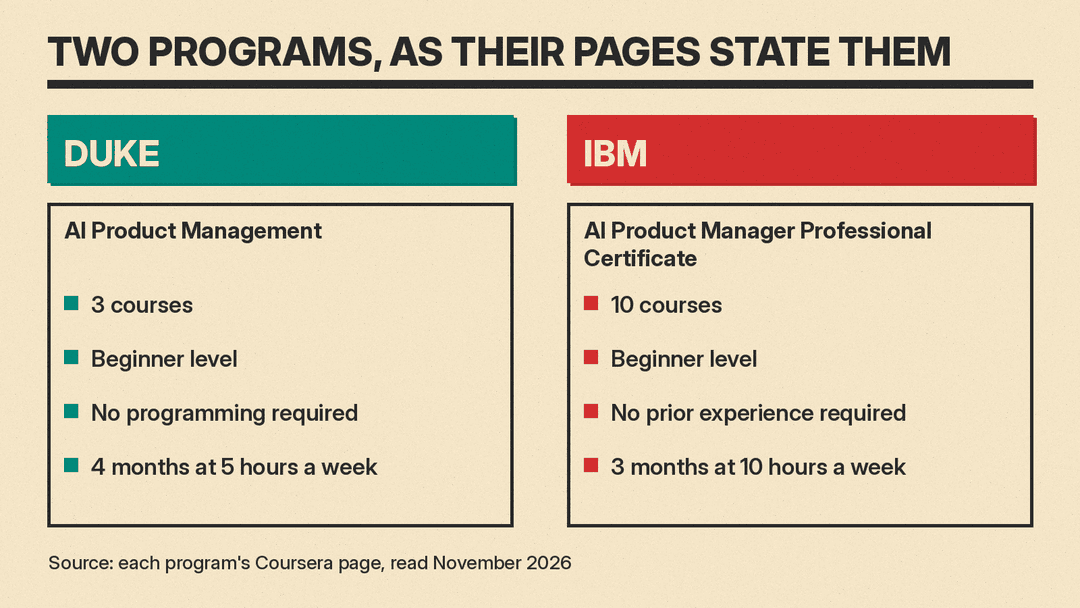
Duke University's Pratt School of Engineering offers the AI Product Management Specialization, taught by Jon Reifschneider. The page lists it as a 3 course series at beginner level, about 4 months at 5 hours a week. Duke's own course page says product managers and product owners, engineering team leaders, executives and analysts will find the program valuable.
The three courses are:
- Machine Learning Foundations for Product Managers, 16 hours. It ends with a hands-on project in which you train and optimize a model on a simple real-world problem.
- Managing Machine Learning Projects, 18 hours. The project is to frame a problem of interest, design an ML system for it and begin a project plan.
- Human Factors in AI, 17 hours. The project is a basic user experience design exercise for your ML-based solution, plus an analysis of ethical and privacy considerations.
Our reading: this program is built around machine learning in general. The Coursera page does not use the words generative AI or large language models, so if you want that coverage, pair it with something else.
IBM: AI Product Manager Professional Certificate
IBM's certificate is a 10 course series at beginner level, with 3 months to complete at 10 hours a week. The page says "no prior experience required" and that you finish with "a portfolio of projects and a Professional Certificate from IBM." IBM also lists the program on its own training badge page.
The first four courses are about product management itself:
- Product Management: An Introduction
- Product Management: Foundations & Stakeholder Collaboration
- Product Management: Initial Product Strategy and Plan
- Product Management: Developing and Delivering a New Product
The other six mix AI topics with product work:
- AI Foundations: How Artificial Intelligence Works
- Generative AI Essentials: From Fundamentals to Real-World Applications
- Prompt Engineering for Generative AI: Build Better AI Prompts
- Generative AI: Foundation Models and Platforms
- Product Management: Building AI-Powered Products
- Generative AI: Supercharge Your Product Management Career
The hands-on work includes building a product concept, vision and project charter, creating a product backlog with the sprint planning process, and using generative AI models to create a prediction model for used car sale price.
Our reading: the IBM program opens with four courses on core product management and then moves to AI and generative AI topics, so it suits someone who has not worked as a product manager before. Duke's program assumes you will pick up the product side elsewhere.
Both pages show an "Included with Coursera Plus" label and an enroll button. We do not quote prices here because Coursera pricing and start dates change; check the page.
Guides and toolkits for designing AI products
Two public toolkits are written for the teams that design AI products. Neither is a course, and both are useful reading for a new AI product manager.
Google PAIR: People + AI Guidebook
The People + AI Guidebook comes from Google's People + AI Research group. The guidebook's old-gb page says it "was written to help user experience (UX) professionals and product managers follow a human-centered approach to AI." It has six chapters that "follow the product development flow," and each has a related worksheet. Three of the chapter names are User Needs + Defining Success, Data Collection + Evaluation, and Errors + Graceful Failure. The page cites a publication date of May 8, 2019, so treat it as foundational reading and check for newer sections.
Microsoft HAX Toolkit
The HAX Toolkit is described as being "for teams building user-facing AI products," and Microsoft says to use it early in the design process. It has four parts:
- Guidelines for Human-AI Interaction, best practices for how AI systems should behave.
- The HAX Design Library, patterns and examples for applying the guidelines.
- The HAX Workbook, a discussion guide for prioritizing which guidelines to implement.
- The HAX Playbook, for products that use natural language processing, to identify common failures so you can plan for mitigating them.
Learn evals, because the sources keep returning to them
Arize calls evals the new requirements document. OpenAI's Working with evals guide shows the idea at small scale. It says there are three steps to build and run evals for an LLM application:
- Describe the task to be done as an eval.
- Run your eval with test inputs, which are a prompt and input data.
- Analyze the results, then iterate and improve on your prompt.
Its worked example sorts IT support tickets into Hardware, Software or Other, and checks each model answer against a label a human wrote. The guide compares the process to behavior-driven development, where you specify how the system should behave before you build it.
One caution: the same page says OpenAI is deprecating its Evals platform. The page says evals become read-only for existing users on October 31, 2026, a date that has now passed, and that the platform is scheduled to shut down on November 30, 2026. The three-step idea does not depend on that platform, but if you want to practice on it, check the deprecations page first.
Our reading: a product manager does not need to write the code for an eval. The skill is deciding what a good answer looks like, collecting realistic test cases and reading the results. That is the same work as writing acceptance criteria, applied to outputs that vary.
How to switch: a plan from another field
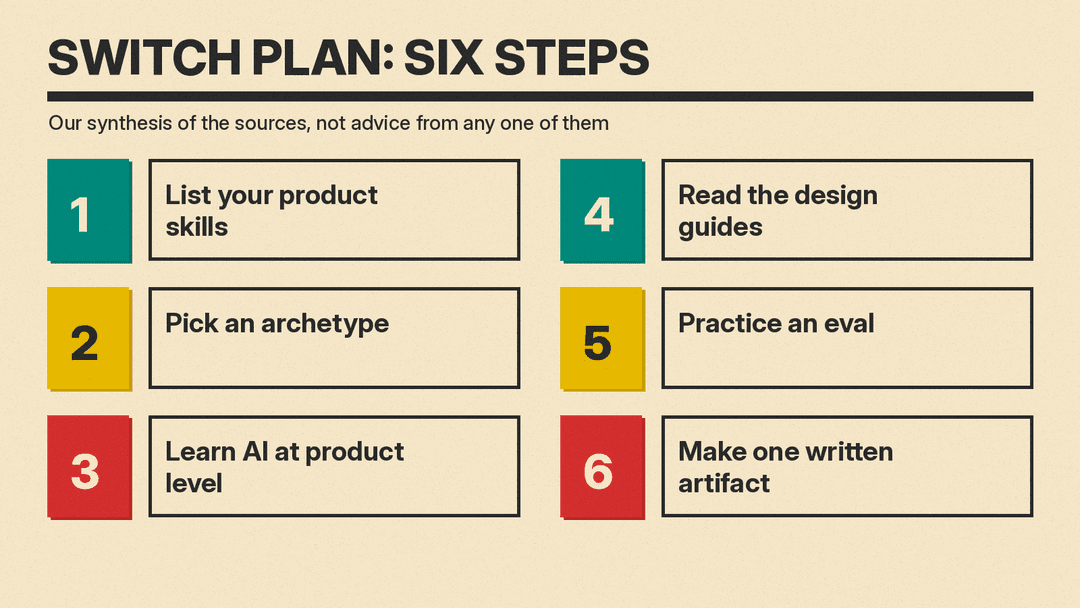
This plan is our own synthesis of the sources above, not advice from any one of them. Arize says moving into the role is "an evolution of existing strategic, product, and leadership skills," which fits the order below.
- List the product skills you already have. If you run projects, write requirements, talk to customers or set priorities, those carry over. If you have never done product work, the IBM certificate starts at the beginning.
- Pick an archetype. Decide whether you want to build AI features for users, run an AI platform, or use AI to speed up ordinary product work.
- Learn how AI works at product level. Take the Duke specialization, the IBM certificate, or both, depending on how much product experience you have. For a general base first, see our 12-week plan to learn AI from scratch and our free LLM course picks.
- Read the design guides. Go through the PAIR chapters and the HAX Guidelines, and fill in one worksheet or workbook for a product you use.
- Practice an eval. Pick a small task, such as sorting messages into categories, write 10 or so examples with the right answers, and score a model against them using the three steps above. The number of examples here is our suggestion, not a figure from a source.
- Make one written artifact. Combine what you read in the design guides with your eval practice in a short product document: the user problem, what a good output looks like, how you tested it, where it fails, and what the product does when it fails. It gives you something specific to show in an interview.
If you are still deciding between this and a more technical path, our comparison of AI engineer, ML engineer and data scientist explains where those roles differ from product management.
What we could not verify
- Pay. We found no official government page for AI product manager pay. Arize's guide says, based on Glassdoor and industry benchmarks from 2025, that AI PMs earn "approximately 15-20% more than traditional PMs in the U.S." We could not check the underlying data, so treat it as a vendor claim.
- Hiring. We did not find a neutral source for how many AI product manager jobs exist, so this page makes no claim about demand.
- Outcomes. IBM's page says you can get "job-ready in 3 months or less." We did not find an independent source that tracks job results for either program, so we cannot say how many graduates get hired.
Sources
- IBM AI Product Manager Professional Certificate, Coursera
- IBM AI Product Manager Professional Certificate badge, IBM Training
- AI Product Management Specialization, Duke University on Coursera
- AI Product Management, Duke Online
- People + AI Guidebook, Google PAIR
- People + AI Guidebook (old-gb page), Google PAIR
- Microsoft HAX Toolkit
- Working with evals, OpenAI API documentation
- What is an AI product manager? The role and skills in 2026, Arize
