
This is an opinion piece. The facts come from the linked sources. The argument is mine.
On November 5, 2026, OpenAI published a National Community Compact and a Compute Campus Policy Blueprint. Our news desk covered the details in OpenAI Pledges No NDAs, Full Power Costs at New Campuses. This post is about what the pledges are worth. My view: the compact is a sensible start, but most of it is a promise that only OpenAI can check. The parts worth watching are the ones an outsider can verify, and the blueprint, which asks lawmakers to write rules for everyone, matters more than the compact.
What OpenAI promised
The compact's scope is stated plainly. OpenAI says it sets out "what communities can expect from OpenAI at future campuses that we own and operate". Each such campus gets its own local compact with a common set of commitments.
- Energy: OpenAI says it will pay "the full cost of the electricity we use and the infrastructure needed to serve us," and will provide financial assurances before major spending begins, so other customers are protected if a project is delayed, reduced, or canceled.
- Reporting: it will publish site-level water and electricity use, publish construction plans and independent noise studies, and report publicly each year.
- Secrecy: it says it will not use non-disclosure agreements with public officials, allowing only "narrow protections covering legitimate security information, trade secrets, or proprietary or competitively sensitive information."
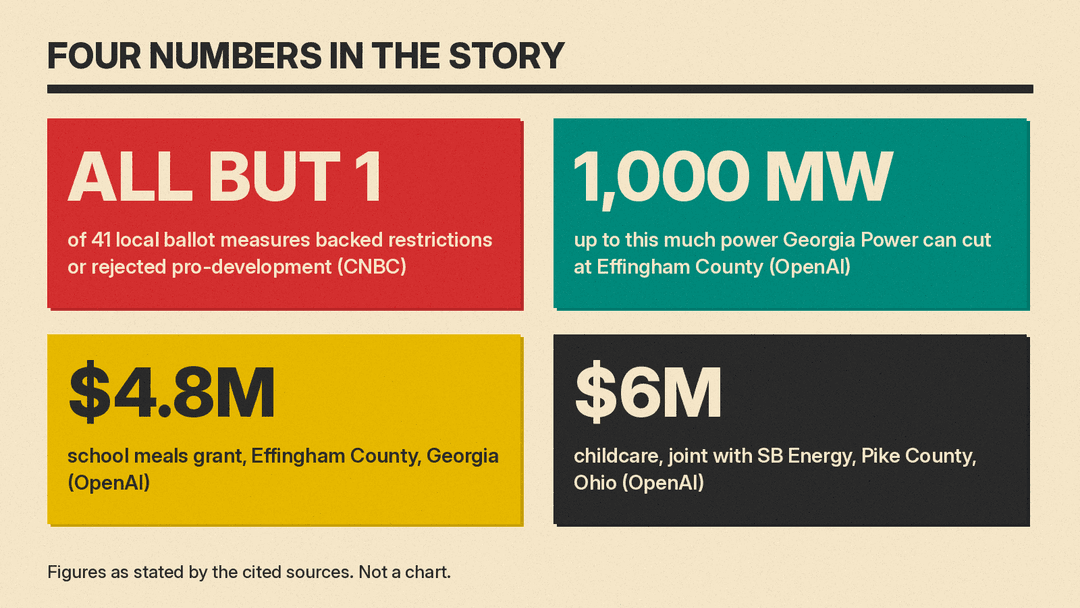
- Jobs and local spending: it says it will publish the jobs it expects to create and make sustained investments in priorities residents help select. Its examples are a $4.8 million grant for free school meals in Effingham County, Georgia, and a joint $6 million commitment with SB Energy for childcare in Pike County, Ohio.
The timing stands out. CNBC reports that voters backed restrictions or rejected pro-development measures in all but one of 41 local data center ballot measures across 10 states, according to an analysis by Ballotpedia and additional results gathered by CNBC. The same report says OpenAI's chief global affairs officer, Chris Lehane, told reporters the blueprint has been in the works since August. We covered the Ohio results in Ohio Votes Ban and Limit Data Centers in 14+ Places. Whatever the sequence, the publication date puts the pledges next to the vote, and readers will judge them that way.
Three gaps between the promise and the proof
Scope. The promises cover campuses OpenAI owns and operates. Reuters notes: "Partners such as Oracle are building and own much of OpenAI's data center infrastructure, with the capacity dedicated to the startup." I cannot tell from these sources how much of OpenAI's capacity falls inside the compact. A reader should ask that before treating the pledge as a company-wide standard.
Who checks the reports. The reporting promises are published by the company that makes them. The one item described as independent is the noise study. Publishing site-level electricity use is useful, but a figure published by the operator is a claim until someone else can compare it with a utility's records. The compact, as OpenAI describes it, does not say who that someone is.
The exceptions. The NDA pledge is a real change, and it has a carve-out. Reuters adds that OpenAI said it will no longer use NDAs with public officials "although proprietary information would still be under wraps." The carve-out lists "competitively sensitive information," and that phrase can stretch. The text does not say whether electricity terms count as sensitive. I do not know the answer, and a reader of the announcement cannot know it either. That is the gap.
What I think is underrated, and what I think is overhyped
The most concrete line in the announcement is the one about Georgia. OpenAI says that at its planned Effingham County campus, its agreement with Georgia Power "allows the utility to reduce the power it delivers to us by up to 1,000 megawatts during periods of high demand." It is the only commitment about power use that comes with a number, and I expect a utility could confirm it. It also speaks to a demand Axios reports from newly elected candidates, that new strains on the grid not hit ratepayers. I would give it more weight than the school meals grant, which is welcome but is not a safeguard.
The renaming is the opposite. Axios reports that Lehane said renaming data centers "compute campuses" was an intentional effort to "provoke that conversation," and that some policymakers and consumer advocates view the renaming as a gimmick. A new label is not a commitment. I would judge the company by the financial assurances and the reports, and ignore the vocabulary.
Why the blueprint matters more than the compact
OpenAI itself writes that "Voluntary commitments from companies are an important starting point," and its blueprint asks federal, state and local policymakers to establish clear rules. Lehane told reporters the blueprint will help ensure "a very high floor" for how people move forward. A floor that applies to one company's own campuses is a company policy. A floor in law applies to every developer, including the partners that own much of the capacity.
Axios reports that some new state leaders campaigned on the importance of binding agreements, and that a report last month from Sen. Elizabeth Warren found that major tech companies are not covering the full infrastructure costs of their data centers. Permit politics already reaches finance: our report on the Texas pause that stalled a bond sale for an Anthropic-linked data center describes banks delaying part of a roughly $15 billion loan sale after the state put a hold on new projects.
Five checks I would apply
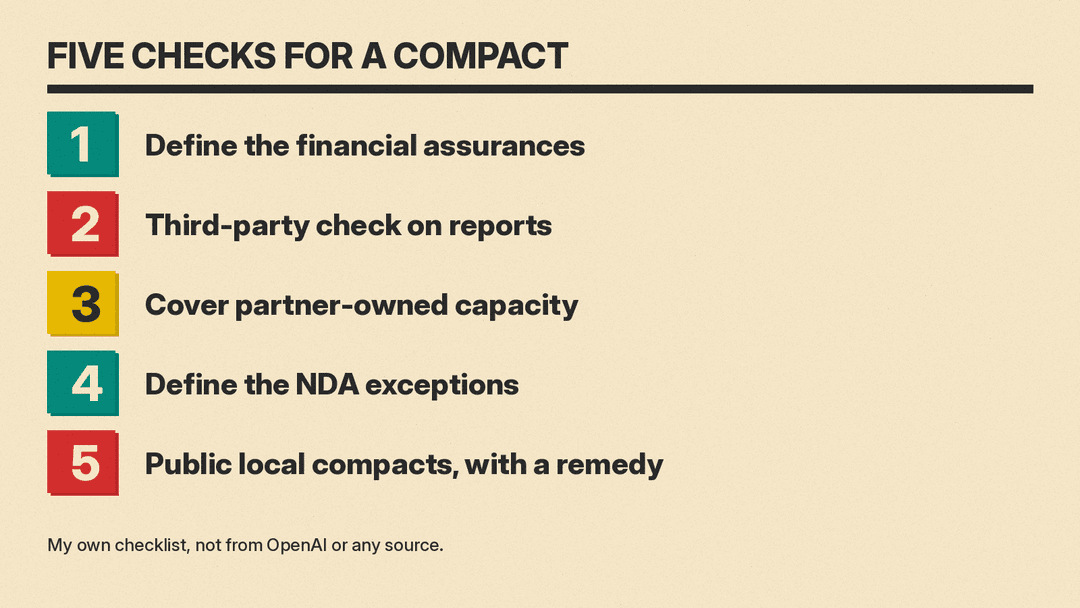
This list is my own view, not a standard from OpenAI or anyone else.
- Ask what "financial assurances" means in dollars and who holds them.
- Ask for a third party to check the annual reports against utility records.
- Ask whether partner-owned capacity falls under the compact.
- Ask that the NDA exceptions be defined, including whether power terms are covered.
- Ask for each local compact to be public, with a stated remedy if a commitment is missed.
None of these is hostile. They are what a careful reader asks of any pledge that depends on the pledger's own paperwork. If OpenAI answers them, the compact becomes a standard others can measure. If it does not, it remains a statement of intent, and the blueprint's call for rules is the stronger part of the package.
Sources
- OpenAI: Setting a new standard for responsible AI infrastructure, November 5, 2026
- CNBC: OpenAI to pay for data center power after election shows AI concern
- Reuters via StreetInsider: OpenAI kicks off charm offensive to change voters' view of data centers
- Axios: Big tech scrambles to offer voters a new AI deal
