
MiniCPM is a family of open-weight AI models built for on-device use. OpenBMB's about page says the group focuses on "device-cloud collaboration, low-power inference and multimodal perception, providing a full-stack open-source solution from model training to on-device deployment." The home page title is "OpenBMB · Big Model for Everyone."
On September 8, 2026, a post on the OpenBMB site said, "On September 8, ModelBest and the OpenBMB open-source community officially released the new-generation" MiniCPM5-2B. The model cards and docs also list earlier MiniCPM text models, MiniCPM-V vision models, and MiniCPM-OCR. Weights are published on Hugging Face and ModelScope.
This guide starts with the newest text models, MiniCPM5-2B and MiniCPM5-1B, then MiniCPM-V 4.7 and MiniCPM-OCR 1.0. It then places MiniCPM-SALA, MiniCPM4 / 4.1, and MiniCPM-o in the family, and records each license from its own source. Vendor-measured scores are given as reports, with the page that publishes them.
The MiniCPM family
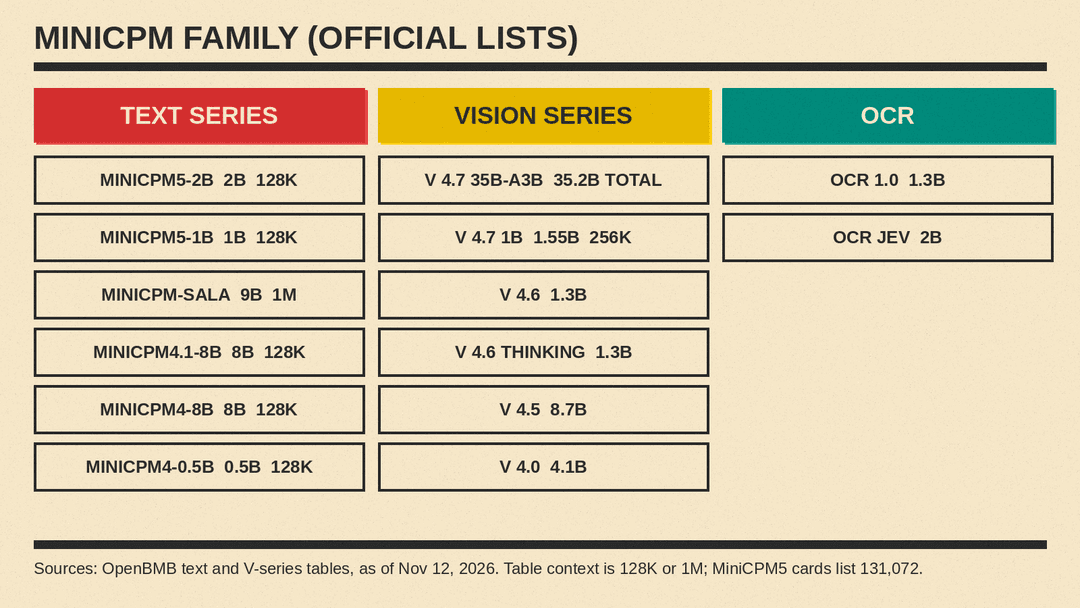
OpenBMB's docs split the lineup into a text series and a multimodal series. The MiniCPM text series page calls it "a family of high-performance language models built for on-device deployment, with parameter sizes ranging from 0.5B to 9B." It says the series "currently includes MiniCPM5, MiniCPM-SALA and MiniCPM4 / 4.1."
That page's table lists:
- MiniCPM5-2B: 2B parameters, 128K context, "Strong performance on code, math, long text, tool calling and agent tasks"
- MiniCPM5-1B: 1B parameters, 128K context, "Hybrid Think/No Think reasoning, tool calling"
- MiniCPM-SALA: 9B parameters, 1M context, "Hybrid sparse + linear attention"
- MiniCPM4.1-8B: 8B parameters, 128K context, "Sparse attention, hybrid reasoning"
- MiniCPM4-8B: 8B parameters, 128K context, "5x on-device generation speedup"
- MiniCPM4-0.5B: 0.5B parameters, 128K context, "Ultra-lightweight on-device model"
The same page's recommended-choices table calls MiniCPM4-0.5B "The smallest model in the series." That wording refers to the text series on that page. It is not a claim about every MiniCPM-named model. The MiniCPM-V multimodal page lists vision models "with sizes ranging from 1B to 35B parameters," so MiniCPM-V 4.7 35B-A3B has more total parameters than MiniCPM-SALA at 9B. MiniCPM4-0.5B is still the smallest model on the official text-series list.
The text page's quick advice is: "If you're unsure, start with MiniCPM5-2B and MiniCPM5-1B; choose MiniCPM-SALA if you need million-token context; choose MiniCPM4.1-8B if you need stronger 8B-class capability."
The multimodal page says: "MiniCPM-V is a series of multimodal vision-language models built for on-device deployment, supporting image and video understanding, with sizes ranging from 1B to 35B parameters. The series also includes MiniCPM-OCR 1.0 for document parsing and MiniCPM-OCR Jev for OCR quality assessment." It also says MiniCPM-V 4.7 and 4.6 "can run fully offline on mobile devices (iOS / Android / HarmonyOS)" and points to MiniCPM-V-Apps.
The OpenBMB changelog lists a further line, MiniCPM-o. It records MiniCPM-o 4.5 as open-sourced on February 3, 2026, and describes it as a "9B-parameter full-duplex multimodal model" with vision and speech. The same changelog lists VoxCPM under "Speech Models (VoxCPM Series)," a separate heading from the MiniCPM-named models.
MiniCPM5, the current text models
The changelog dates MiniCPM5-1B to May 19, 2026, and MiniCPM5-2B to September 7, 2026. The MiniCPM5-2B announcement blog is dated September 8, 2026.
MiniCPM5-2B
The MiniCPM5-2B model card calls it "the second model in the MiniCPM5 series, following MiniCPM5-1B. It is a dense 2B Transformer that scales up the same training recipe, built for on-device, local deployment, and resource-constrained scenarios."
The card lists these model facts:
- Type: Causal Language Model
- Architecture: Standard LlamaForCausalLM
- Number of Parameters: 2,516,756,480
- Number of Non-Embedding Parameters: 1,981,982,720
- Number of Layers: 42
- Number of Attention Heads (GQA): 16 for Q and 2 for KV
- Context Length: 131,072
The official text-series table says 128K context for MiniCPM5-2B. The model card says 131,072. Both figures are given here, each with its source.
The card says the model is "designed for local assistants, coding agents, tool-use workflows, and reasoning scenarios where a compact model is preferred. The model keeps a small deployment footprint while providing native long-context support."
The same card lists several related checkpoints and packages: the BF16 final release in this repository (post-trained with RL + OPD), plus SFT, Midtrain, and Base checkpoints, GGUF for llama.cpp, Ollama, and LM Studio, MLX 4-bit for Apple silicon, GPTQ 4-bit, a DSpark draft model, and a LiteRT-LM build under litert-community/MiniCPM5-2B. It documents vLLM, SGLang, llama.cpp, and Transformers. For vLLM it shows vllm serve openbmb/MiniCPM5-2B --port 8000. It recommends sampling settings of temperature=1.0, top_p=0.95, and min_p=0.0, and suggests adding repetition_penalty=1.05 if outputs repeat.
The September 8 blog reports figures from the Artificial Analysis Intelligence Index as of that post. It says: "According to the latest evaluation by the internationally recognized Artificial Analysis Intelligence Index (hereafter "the AA Leaderboard"), MiniCPM5-2B scores 23 points overall, ranking first among open-source foundation models under 4B parameters worldwide." It also says: "On Agentic Index, which measures agent capabilities, MiniCPM5-2B leads by a wide margin: it scores 20 points, while peer models such as LFM2.5-2.6B, Granite 4.2 3B, and Mistral 3 3B score only 2." On 34 benchmarks, the blog says "Its average score reaches 53.9, ranking first," ahead of "the second-place 2B model at 33.2" and "the best-performing 4B model, Qwen3.5-4B." Those rankings were not rechecked against Artificial Analysis for this article.
The model card reports that, on the benchmarks listed there, "RL + OPD improves reasoning and general capabilities by an average of ↑10.96 points, and agentic capabilities by ↑6.96 points." It describes OPD as merging "the capabilities of 16 expert models produced by RL training, including 5 agentic expert models."
The blog says four datasets were open-sourced with MiniCPM5-2B: UltraData-Code, UltraData-SFT-Agent-2609, UltraData-RL-2609, and UltraX. It also says the Meshy reinforcement learning framework and JustRL II were open-sourced. This article does not assign a license to those datasets or to Meshy; a request for the Meshy repository LICENSE file on November 12, 2026, returned HTTP 404. The blog also says, "As of August 2026, MiniCPM series models have surpassed 50 million open-source downloads, and the MiniCPM language foundation model has surpassed 13 million downloads."
MiniCPM5-1B
The MiniCPM5-1B model card calls it "the first checkpoint in the MiniCPM5 series." It lists:
- Type: Causal Language Model
- Architecture: Standard LlamaForCausalLM
- Number of Parameters: 1,080,632,832
- Number of Non-Embedding Parameters: 679,552,512
- Number of Layers: 24
- Number of Attention Heads (GQA): 16 for Q and 2 for KV
- Context Length: 131,072
As with MiniCPM5-2B, the text-series table says 128K context and the card says 131,072. The card says the same checkpoint supports "both Think / No Think chat modes."
The changelog entry for May 19, 2026, describes MiniCPM5-1B as "A 1B-parameter on-device SOTA model with hybrid reasoning (Think / No Think), including Agent Skills for deployment and fine-tuning." That SOTA wording is OpenBMB's.
MiniCPM-V 4.7 and the vision series
The changelog dates MiniCPM-V 4.7 to October 12, 2026, "in 35B-A3B and 1B variants." It says "The 35B-A3B variant is the series' first MoE model, supporting smooth inference on phones and other local devices while preserving model capabilities."
The MiniCPM-V 4.7 35B-A3B model card says MiniCPM-V 4.7 "is the latest model in the MiniCPM-V series, available in a 35B-A3B variant, with 35B-A3B being the first MoE model in the MiniCPM-V series." It says the model "builds on the family's single-image, multi-image, and video understanding capabilities."
The official V-series table lists MiniCPM-V 4.7 35B-A3B as "35.2B total · ~3.5B active," with architecture "SigLIP canvas M-RoPE + Qwen3.5-MoE." The Hugging Face repository name and card use 35B-A3B, where A3B in the name indicates 3B active parameters. The docs table's 35.2B total and about 3.5B active figures are different from that name. Both are given here.
The 35B-A3B card reports that with Lookahead Expert Scheduling (LES), "combined with fine-grained layer-wise quantization and DSpark speculative sampling integration, MiniCPM-V 4.7 35B-A3B becomes the first open-source MoE model to run smoothly on-device without compromising performance, achieving a decoding speed of 13+ tokens/s with just 3 GB of memory on iPhone 17 Pro Max." That "first" wording is the card's. The card says LES "uses cross-layer routing prediction to preload experts likely to be needed by the next layer," and that "Predictions guide only prefetching and scheduling; computation still follows the model's original token-level routing."
In Instruct mode, the card reports that 35B-A3B "achieves a higher overall score in less inference time than Qwen3.6 35B-A3B." The numeric scores for that comparison appear as figures on the card and are not transcribed here.
The official V-series table also lists:
- MiniCPM-V 4.7 1B: 1.55B parameters, architecture "SigLIP canvas M-RoPE + Qwen3.5-0.8B," highlights "256K context, on-device friendly"
- MiniCPM-V 4.6: 1.3B parameters, architecture "SigLIP2 + Qwen3.5-0.8B," 4 GB VRAM, highlights "Early ViT compression, on-device deployment"
- MiniCPM-V 4.6 Thinking: 1.3B parameters, same architecture and 4 GB VRAM, "Deep reasoning variant"
- MiniCPM-V 4.5: 8.7B parameters, architecture "SigLIP2 + Qwen3-8B," about 28 GB VRAM. The table's highlight line is "Surpasses GPT-4o-latest, 30+ languages." That comparison is OpenBMB's wording on the table, not an independent measurement in this article.
- MiniCPM-V 4.0: 4.1B parameters, architecture "SigLIP2 + MiniCPM4-3B." The table's highlight line is "Surpasses GPT-4.1-mini," again from that OpenBMB table.
Several MiniCPM-V entries in that table name a Qwen3 or Qwen3.5 backbone. For background on that model family, see What Is Qwen?.
The 4.7 card says MiniCPM-V 4.7 "supports iOS, Android, and HarmonyOS, together with open-source on-device deployment support." It also lists "day-0 support for chip platforms from Rockchip, Houmo, Intel, AMD, and Arm." Runtimes named on the card include SGLang, vLLM, llama.cpp, and Ollama. Fine-tuning frameworks named are SWIFT and LLaMA-Factory. Formats named include GGUF, BNB, AWQ, GPTQ, and FP8. The card says the model is also on Ollama at ollama.com/openbmb/minicpm-v4.7.
On GGUF files, the card says each GGUF repository "also ships a thinking/ subfolder with the same quantization levels suffixed -thinking." It says those files "restore the upstream chat template and therefore emit a [Start thinking] … [End thinking] trace; the files at the repository root keep thinking disabled. Tensor weights are identical between the two sets; only the embedded template differs."
For a closer look at MiniCPM-V 4.7, including on-device speed claims and how to run it, see our MiniCPM-V 4.7 explainer.
MiniCPM-OCR 1.0
The changelog dates the MiniCPM-OCR release to October 28, 2026, "with MiniCPM-OCR 1.0, a 1.3B parsing model, and MiniCPM-OCR Jev, a 2B System-1 decision model." The official V-series table lists MiniCPM-OCR 1.0 at 1.3B, with architecture "SigLIP + Qwen3.5, trained from MiniCPM-V 4.6," and highlights "Chinese/English document parsing, recognition and KIE." The MiniCPM-OCR 1.0 model card lists the base model as openbmb/MiniCPM-V-4.6.
The same table lists MiniCPM-OCR Jev at 2B, with architecture "Qwen3.5-2B + binary classification head," VRAM "≥12 GB (local tutorial)," and highlights "OCR region quality assessment, candidate selection."
Benchmark figures and setup steps for the OCR models are in our MiniCPM-OCR 1.0 post.
MiniCPM-SALA and MiniCPM4
MiniCPM-SALA is dated February 11, 2026, on the changelog, which describes hybrid sparse and linear attention, million-token context support, and efficient inference. The MiniCPM-SALA card calls it "the first large-scale hybrid model effectively integrating sparse and linear attention for million-token context modeling." That "first" wording is the card's. It says 25% of the layers use InfLLM-V2 and 75% use Lightning Attention, and that "This architecture enables inference of one million tokens on consumer GPUs such as the NVIDIA RTX 5090." The card reports "up to 3.5x the inference speed of Qwen3-8B at a sequence length of 256K tokens on A6000D," and says the model "supports inference at context lengths of up to 1M tokens on both NVIDIA A6000D and 5090 GPUs."
The MiniCPM4 series is dated June 6, 2025. The changelog says the series "retains best-in-class performance at its size while improving efficiency, delivering over 5× faster generation on typical on-device chips." The MiniCPM4-0.5B card says the series "can achieve over 5x generation acceleration on typical end-side chips." Neither sentence in those sources names the baseline for that speedup. The same card's series list calls MiniCPM4-0.5B "The small version of MiniCPM4, with 0.5B parameters, trained on 1T tokens," and MiniCPM4-8B "The flagship of MiniCPM4, with 8B parameters, trained on 8T tokens." MiniCPM4.1-8B is dated September 5, 2025, on the changelog, described as "a trainable sparse-attention model supporting hybrid reasoning."
Licenses
The Apache License, Version 2.0, January 2004, is published by the Apache Software Foundation. The GitHub LICENSE files for OpenBMB/MiniCPM, OpenBMB/MiniCPM-V, and OpenBMB/MiniCPM-OCR, fetched on November 12, 2026, contain that text. The appendix notice in the MiniCPM LICENSE file reads "Copyright [OpenBMB]."
The cards and READMEs do not all use the same sentence, and they do not all cover the same items:
- The MiniCPM5-2B and MiniCPM5-1B cards say: "This repository and MiniCPM model weights are released under the Apache-2.0 License." They link to the OpenBMB/MiniCPM LICENSE.
- The MiniCPM-SALA, MiniCPM4-0.5B, MiniCPM4-8B, and MiniCPM4.1-8B cards say: "This repository and MiniCPM models are released under the Apache-2.0 License." They link to the same OpenBMB/MiniCPM LICENSE.
- The MiniCPM-V 4.6 card says: "The MiniCPM-o/V model weights and code are open-sourced under the Apache-2.0 license." It links to the OpenBMB/MiniCPM-V LICENSE.
- The MiniCPM-V 4.7 35B-A3B and 1B cards list
license: apache-2.0in their YAML metadata. Unlike the MiniCPM-V 4.6 card, the 4.7 cards read on November 12, 2026, do not include a separate License section. - The MiniCPM-OCR 1.0 README says: "Model weights, code, and documentation are released under the Apache License 2.0." It links to the OpenBMB/MiniCPM-OCR LICENSE.
A check of those Hugging Face model repositories on November 12, 2026, did not find a LICENSE file inside the repos themselves; a request for /LICENSE returned HTTP 404. The licenses are in the GitHub files the cards link, and in the card metadata. Readers should read the linked files. The Apache License 2.0 text in those files grants a copyright license and a patent license subject to its terms, requires retention of notices, limits trademark use, and distributes the work "AS IS" without warranties. This article does not add use restrictions that those files do not state, and it does not assign a license to the training datasets named in the MiniCPM5-2B blog.
How to get the weights and run them
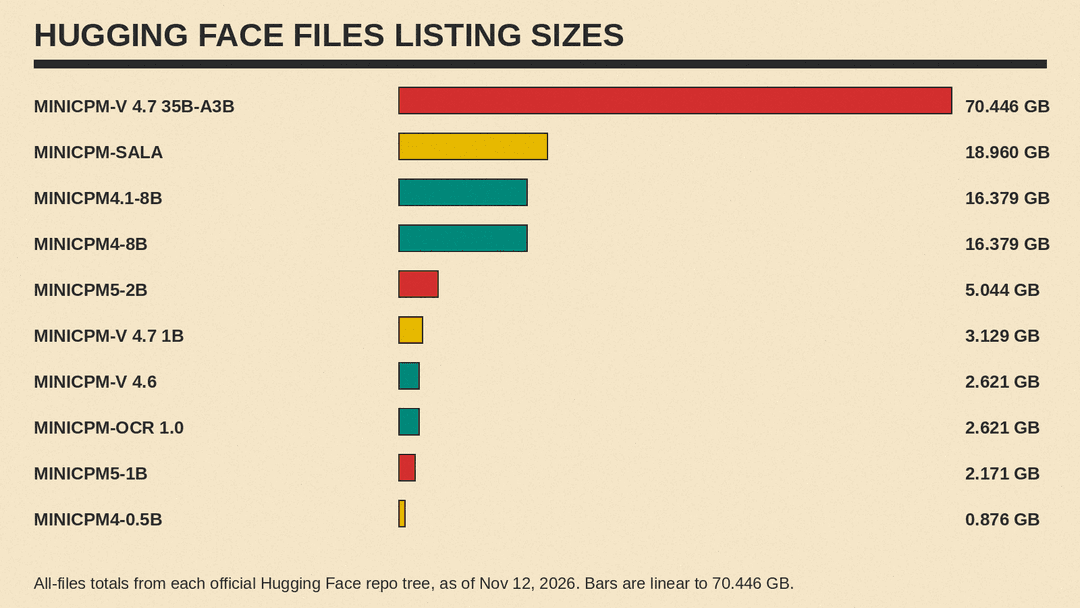
The official checkpoints are on Hugging Face (and, on the cards, ModelScope). As of November 12, 2026, the Hugging Face Files listing (all files in each repository's main tree) totaled about:
- MiniCPM-V 4.7 35B-A3B: 70.446 GB
- MiniCPM-SALA: 18.960 GB
- MiniCPM4.1-8B: 16.379 GB
- MiniCPM4-8B: 16.379 GB
- MiniCPM5-2B: 5.044 GB
- MiniCPM-V 4.7 1B: 3.129 GB
- MiniCPM-V 4.6: 2.621 GB
- MiniCPM-OCR 1.0: 2.621 GB
- MiniCPM5-1B: 2.171 GB
- MiniCPM4-0.5B: 0.876 GB
Among those official checkpoints, the largest Files listing is MiniCPM-V 4.7 35B-A3B and the smallest is MiniCPM4-0.5B.
The MiniCPM5-2B card documents vLLM, SGLang, llama.cpp, and Transformers. The MiniCPM-V 4.7 card documents SGLang, vLLM, llama.cpp, and Ollama, plus iOS, Android, and HarmonyOS. For GGUF files and how llama.cpp works, see What Is llama.cpp?. This article does not add hardware memory recipes beyond the Files listing sizes and the figures the cards themselves report.
Limits
The MiniCPM5-2B card, under "Limitations and Disclaimer," says: "This model has no autonomous intent or legal personhood; its outputs are text generated from statistical patterns and may be inaccurate, biased, or offensive, and may be manipulated by carefully crafted prompts ("jailbreaks") into producing unintended content. Its responses on sensitive topics such as politics, health, finance, and law are not reviewed by experts and should not be treated as professional advice." It also says: "This model is provided "AS IS", without warranty of any kind, express or implied, and the developers are not liable for any damages arising from its use."
The MiniCPM5-1B card uses a different heading, "Limitations and Responsible Use," and different wording: "MiniCPM5-1B is a language model that generates content based on learned statistical patterns from training data. It may produce inaccurate, biased, or unsafe outputs, and generated content should be reviewed and verified before use in high-stakes settings." It also says: "Users are responsible for evaluating outputs, applying appropriate safeguards, and complying with applicable laws, regulations, and platform policies."
Sources
- OpenBMB, About Us
- ModelBest Open-Sources MiniCPM5-2B (OpenBMB blog, September 8, 2026)
- MiniCPM Text Series (OpenBMB docs)
- MiniCPM-V Multimodal Series (OpenBMB docs)
- OpenBMB Changelog
- openbmb/MiniCPM5-2B (Hugging Face)
- openbmb/MiniCPM5-1B (Hugging Face)
- openbmb/MiniCPM-V-4.7-35B-A3B (Hugging Face)
- openbmb/MiniCPM-V-4.7-1B (Hugging Face)
- openbmb/MiniCPM-V-4.6 (Hugging Face)
- openbmb/MiniCPM-OCR-1.0 (Hugging Face)
- openbmb/MiniCPM-SALA (Hugging Face)
- openbmb/MiniCPM4-0.5B (Hugging Face)
- OpenBMB/MiniCPM LICENSE
- OpenBMB/MiniCPM-V LICENSE
- OpenBMB/MiniCPM-OCR LICENSE
