
BARS is a new research model that writes no lyrics of its own: you give it a beat, your lyrics and a 3-second voice clip, and it raps those lyrics over the beat in that voice. The paper was posted to arXiv on November 9, 2026, and is listed as a Best Paper Award nominee at ISMIR 2026.
The authors, Taemin Cho, Hector Martel and Enyan Koh, say the main gains are tempo control that does not depend on the beat, fewer skipped or repeated words, and the ability to redo a single line. There is a demo page with audio, but no public code or model.
What is BARS?
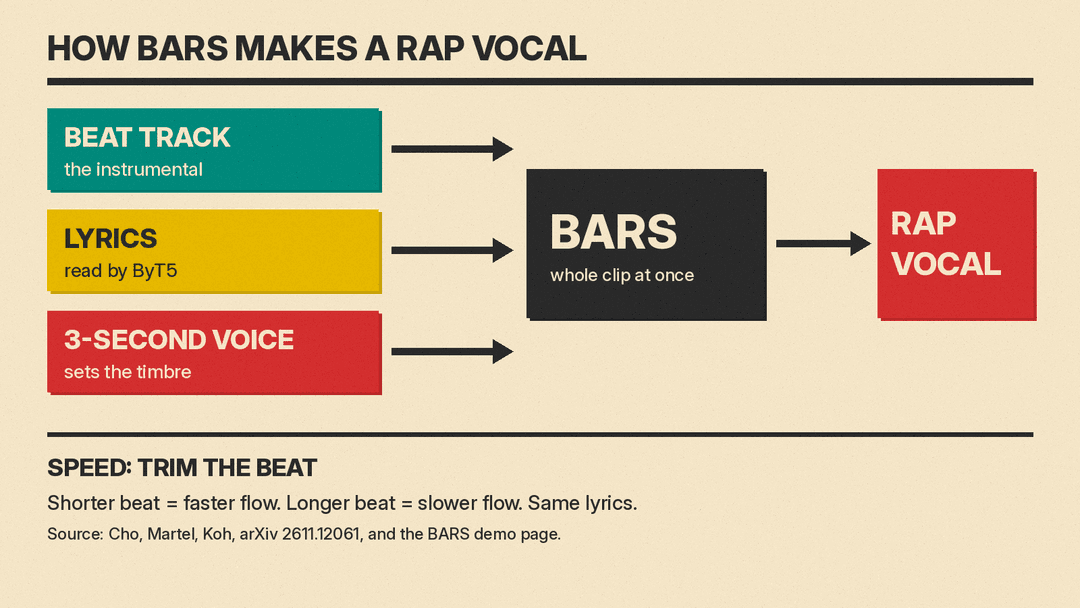
BARS stands for Beat-Adaptive Rap Synthesis. According to the arXiv paper, it takes three inputs:
- a beat track (the instrumental)
- the lyrics
- a 3-second reference voice
It outputs a rap vocal track that can then be mixed with the beat. The authors describe it as "a creative tool to help rap artists prototype and refine their vocal delivery."
The paper explains why rap needs its own model. Rap syllables have to land in tight timing windows on the beat, and pitch matters less than in singing. Singing-voice tools usually need set pitches and note lengths, which the authors say fit rap poorly. That is a different job from AI singing software like VOCALOID7, where you program the melody note by note.
How does BARS work?
BARS is built on Flow Matching, a type of generative model. In plain terms, it generates the whole vocal clip at once instead of one small piece after another. The earlier rap model the authors contrast it with, Freestyler (AAAI 2025), works piece by piece. The authors say that makes it slow to decode and ties both its rap pace and output length to the beat. Freestyler's weights are not public, so the team could not test it directly.
To read the lyrics, BARS uses ByT5, a Google text model that reads raw bytes rather than a fixed word or sound list. A small adapter, trained along with the model, translates ByT5's output into a form the audio side can use. The authors say this handles slang, abbreviations and numbers common in rap lyrics. Speech-trained text encoders such as SpeechT5 use a fixed phonetic vocabulary and treat such input as unknown tokens.
The team found that a strong beat signal made the model skip or repeat lyric words. Their fix is called Asymmetric Scaled RoPE (A-RoPE), a change to how the model tracks word positions. In the authors' words, it works "as if a lyric sheet were laid out along the track's timeline." The effect is to nudge the model to move through the lyrics in order.
BARS also supports span masking. You can regenerate one section of the lyrics and keep the surrounding vocal style.
Can you change the rap speed?
Yes. The paper says BARS controls rap tempo independently of the beat. On the demo page, speed is set by trimming the input beat: a shorter beat forces a faster flow for the same lyrics, and a longer beat gives a slower flow.
The training data averaged 17.9 characters per second, with a standard deviation of 2.9. Demo clips range from 9.2 to 46.9 characters per second. The demo also plays one lyric set over six styles: UK Grime, Trap, Orchestral, Drill, Trip Hop and Slow Hip Hop.
How well does it work?
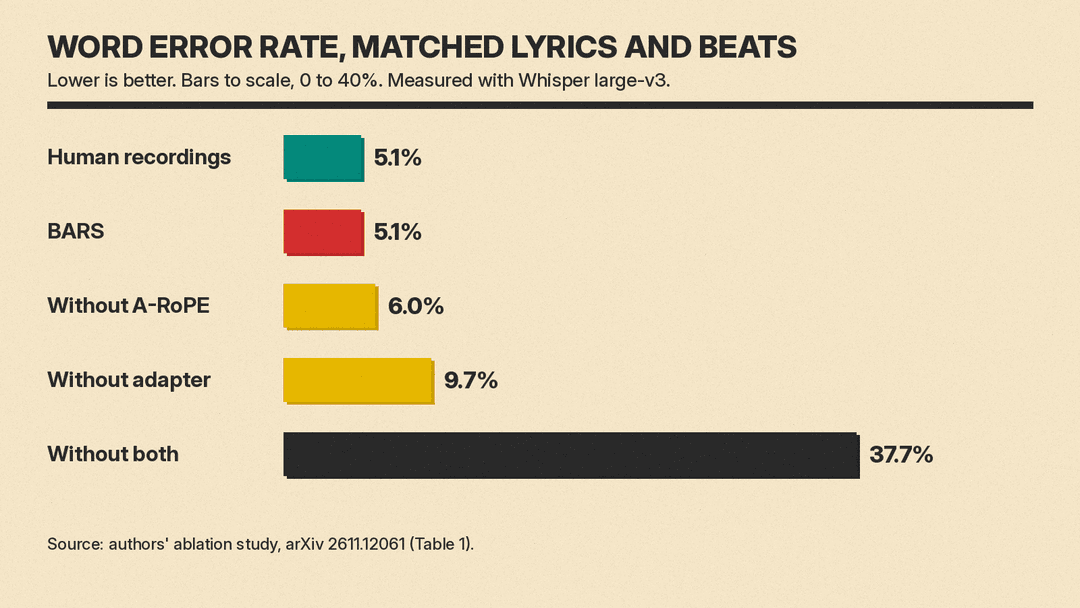
The authors measured word error rate (WER) by transcribing the output with Whisper large-v3, OpenAI's speech recognizer. Rap is hard for speech recognition, so they compare against human recordings run through the same test.
- BARS: 5.1% WER, the same as the human recordings (5.1%)
- Without A-RoPE: 6.0%
- Without the adapter: 9.7%
- Without both: 37.7%
The harder test pairs lyrics with beats they were not written for. Here BARS scored 12.3% to 20.5% WER across five speed groups, against 22.0% to 33.6% for the version without A-RoPE.
On voice match, BARS scored 0.80 on an automated similarity measure for matched pairs, the same as real recordings, and 0.75 on mismatched pairs.
In a blind listening test, 40 listeners rated clips on a 5-point scale:
- Flow: 3.51 for BARS, 3.34 without A-RoPE, 3.81 for real recordings
- Audio quality: 3.35, 3.46 and 3.73
- Speaker similarity: 3.82, 3.98 and 3.95
The authors report that BARS's flow gain over the version without A-RoPE was significant (p = 0.01). Both models scored below real recordings on flow and audio quality. Speaker similarity was not significantly different from real recordings. The test only used clips where both models already had WER below 5%.
What did it train on, and how fast is it?
- About 1,500 hours of English rap from male and female artists across many subgenres, with no rapper in both the training and test sets
- About 200 million parameters, trained for 500,000 steps on 8 NVIDIA H100 GPUs
- Training clips capped at 60 seconds; longer output was not evaluated
- On one NVIDIA RTX 4090, 10 seconds of audio takes 0.27 seconds to generate
The paper does not say where the 1,500 hours came from or whether they were licensed. The audio compression model it uses was trained on "proprietary music data." Evaluation is English only. The demo page has a "preliminary" multilingual showcase (Spanish, Russian, Korean, French, Japanese, Italian and Persian) that is not part of the main paper.
Can you try BARS?
Only by listening. The demo page has audio samples, including the paper's own abstract rapped by BARS. No code or model weights are linked from the arXiv page or the demo page as of November 12, 2026. This is a research paper, not a product.
What about voice cloning?
BARS copies a voice's timbre from a 3-second clip it has never heard before. The paper's ethics statement says the authors "acknowledge the potential for misuse, such as the unauthorized synthesis of a specific individual's voice," and that the tool "should be used responsibly and only with the explicit consent of the original speaker."
The demo page's voice examples include reference voices labeled Female, Male, Child (Female), Donald Trump and Pikachu (Character Voice). The paper does not say whether consent was obtained for those voices.
Voice and style imitation is already in court. Elvis Presley rights holders and Eminem's publisher have sued Suno, and AI song generators such as ACE Music v1 and Suno v6 already make full songs with vocals.
Why it matters
Song generators make a whole track from a prompt. BARS targets a narrower job: rap your exact lyrics over your own beat, at a speed you choose, and fix one line without redoing the take. Music tech site audio nerds framed it as a tool for producers who want control over timing.
The open questions are practical. The model is not released, its training data source is not stated, and its tests cover English only. If a version ships, those are the details to check first.
