
Zyphra, a San Francisco AI lab, released ZONOS3-Mini on November 9, 2026. It is a small text-to-speech (TTS) model that can clone a voice from a short clip. Zyphra says it runs in real time on phones and laptops, and even inside a web browser. The weights are open under the Apache 2.0 license, which allows commercial use.
It joins a group of small open voice models we covered this month, such as Gradium's Phonon and Underdog Woof. What sets ZONOS3-Mini apart is how much control it gives over the voice and the delivery, down to single words.
What is ZONOS3-Mini?
ZONOS3-Mini is a "zero-shot" voice-cloning TTS model. Zero-shot means you do not train it on a new voice. You give it a reference recording, and it speaks new text in that voice.
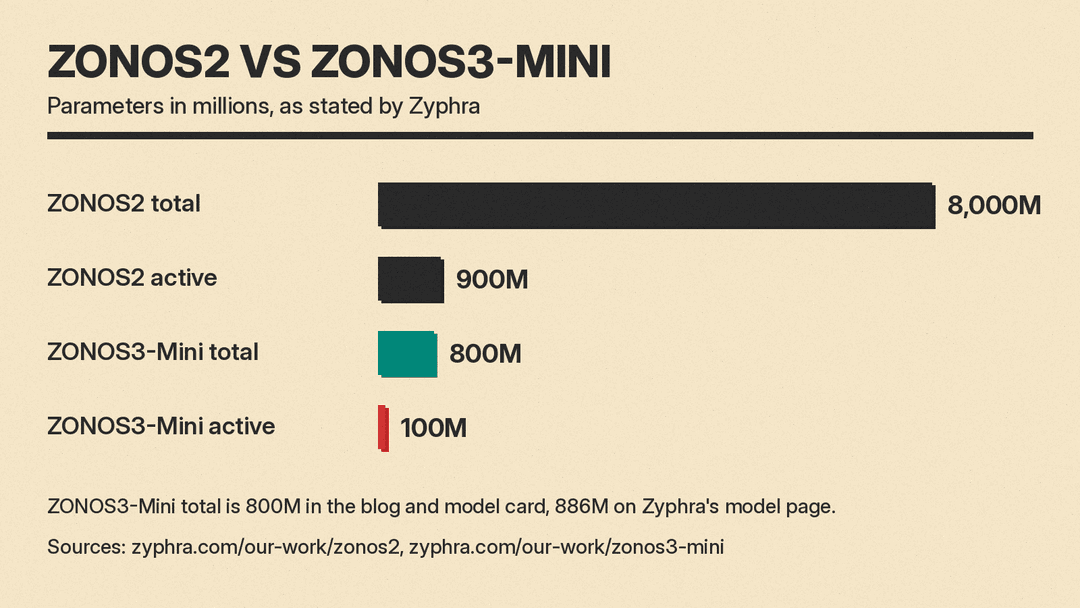
The model is a sparse Mixture of Experts (MoE). Only part of the network runs for each step. Zyphra says it has about 100 million active parameters and 800 million total parameters, per the release blog and the Hugging Face card. The model page lists 886M total parameters, a 32K context length and BF16 weights.
Zyphra says it trained the model on 112 NVIDIA H100 GPUs in 2.5 days.
It follows a much larger model. ZONOS2, released June 12, 2026, had 8 billion total parameters, 900 million of them active, and an audio codec running at 86 Hz. Zyphra says that design "limited the deployment of the model."
How does voice cloning work?
You can clone a voice in two ways, per the Hugging Face card:
- A raw reference clip, up to 60 seconds. The model encodes the clip and uses it as a prefix.
- A speaker embedding, a compact numeric fingerprint of a voice.
Zyphra uses the speaker-embedding mode for its benchmark results and for its voice design samples.
What can you control?
Control is the main selling point. Zyphra splits it into two groups.
Voice design shapes who is speaking:
- Age (Zyphra demos targets of 25, 45 and 75)
- Gender presentation, including an androgynous setting
- Accent (examples: General American, a Southern English target, Australian English)
- Vocal texture (examples: soft, raspy, bright, deep)
Zyphra notes there is no dedicated breathiness control. The "soft" texture approximates it.
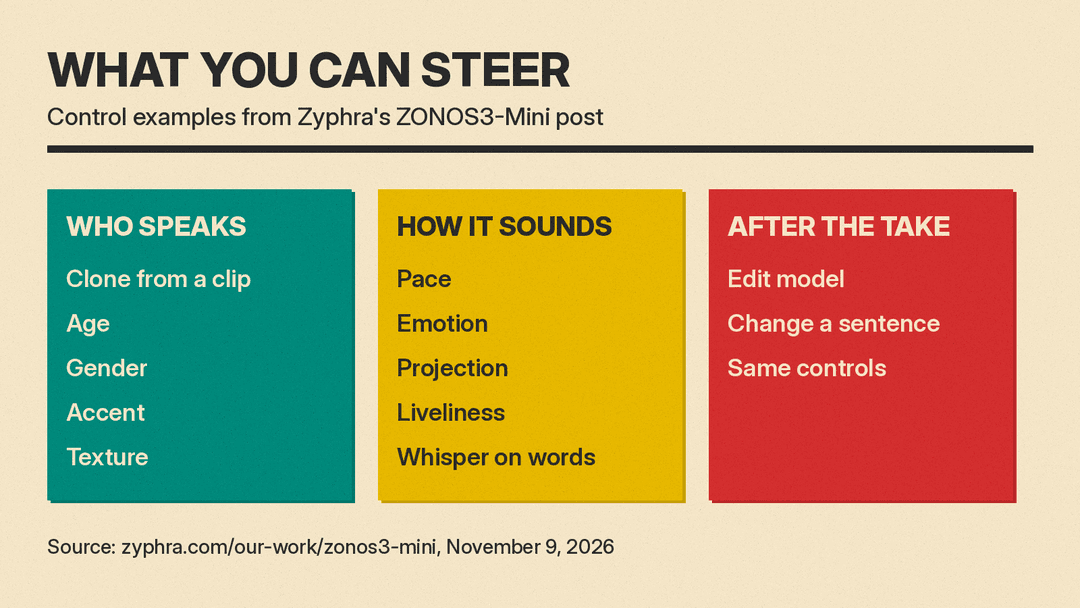
Delivery shapes how the line is spoken: pace, emotion, projection, liveliness, and whisper. You can apply a setting to a whole line or to a span of words. One demo whispers only "I didn't say" in the sentence "I didn't say she took the keys."
Word-level control works during streaming. Zyphra also released an edit model, based on a VoiceCraft recipe, that changes sentences after generation with the same controls.
Zyphra is careful about these claims. It calls the settings "generation targets" and says perceived traits "should be assessed by listening."
How do you run it?
Zyphra lists these ways to run it. Its own runtimes (WebGPU, CUDA, MLX and C++/ggml) share one HTTP API:
- In the browser through WebGPU, with no install
- NVIDIA GPU servers through Zyphra's CUDA server, or through SGLang and vLLM
- Apple Silicon through an MLX server
- A C++/ggml server and CLI for CPU, CUDA, Metal or Vulkan
There is also a hosted API on Zyphra Inference. The model page shows it working with the standard OpenAI Python and TypeScript client libraries, pointed at Zyphra's own endpoint.
One generation can produce up to 10 minutes of audio, at 44.1 kHz. Text normalization covers English, Mandarin, Japanese, Korean, German, Spanish, French, Italian and Portuguese. Other languages "pass through as written." The Hugging Face card lists 43 supported languages.
How fast is it?
Zyphra gives these numbers:
- Under 570 ms to first audio in the browser on a Pixel 9
- Under 150 ms to first audio on an M3 MacBook Air
- On one H100 80GB GPU, a median of 80 ms to first audio with 8 concurrent requests, and a peak of 457 seconds of audio per second, per the Hugging Face card
These are Zyphra's own tests. We did not run them.
What changed under the hood?
Two changes explain the size drop.
First, a new codec. ZAC-1 (Zyphra Audio Codec 1) runs at 15 Hz, far below the 86 Hz codec in ZONOS2. Zyphra says that, under similar data constraints, a model trained with ZAC-1 had a 10x reduction in word error rate compared with one trained with the Descript Audio Codec (DAC).
Second, the network borrows ideas from recent language models. It mixes Gated DeltaNet layers and global attention layers in a 3:1 ratio. After pretraining, Zyphra ran direct preference optimization (DPO) and then Group Relative Policy Optimization (GRPO) "to enhance robustness."
How does it compare?
Zyphra also released a new benchmark, ZTTS2-Eval. Its clean set covers 35 languages and its in-the-wild set covers 20. On Zyphra's combined index, it says "ZONOS3-Mini ranks first among open models followed by Fish S2 Pro and MOSS TTS v1.5."
Keep in mind that Zyphra built this benchmark. Independent tests may differ. The blog also has listening comparisons against Fish Audio, Qwen, Cartesia, ElevenLabs and OmniVoice, but these are audio samples, not scores. Fish Audio, one of the labs on this list, also has an open-weight model under a different license. See our post on Fish Audio's open-weight TTS.
What does it cost?
The weights are free under Apache 2.0. For the hosted API, the model page lists $10.00 per 1M UTF-8 bytes of input text, as of November 2026.
Why it matters
Small open voice models now handle cloning, run on a laptop or phone, and come with licenses that permit commercial apps. Zyphra names games, narration and voice assistants as uses.
The same features raise consent questions. A model that clones a voice from a short clip makes misuse easier. Clone only voices you have permission to use, and label synthetic audio where it matters.
What to watch
- Independent tests of quality and speed outside Zyphra's own benchmark
- Real-world use of the browser build on mid-range phones
- How its delivery controls hold up in long narration
