
Gradium, a voice AI company founded by the cofounders of the Kyutai research lab, has released Phonon, a family of small open-weight text-to-speech models that run fully on the user's device. On November 5, 2026, about two weeks after release, Gradium published "A Closer Look at Phonon" on the Hugging Face blog, with download numbers and results from Hugging Face's new Open TTS Leaderboard.
What is Phonon?
Gradium open-sourced Phonon in an October 20, 2026 blog post and announced it in a press release at NVIDIA GTC in Berlin on October 21. Speech is generated locally, with no network round-trip and no cloud dependency, so your text and the resulting audio stay on the device. The models were trained on a cluster of NVIDIA H100 GPUs.
Gradium announced Phonon in April and spent six months building on it with partners. The models follow the Pocket TTS lineage from Kyutai and use flow matching. There are two sizes, about 65 MB and 75 MB, covering English, French, German, Spanish, and Portuguese between them. Output is mono 24 kHz audio that streams while the model is still generating. The models handle phone numbers, dates, and codes, and they run on phones, laptops, single-board computers, and in a browser tab. If text-to-speech is new to you, our explainer on what text-to-speech is and how AI voices work covers the basics.
More than 100 voices are built in. Gradium Studio adds custom voices two ways: voice cloning from a short recording made with the speaker's consent, and voice design, where you describe a voice in plain text. You download the voice file and load it in Phonon.
Gradium built a new inference framework for it, ptts, which supports more than 10 backends: CPU (Intel, Arm, WebAssembly), GPU (CUDA, Vulkan, Metal, WebGPU), and NPU (Apple Core ML, Snapdragon). Phonon is also available in Hugging Face Transformers.
Which Phonon model should you use?
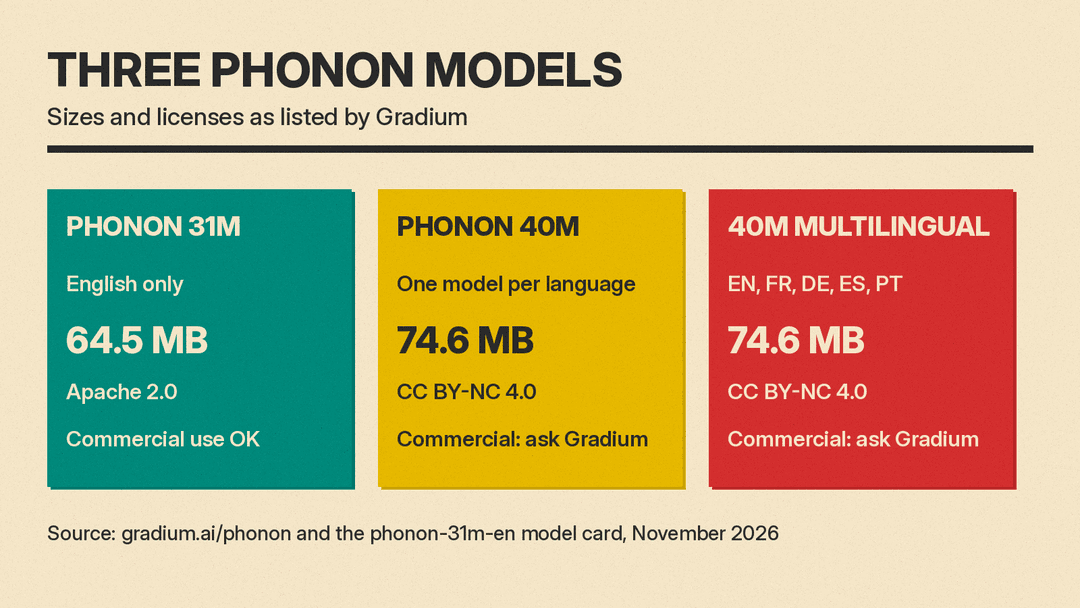
The lineup, per the Gradium Phonon page and model card:
- Phonon 31m: English only, 31M parameters, a 64.5 MB 8-bit weights file, Apache 2.0 license, open to download
- Phonon 40m: one model per language (English, French, German, Spanish, Portuguese), 74.6 MB, CC BY-NC 4.0 license
- Phonon 40m multilingual: all five languages in one model, 74.6 MB, CC BY-NC 4.0 license
The 40m repos on Hugging Face are gated, so you must request access; 31m downloads without a request. Pick 31m for English products under a permissive license. Pick the 40m models when you need the other languages or want all five in one file. For another small offline voice in this class, see our post on Klein TTS X1.5 Linnet.
Is Phonon free for commercial use?
Phonon 31m is Apache 2.0, so commercial use is allowed. The 40m models are CC BY-NC 4.0, which is non-commercial. For commercial use of those, talk to sales. Gradium says licensing is priced on the number of users, not how much speech you generate.
Gradium also builds custom Phonon models with design partners: smaller models, versions for Korean, Arabic, or Japanese, or models fine-tuned on product vocabulary.
How good is it?
Most published numbers come from Gradium. The release blog says Phonon 31m starts speaking in 7 ms on a laptop CPU. The Phonon page claims up to 22x faster than real time on an iPhone 16 Pro. The press release says an NVIDIA L40S GPU delivers the first bit of speech in 5 ms, versus 43 ms on an AMD EPYC 7413 CPU, and that CUDA runs 8x faster than CPU.
The Open TTS Leaderboard is run by Hugging Face across 23 languages. It measures intelligibility by word error rate, speed by inverse real-time factor and time to first audio, and naturalness by UTMOS for English. Gradium says Phonon ranks first on intelligibility in German and Spanish, places in the top three in every language Gradium evaluated, and tops the CPU streaming benchmark on time to first audio.
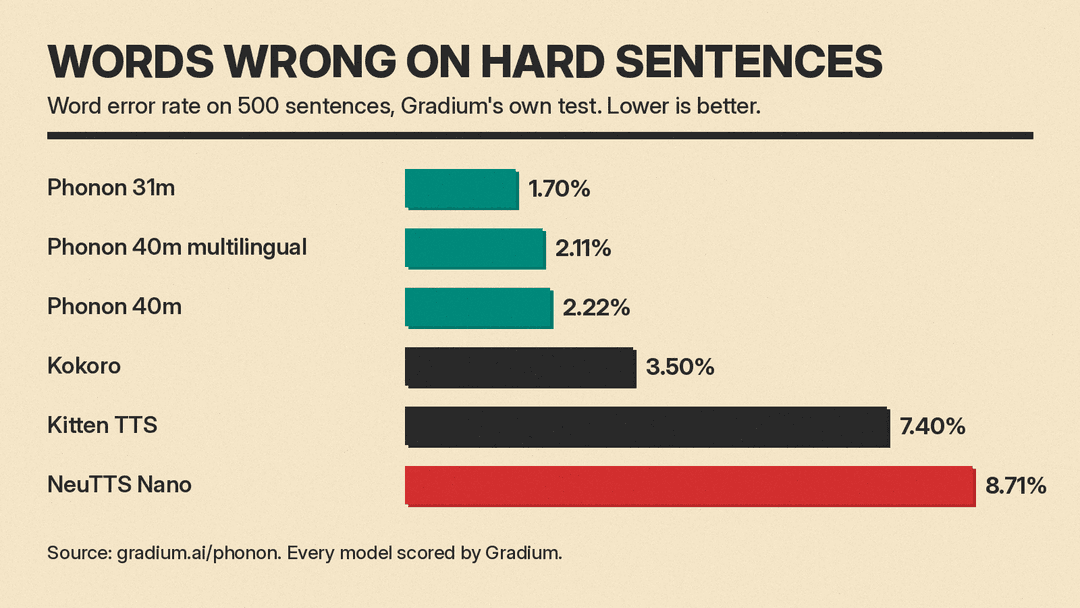
The Phonon page lists English word error rates, measured by Gradium, on 500 sentences that other models get wrong, such as phone numbers, email addresses, and postal codes:
- Phonon 31m: 1.70 percent
- Phonon 40m multilingual: 2.11 percent
- Phonon 40m: 2.22 percent
- Kokoro: 3.50 percent
- Kitten TTS: 7.40 percent
- NeuTTS Nano: 8.71 percent
The model card's English (US) table reports blind listening Elo from 468 raters and 8,290 votes: phonon-40m-en 2117, phonon-31m-en 2098, phonon-40m-multilingual 2097, Kokoro 2043, NeuTTS 2034, and Magpie 1939. The card states, "In every language, a Phonon model is first on all three measures." In that English table, Kokoro ties phonon-40m-en on Seed-TTS word error rate at 0.45 percent, and the hard-set column differs from the Phonon page: 1.5 percent for phonon-31m-en, 2.3 percent for phonon-40m-en and 2.0 percent for the multilingual model. For scale, Kokoro has 82M parameters, and Gradium's press release calls it "the most widely used open on-device TTS model."
Another company's test ranks it differently. Underdog, maker of the Woof TTS model, ran its own test of hard English sentences and scored Phonon 31m at 2.16 percent word error rate, versus 1.42 percent for its two-voice Woof, as we covered when Woof launched. Each company's table is its own measurement, on its own sentences, so the tables are not directly comparable.
The model card also lists limits. Phonon speaks only its listed languages, and other languages get wrong pronunciation. You must set lang to match the text so number and date normalization works. Very long inputs are split into sentences, so prosody does not carry across the whole text. On responsible use, it says not to impersonate a real person or clone a voice without consent, and to tell listeners when speech is synthetic where that matters.
The Hugging Face blog says Phonon was downloaded more than 200,000 times in its first two weeks.
How to try Phonon
- Browser demo: the Phonon Space on Hugging Face
- Command line:
uvx ptts --lang en --quant q8 --voice Easton "Hello from Phonon." -o speech.wav - Python:
pip install ptts(ptts on PyPI) - Web apps: the phonon-tts npm package
- Apple devices: a Swift guide for iPhone, iPad, and Mac
- Android: a guide plus a system TTS engine for TalkBack and apps that use TextToSpeech
- Self-hosting: a Docker server with an OpenAI-compatible API, and a Home Assistant setup
The runtime source is in the xn-ptts repository on GitHub, licensed MIT OR Apache-2.0. The voice catalog (about 100 voices) is in the phonon-voices repo, and cloning and design live in Gradium Studio.
Gradium points to demos including an Apple Watch with Wi-Fi off talking through a coffee brew, an iPhone with no signal counting reps, the robot Lamp from Autonomous in a sorting hat, an offline dinosaur runner game called Offline FM where Rex hosts a radio show in a browser, and Proust read aloud page by page.
Why it matters
Phonon sits next to other small offline voices we have covered, such as Woof and Linnet, and Gradium compares it directly with Kokoro. For apps that should keep text private or work without a connection, a voice that runs on the device avoids a server round trip. The license split is the practical part for builders: a permissive English model at 64.5 MB, with the multilingual options behind a commercial agreement. The benchmark picture is also a lesson in attribution, since nearly every number above comes from Gradium or from Gradium's reading of Hugging Face's leaderboard, and a rival's test orders the models differently. For cloud and app-based options, see our roundup of the best AI voice generators.
