
Anthropic is widening its AI for Science program from individual researchers to the groups that fund and run research. In an announcement on Oct. 28, 2026, the company said it is "highlighting 20 scientific foundations, institutions, and research groups from around the world" that it has partnered with in an expansion of the program, which "gives free Claude credits to researchers working on high-impact scientific projects."
The new partners include the US National Science Foundation, the Simons Foundation, the Francis Crick Institute, EMBL and the Space Telescope Science Institute, which runs science operations for NASA's Hubble, James Webb and Roman telescopes.
What changed
Anthropic launched AI for Science in May 2025 as a program offering free API credits to researchers, "with a particular focus on biology and life sciences applications." Researchers attached to a research institution applied through a form, and Anthropic's team reviewed the applications.
The Oct. 28 post says that "AI for Science began by supporting individual scientists. By partnering with institutions and foundations, we're now able to reach more researchers across many fields." Anthropic also says that over the last few months it launched a discounted Team plan for scientists and has supported "hundreds of projects across biology, medicine, physics, chemistry, climate science, and mathematics."
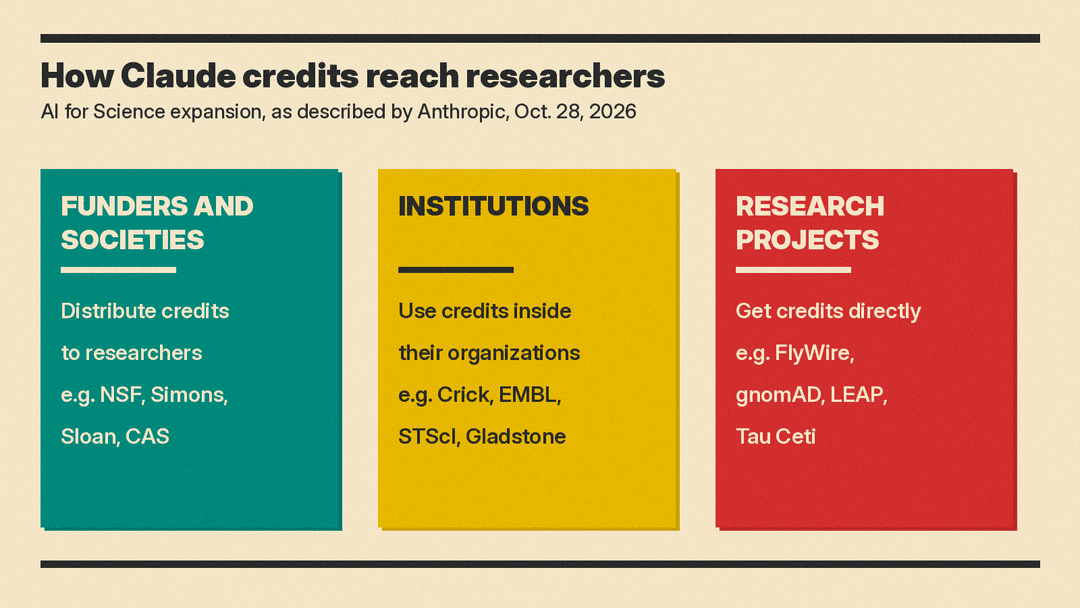
The partners fall into three groups, and each group gets the credits in a different way.
Funders and societies hand credits to researchers
The first group are science funders and societies. Anthropic says it is sharing Claude credits with these organizations, "which will distribute these resources to ambitious researchers aiming to use AI for scientific research." The list:
- The Alfred P. Sloan Foundation
- The Simons Foundation
- Schmidt Sciences, founded in 2024 by Eric and Wendy Schmidt
- The Open Source for Science Fund, a program of Renaissance Philanthropy
- The US National Science Foundation, which Anthropic describes as a $9 billion federal agency that accounts for about 25% of federal support for basic research at US colleges and universities
- CAS, a division of the American Chemical Society that maintains the CAS Registry for identifying chemical substances
In practice, this means a researcher may get Claude credits through one of these funders or societies, rather than only by applying to Anthropic's own program.
Institutions use credits in house
The second group are research institutions that "will use Claude credits inside their organizations to enable scientific discovery":
- Space Telescope Science Institute (STScI)
- Wellcome Sanger Institute, a genomics center
- The Francis Crick Institute in London
- Imperial College London, Department of Life Sciences
- EMBL, the European Molecular Biology Laboratory, whose European Bioinformatics Institute hosts open data resources such as Ensembl, Protein Data Bank in Europe and Europe PMC
- Gladstone Institutes, an independent biomedical research institute in San Francisco
Specific projects get credits directly
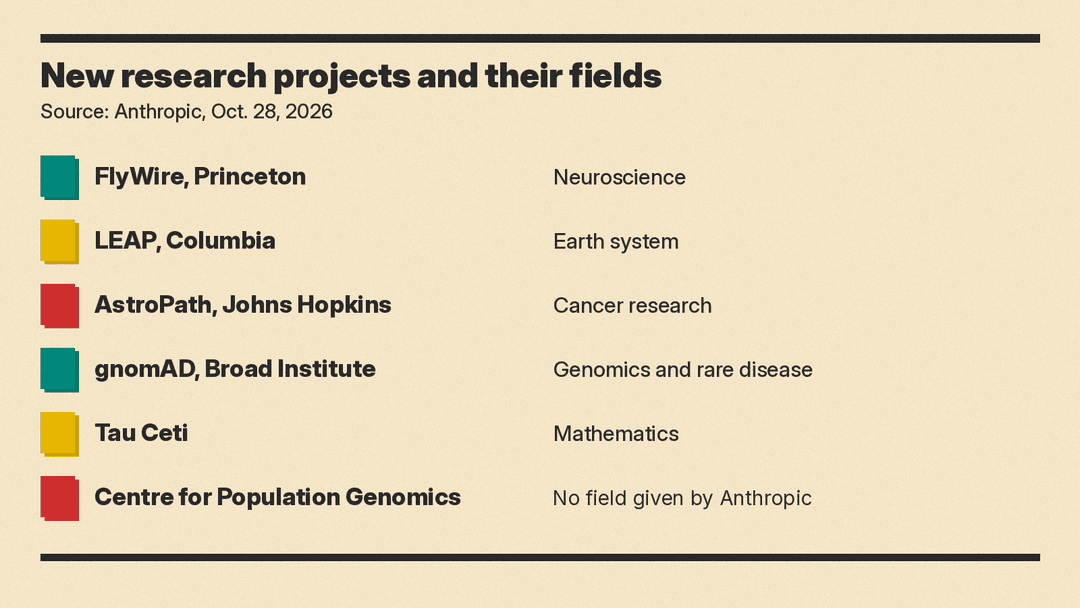
The third group are research projects that Anthropic says it is supporting by "providing Claude credits directly to specific research initiatives, focusing on problems with the potential for large public impact." The new projects are:
- FlyWire at Princeton University, which produced the first complete wiring map of an adult fruit fly's brain
- LEAP at Columbia University, a National Science Foundation center that combines machine learning with physics to improve how climate models capture clouds, oceans and land
- AstroPath at Johns Hopkins University, which uses calibration methods from astronomical surveys to image tumors cell by cell
- gnomAD at the Broad Institute, which pools DNA data from over 800,000 people into an open reference of human genetic variation used for rare disease work
- Tau Ceti, an open, community-driven project building a shared autoformalized library of mathematics in Lean, a language that lets computers check every proof
- The Centre for Population Genomics, a joint initiative of Australia's Garvan Institute of Medical Research and Murdoch Children's Research Institute
Earlier lab partnerships
The post also points to two collaborations from the past year. Anthropic says it worked with HHMI Janelia Research Campus to develop the Model Hardware Standard (MHS), "a shared specification that lets AI agents safely operate lab instruments." MHS is in research preview. Anthropic's August preview post says MHS lets agents operate instruments such as microscopes, liquid handlers and robotic arms, and that the company plans to make the standard open source after building safety evaluations with partners.
Anthropic also says it supports the Allen Institute, which "is building teams of AI agents to analyze" its open datasets on the brain, cells and the immune system, "turning months of manual analysis into hours."
Why it matters
The expansion fits a wider push by Anthropic into science this month. On Oct. 27 the company said it had bought Mithril and started its own drug programs. The AI for Science change is a different kind of move: instead of running research itself, Anthropic is routing credits for Claude through the funders and institutions that already choose and run research.
That could matter in two ways. Anthropic's stated aim is to "reach more researchers across many fields" through partners, not one researcher at a time. And Claude credits now go to the teams behind widely used open resources: Anthropic says gnomAD is used by "researchers and clinical labs around the world," and that biologists use EMBL-EBI resources "every day."
Anthropic says many of these projects "will also produce public goods that benefit the wider scientific community: open datasets, open-source software, open standards, and shared libraries."
The company is careful about how far along this is. "Many of these collaborations are still in their early stages," the post says, and Anthropic says it hopes "to expand these efforts to even more partners around the world."
For individual researchers, the older routes stay in place: the AI for Science program itself, and the discounted Team plan for scientists at academic and nonprofit research institutions. Anthropic says that plan has "limited availability" and that final pricing is confirmed after verification at sign up.
