
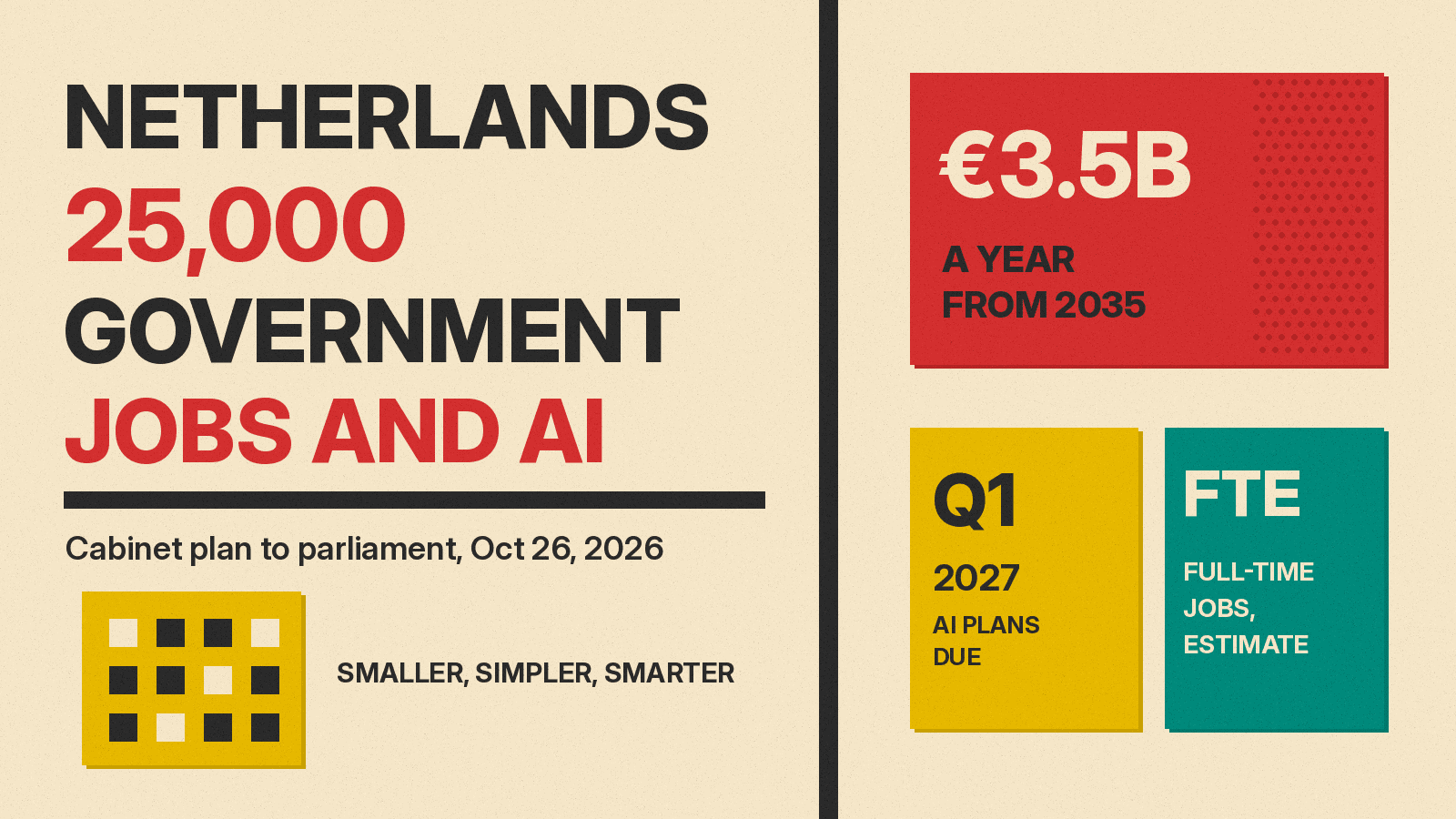
The Dutch government plans to shrink its central civil service by an estimated 25,000 full-time jobs over the next decade, and AI is one of several tools it names to get there. State secretary Eric van der Burg set out the plan on Monday, October 26, in a progress letter to the Dutch parliament and a government news release.
The headline number is a cost target, not a list of AI projects. The concrete AI plans do not exist yet. They are due in the first quarter of 2027.
What the cabinet announced
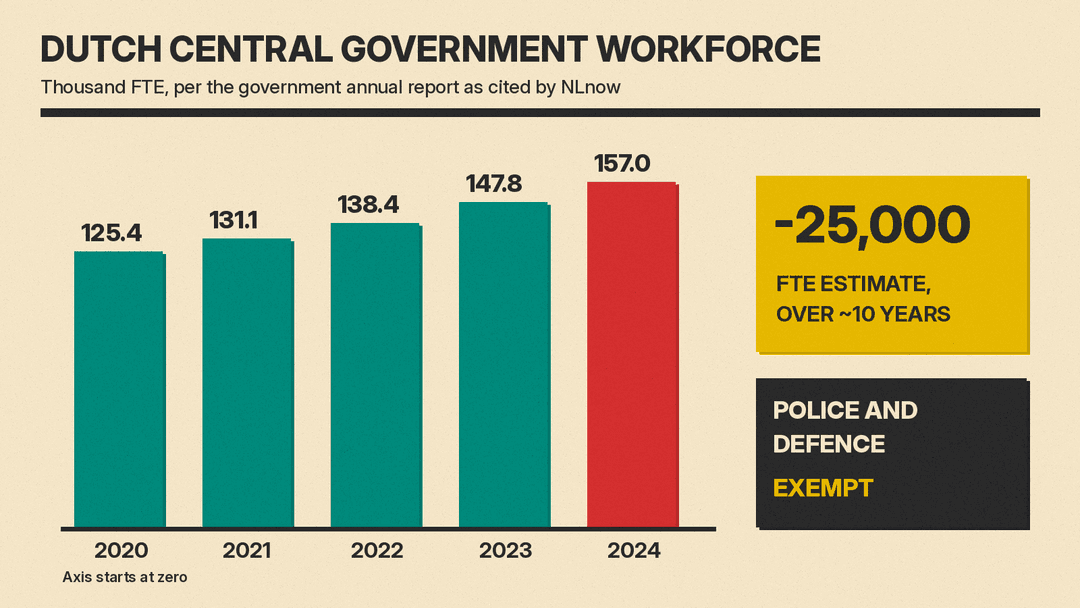
According to the release, the central government must cut €900 million from its own running costs in 2027, rising to €3.5 billion a year from 2035. The cabinet says that comes to "an estimated 25,000 FTE, spread over several years." FTE means full-time equivalents, so the count is in full-time jobs, not people. The release says the cuts will not fall equally everywhere, and that police and defence, among others, are exempt.
The same release lists the other parts of the plan:
- Scrap or simplify at least 500 rules a year, and study a German-style rule where each ministry must show a rule is still needed or it lapses.
- Within two years, draft a legal basis for government bodies such as the tax office, the Chamber of Commerce and municipalities to share citizens' data, so services can be offered proactively.
- Pare back facilities at ministries, standardise IT systems, sell surplus buildings and aim for one workplace for every two employees.
- Buy more often as one government, with fewer requirements.
- In the first quarter of 2027, set goals and savings plans for using AI to work more productively.
NLnow reports that the split by ministry will come in the Voorjaarsnota, the spring budget update, in about six months.
Where AI fits
The letter to parliament says AI initiatives have already started in several parts of the central government over recent years. The aim, it says, is to apply AI more widely "within the conditions of security, data quality and sovereignty," which will require changes to infrastructure and a fundamental review of work processes. The letter also says the government will systematically look for places to use AI in purchasing. (Quotes from Dutch documents are our translation.)
Van der Burg pointed to non-binding motions in parliament that call on the cabinet to raise government productivity by 20% through AI, The Next Web reports, citing Bloomberg. The Next Web also reports, citing Bloomberg, that the government wants to work with Dutch and European suppliers where it can, to avoid depending on technology from outside Europe. On the same day, Sweden's Government Offices began blocking staff from opening Claude and ChatGPT in a browser on work computers, pointing them to Microsoft's Copilot instead.
Van der Burg's letter is also cautious about AI. One of the lessons it draws from past savings rounds reads: "Do not overestimate the staffing effects of digitalisation and AI." NRC reports that he warned parliament that AI is not a miracle cure. NRC writes that several cabinets have looked to digitising government services during past savings rounds, and quotes Van der Burg that this "led to new tasks, to more capacity and to more hired-in staff."
Who is likely to be hit
Most Dutch civil servants work in delivery, so delivery agencies will carry much of the cut. "An important notion is, given the fact that most civil servants work in delivery, that a large part of the target will also land on delivery," Van der Burg wrote, as quoted by NRC. NRC says this drops an intention of earlier cabinets to spare those agencies, such as the tax office. The letter says many organisations face a staff cut of about 20%, rising in the coming years to about 45% for some and, in a single case, about 60%, as temporary budgets run out. Its annex also lists bodies exempt from one or more of the cuts, including the prison service (DJI), the security services and the public prosecution service.
Outlets put the overall share differently. Reuters says the government aims to cut "around 20% of all government jobs" over the next decade. Bloomberg, in an analysis republished by Moneycontrol, puts it at roughly 15% of civil servants, and Trouw at about 16%. The letter's own numbers explain part of the spread: 25,000 is about 16% of the roughly 160,000 FTEs in the affected ministries, inspectorates and agencies, while the letter puts the cut at about 20% for many individual organisations.
The workforce it is cutting from
The plan follows fast growth. Central government employed 157,019 FTEs in 2024, up from 125,446 in 2020, according to the government's annual report as cited by NLnow. The letter gives a newer count: 160,016 FTEs at the end of 2025, up about 41% (46,500 FTEs) since 2018. Reuters notes that this growth came despite earlier goals to shrink the civil service.
That history is the main doubt. Trouw notes that nearly every cabinet since Ruud Lubbers's in the 1980s planned to shrink the civil service, and that this almost never worked. ING chief economist Marieke Blom said in the Bloomberg piece: "The big question is whether this government will be able to meet its targets." She added that previous headcount cuts were followed by more hiring, and said: "AI can lower the amount of people working in the government, but it can also lead to 'needs', such as when government institutions are bombarded by complaints as people use AI-agents to file them," per Moneycontrol's copy.
That last risk has a name in research. The same Bloomberg piece cites an August study, with Chris Schmitz of Berlin's Hertie School among its authors, that documented 84 cases across 11 countries of "agentic flooding": an AI-assisted surge in complaints, court claims and other requests to government.
Why it matters
Bloomberg notes that private companies have announced waves of AI-driven job cuts since ChatGPT launched in 2022, while governments are behind. It cites a September 2025 OECD report saying public-sector AI use "trails the private sector." Inside the AI industry, Anthropic reported this month that junior roles fell from 27% to 9% of its own technical hires. The Dutch plan puts a specific headcount and euro figure next to a government AI program, so other countries can watch whether the savings show up.
For now, the 25,000 figure is a rough estimate derived from a budget target. How AI will be used and what it should save are the parts the cabinet has promised for the first quarter of 2027, and the split by ministry is due in the Voorjaarsnota.
Sources
- Rijksoverheid: Kabinet werkt aan slagvaardige overheid: eenvoudiger, slimmer en kleiner (Dutch)
- Letter to parliament: Voortgangsbrief Slagvaardige Overheid (Dutch, PDF)
- NLnow: Cabinet plans to cut 25,000 civil service jobs and use more AI
- Reuters via Yahoo Finance: Netherlands aims to cut around 20% of government jobs over next decade
- The Next Web: Netherlands to cut 25,000 government jobs as it turns to AI
- Bloomberg via Moneycontrol: Can AI replace government jobs? World is watching the Dutch
- NRC: Kabinet wil komende jaren een op de vijf voltijdsbanen bij de rijksoverheid schrappen (Dutch)
- Trouw: Kan het kabinet wel 25.000 banen schrappen bij de Rijksoverheid? (Dutch)
