
Suno replaced its whole model lineup on September 9, 2026. The new family, called v6, comes in three versions: v6, v6-wild and v6-mini. Suno says it developed v6 with Warner Music Group, BMG and Believe, and that older models will be retired as v6 rolls out. Nine days later, Universal Music Group and Sony Music sued Suno again, this time aiming at v6 itself.
This explainer sets out what each v6 model does, who can use it, what Suno says v6 was trained on, and why the labels that did not sign a deal say the new models are still a problem.
The three v6 models
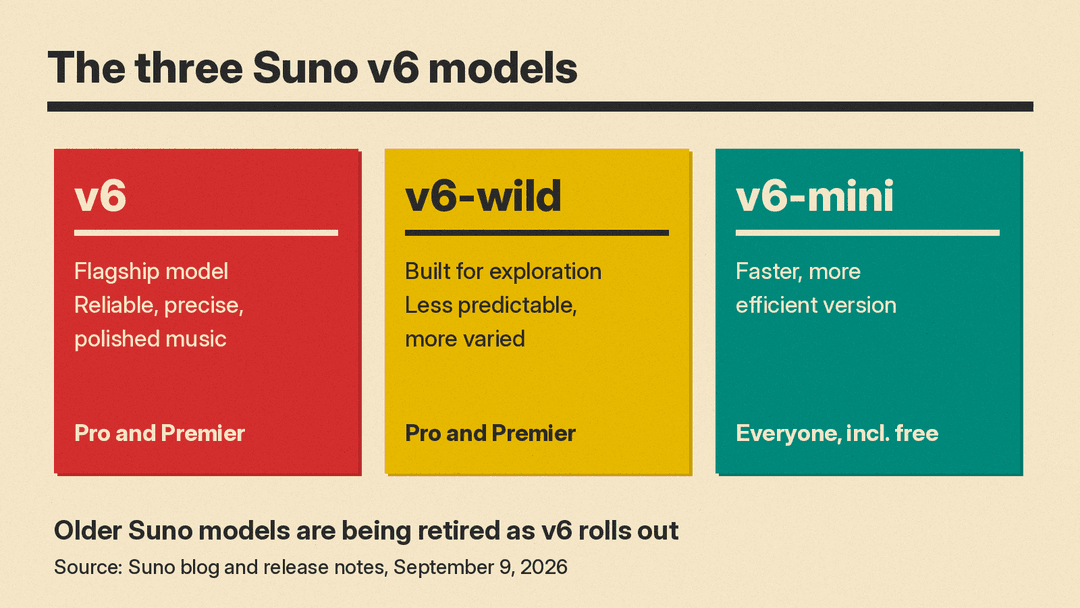
Suno's launch post, written by co-founder and CEO Mikey Shulman, describes three models built for different kinds of users.
- v6 is the flagship model for Pro and Premier subscribers. Suno calls it "reliable, precise" and says it "consistently delivers polished music across every genre and style." It is the model for when you already know what you want.
- v6-wild is "built for exploration." It is also limited to Pro and Premier subscribers. Suno says it is "less predictable and more varied," and suggests using it for new ideas that you can then bring back into v6 to refine.
- v6-mini is "a faster, more efficient version available to everyone." Suno claims it gives "better, faster results than any free model on any music creation platform." That is Suno's own claim, not an independent test.
Suno's release notes state it plainly: "v6 and v6-wild are available only to paid users." Free accounts get v6-mini. For what Pro and Premier cost and what each plan includes, see our AI voice and music pricing comparison.
Suno also says all three models understand "more of the language and building blocks musicians use," from vocals, instrumentation and structure to mood and references.
What you can do with v6
The launch post lists six new ways to work. Each one comes with an example prompt from Suno:
- Edit one part of a song in plain language. Change one section and keep the rest. Suno's example: "Change the chorus so it's sung by a gospel choir."
- Build a mashup from several of your songs in one request. Example: "Take the vocals from x, drums from y, and add new lyrics about losing control, make it 80s synthwave."
- Sample, isolate and build a beat in one workflow. Example: "Sample the riff at 0:45, isolate the guitar, build a beat around it."
- Start from a vibe, genre or mix of inspirations. Example: "Make a song that feels like midnight on a rooftop."
- Create from text, audio, images and video. Start from a written idea, a voice memo, a picture or a video.
- Change a single lyric without rebuilding the song. Example: "Change the lyric from 'love' to 'light.'"
The pattern is that v6 treats a song as something you revise, not only something you generate and then throw away. Partial edits and one-word lyric changes matter most for people who already have a track they like and need to fix one part of it.
If you are deciding between Suno and other tools, our Suno vs Udio comparison and our list of the best AI music generators cover the wider field.
What happens to the old models
Suno says that "as v6 rolls out, we will retire our previous models and move Suno entirely onto the v6 generation." According to Rolling Stone, users keep access to the songs they made with the old models and can use the new model to rework them.
In practice, older model choices go away. If you relied on one older model's sound, plan to rebuild those prompts on v6.
What Suno says v6 was trained on
This is the core of the launch. Suno's earlier models are at the center of copyright suits by the major labels. In court, Rolling Stone reports, the company has acknowledged that previous models were trained on essentially any music of usable quality it could find on the open web, and it defends that as fair use.
For v6, Suno gives a different account, in three slightly different wordings:
- TechCrunch reports that Suno said v6 "is not trained using the data it used to train previous versions."
- Chief product officer Jack Brody told Rolling Stone that the v6 models are "trained from the ground up on licensed data provided to us by our partners, user data, and then the accumulation of all the learnings that have gone into it."
- A Suno spokesperson told Variety that "v6 was trained on content licensed from our partners, interactions including creations and preference signals from our community, and the accumulated learnings from our team."
Brody also told Music Business Worldwide that v6 was trained "entirely from scratch" on data that "doesn't include data from Universal or Sony."
Some details are still open. Rolling Stone reports that Suno did not say how many songs Warner provided or whether artists opted in to the process. "The data that was provided by WMG was their own process," Brody said. "We weren't involved in deciding what music they handed over to us." Rolling Stone also reports that Suno will add more authorized music to its training data soon.
The label deals behind v6
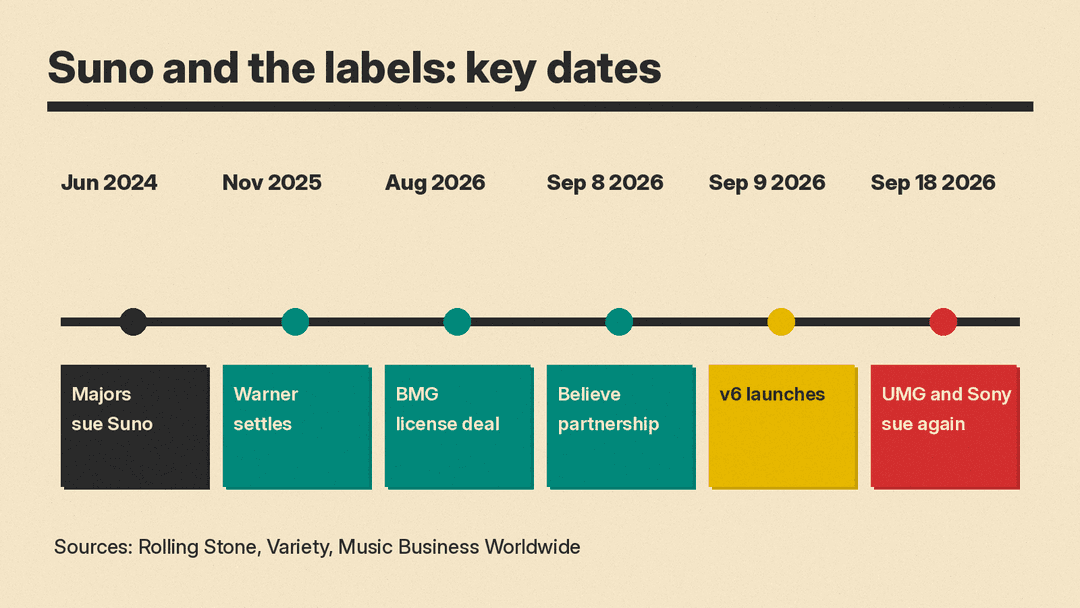
Suno names Warner Music Group, BMG and Believe as v6 partners. Rolling Stone describes each deal:
- Warner Music Group settled in November 2025. It dropped its infringement suit in exchange for a licensing partnership with undisclosed financial terms.
- BMG, which had not sued Suno, signed a licensing deal in August covering both its recordings and its publishing catalog.
- Believe, which owns the distribution platform TuneCore, partnered with Suno on September 8, the day before launch. Rolling Stone notes that the deal came months after Believe had begun blocking Suno creations from reaching streaming services.
Warner's chief executive, Robert Kyncl, framed the deal as a new income line. In a staff note reported by Axios, he wrote that WMG "artists and songwriters will share in revenue generated by Suno's more than 2 million paying subscribers."
Suno also points to what comes next. Its launch post describes "opt-in experiences built around individual artists, where artists can choose to participate and get paid when they do." Brody told Rolling Stone that the next phase will let users remix and reimagine existing songs, and that it will only include artists who opt in.
Suno also points to new safeguards. The launch post says it screens uploaded audio files and lyrics for unauthorized use. Rolling Stone reports that in early September Suno added audio watermarking, so its songs can be identified off the platform, and set monthly download caps meant to discourage flooding streaming services with AI tracks.
The second Universal and Sony lawsuit
On September 18, Universal Music Group and Sony Music Entertainment filed a new 45-page complaint against Suno in federal court in Massachusetts, Variety reports. These are allegations in a complaint. No court has ruled on them.
The labels' main argument concerns how v6 was built. They point to Suno's own statement that v6 learned from user "interactions" and argue that those interactions are outputs of the older models. As MBW explains, Suno generates two tracks per prompt, and its preference data records which one the user picks. The complaint argues: "Training a 'new' model on the outputs of an infringing model does not eliminate the infringement; it launders it." It adds: "v6 is not a fresh start; it is the fruit of the same poisoned tree."
Other points in the filing, as reported by MBW and Variety:
- It lists 60,202 sound recordings. The labels say these are only a small portion of the works involved.
- It alleges Suno built v6 using knowledge distillation, where a new "student" model learns to copy the behavior of an older "teacher" model.
- It asks for a court order to stop Suno from further use of the labels' recordings, and it demands a jury trial.
Suno rejects the claims. A spokesperson told Variety the labels' claims are "fundamentally flawed on both the facts and the law," and said Suno has "doubled down" on its goal by launching v6 with WMG, BMG and Believe.
The original 2024 case is still running too. Rolling Stone reports that Universal and Sony are still pursuing it, and that Brody had "nothing to share at this point" about settlement talks.
Why it matters
v6 tests a specific idea: that an AI music company can move from unlicensed training to licensed training and leave its legal problems behind. Warner, BMG and Believe have accepted that approach. Universal and Sony have not, and their new suit argues that a model trained partly on an earlier model's outputs still carries that model's problems.
For creators, the practical points are simpler:
- Free users get v6-mini. The flagship v6 and the experimental v6-wild need a Pro or Premier plan.
- The new editing tools let you fix part of a song without generating a new one.
- Old models are going away, so save any prompts and settings you want to rebuild.
- The rights picture is still being argued in court, in both the 2024 case and the new Massachusetts suit.
Suno has kept shipping since v6. On October 1 it opened Speech, a beta for spoken audio set to original background music, which we cover in Suno Speech explained.
Sources
- Suno: Introducing v6
- Suno: Release notes
- TechCrunch: Suno replaces its AI models with a new one trained on licensed music
- Rolling Stone: Suno launches new models built on a major label catalog
- Axios: Warner Music CEO says creation-based revenue for artists set to grow
- Variety: Sony Music and Universal Music Group sue Suno over label-backed model
- Music Business Worldwide: Universal and Sony sue Suno for a second time
