
Suno filed a motion on Tuesday, November 3, 2026 asking a federal court in Boston to dismiss a proposed class action by Jason Isbell, David Lowery, Guy Forsyth and Eduardo Calle, according to Music Business Worldwide (MBW). Suno says artist names are shorthand for musical styles.
This is a motion. The musicians' statements are allegations, and Suno's statements are arguments. No court has ruled, and the sources reviewed report no ruling.
The case
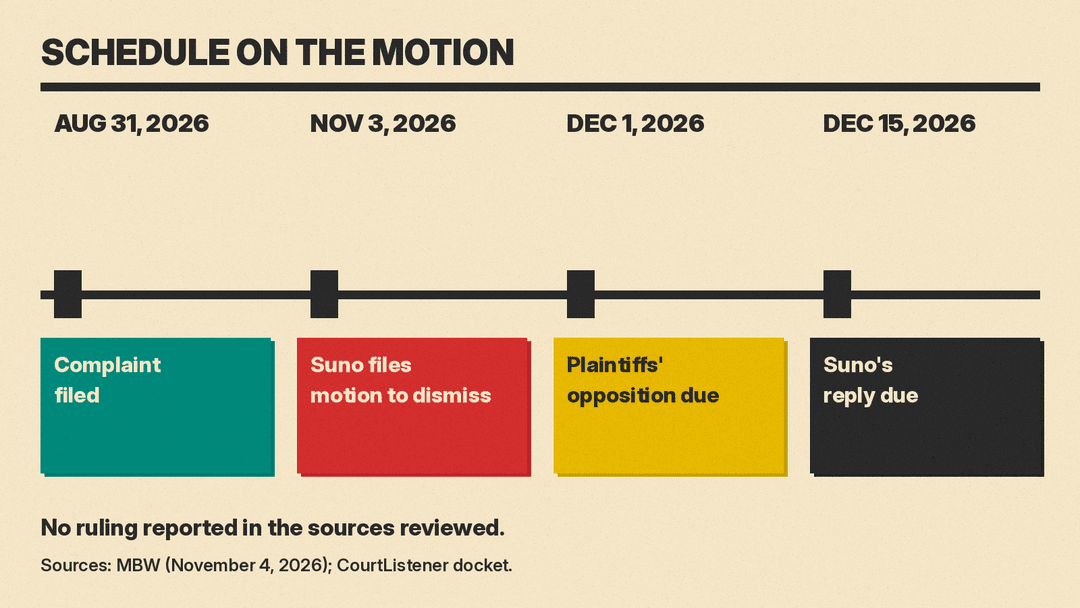
The four musicians filed on August 31, 2026 in the District of Massachusetts, MBW reports. The CourtListener docket lists the case as Lowery v. Suno, Inc., No. 1:26-cv-14005, before Judge Angel Kelley. The 84-page complaint has no copyright claim, MBW reports. It brings right of publicity claims under the laws of more than a dozen states and a claim under the Illinois Biometric Information Privacy Act (BIPA).
MBW's August coverage says the complaint accuses Suno of building a product that answers a musician's name with a song, a written description and a cover image evoking that person.
The complaint says the musicians "claim no ownership of country music, of Americana music, or of any genre, style, or musical idea." It adds: "The claim is narrower and older than that: no one may commercially exploit another's right of publicity in their name and identity."
What Suno argues
Suno's memorandum (Document 30, 43 pages with tables) is signed by Andrew M. Gass of Latham & Watkins. SCAPI describes a separate three-page motion and says Suno requested oral argument. The detail below is from the memorandum.
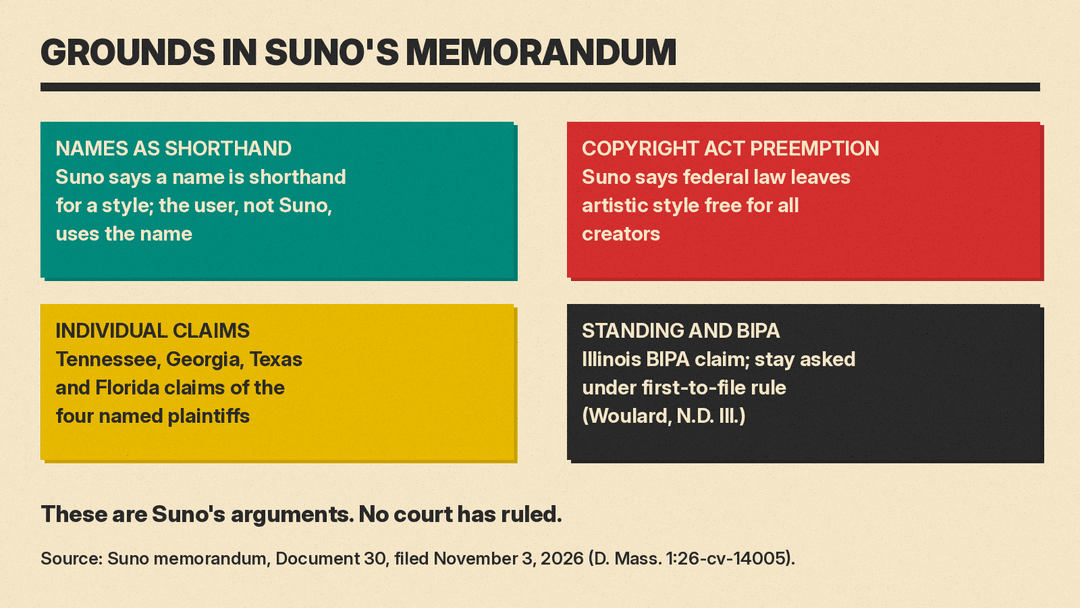
Names as shorthand. The memorandum opens: "When people describe styles of music, they often use artists' names as shorthand for the genre they perform in." Of a musician asking a producer for "more of a Jason Isbell vibe," it says: "There is nothing unlawful about that."
No use by Suno. Suno argues that a name typed into a prompt is "at most a use of the artist's name by the user." It says "secondary liability for a right of publicity claim is not a recognized concept in the law." It also argues that "Internal, backend uses of a celebrity's name have never been the conduct regulated by the right of publicity tort."
Suno says it does not train its model to recognize artist names. It says it blocks a prompt with a name or replaces the name with a description, for example "New wave, Synth-pop, Pop rock" for "Duran Duran." The complaint alleges that Suno began giving outputs for "purportedly blocked names" and that its name filter can be worked around. MBW also reports that in an October 20 answer in a separate suit, Suno admitted that "as of January 2026, users may include artist names in their prompts."
First Amendment. Variety reports that Suno said invoking an artist's name to describe a genre is protected by the First Amendment.
Copyright Act preemption. The memorandum says: "Congress made the considered policy choice not to confer intellectual property protection on an artistic style." It says the musicians' theory "would create a shadow state law IP regime." On the "claim no ownership" line above, Suno says that is "exactly what their legal theory would confer," MBW reports.
Individual claims. Suno argues that Isbell's Tennessee claim fails because the complaint does not allege Suno used his voice. It says Lowery's Georgia claim rests on a band name, Forsyth's Texas claim lacks facts on the value of his name, and Calle's Florida claim rests on a song title.
Standing and BIPA. Suno argues the four plaintiffs allege no facts about themselves that support a BIPA claim. It asks, at a minimum, for a stay of that claim under the first-to-file rule because of a BIPA suit by David Woulard, which the memorandum cites as filed October 16, 2025 in the Northern District of Illinois.
The musicians' side so far
The plaintiffs have not yet answered the motion in court. Variety reports that their attorney did not respond to an immediate request for comment. The complaint states their position: "The heart of Plaintiffs' claims is Suno's own conduct, not any act by a user." It says Suno built a platform with the capability "to use musicians' names as a retrieval key."
On copyright, the complaint argues the claims survive preemption because they concern a person's identity, which it says is "not a work of authorship." It also says the conduct "would be just as much of a violation even if every song in the training corpus were in the public domain for copyright purposes or obtained via authorized copyright licensing."
What comes next
Under a briefing schedule Judge Kelley approved on October 28, the plaintiffs' opposition is due December 1, 2026 and Suno's reply is due December 15, 2026, according to the docket entry on CourtListener. MBW reports the same dates.
Why it matters for AI music tools
Many users type an artist's name to steer a song. This case asks whether that is a use of the name by the tool or only by the person typing. It also asks whether state publicity law can reach a name that a tool turns into a style description, or whether federal copyright law keeps styles free. The answers could affect any music tool that accepts artist names, but only after the briefs are filed.
For how prompts work in practice, see our Suno prompts guide. For another pleading-stage fight over AI and music, see our report on the lyrics suit against Anthropic.
Sources
- Suno memorandum in support of motion to dismiss, Document 30, filed November 3, 2026 (PDF)
- Class action complaint, Document 1, filed August 31, 2026 (PDF)
- CourtListener docket, No. 1:26-cv-14005
- Music Business Worldwide: Suno asks court to dismiss Jason Isbell's right-of-publicity class action (November 4, 2026)
- Music Business Worldwide: Jason Isbell and David Lowery are suing Suno (September 1, 2026)
- Variety: Suno Seeks to Dismiss Jason Isbell Lawsuit (November 4, 2026)
- SCAPI: Suno Seeks Dismissal of Jason Isbell and Other Musicians' Identity Lawsuit (November 4, 2026)
