
Salesloft announced Agentic Playbook on October 27, 2026, an AI system that turns pipeline signals into sales plays that AI agents can carry out. It came with three other tools: natural-language analytics, a meeting prep agent and live battlecards in Zoom. Salesloft says Agentic Playbook, the analytics and the meeting prep tools are entering early access. Here is what each piece does, what Salesloft has and has not said, and what a sales or revenue operations team should do now.
What Agentic Playbook is
Salesloft calls Agentic Playbook an "orchestration engine" that coordinates sellers and AI agents around shared sales goals. In plain terms, it is a way to write a sales play in ordinary language and let AI agents watch for the moment to run it.
Salesloft pitches it as an alternative to revenue operations (RevOps) teams building complex workflows by hand for every scenario. Teams "define and refine sales plays in natural language," and the plays adapt as deal and customer conditions change.
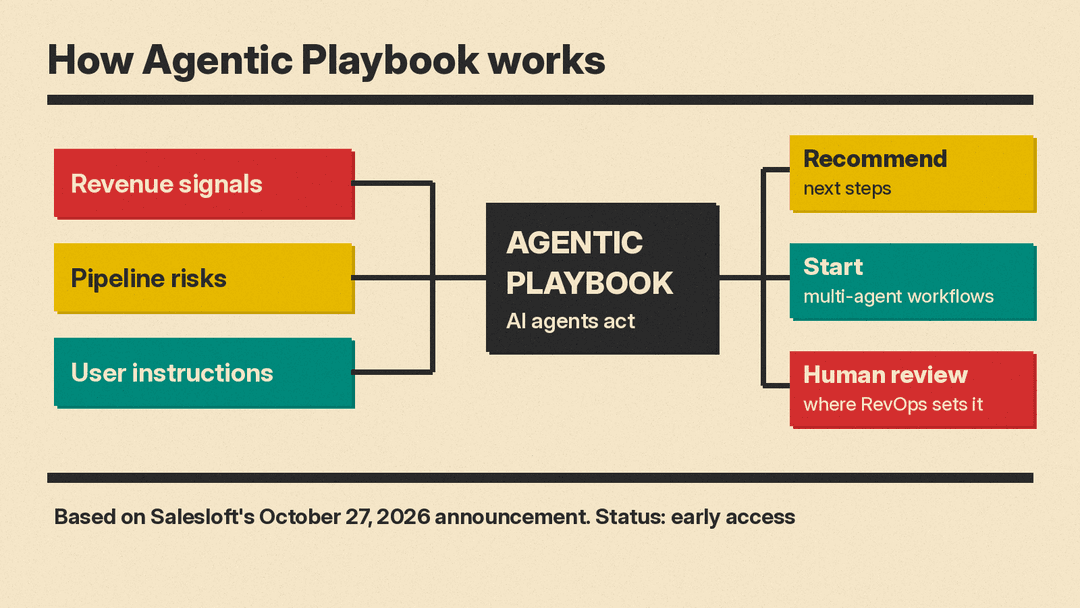
The agents respond to three kinds of input, per the announcement:
- revenue signals, such as buyer intent on an account
- pipeline risks, such as a deal that has stalled
- instructions a user gives them
From those inputs, the agents find openings, recommend next steps and start multi-agent workflows.
The guardrails
The most practical detail is who stays in control. Salesloft says RevOps teams set "the objectives, guardrails and level of autonomy for each play, including when human review is required." Salesloft says this keeps sellers and revenue leaders in control of critical decisions.
Salesloft lists the plays it has in mind:
- finding gaps in the pipeline
- writing personalized prospecting outreach
- automating pipeline generation across long-tail accounts
- re-engaging inactive accounts that show high buyer intent
- coordinating account and deal teams internally
- recommending next-best actions on stalled deals
Under the plays sits what Salesloft calls the Context Engine. It pulls together sales models, sales methods, competitive playbooks and past performance to inform both sellers and AI agents, so their work is grounded in the company's own sales strategies and historical results. Salesloft says it "identifies winning patterns and learns from outcomes over time." The release does not say how that learning works or how a team can check it.
The three other new tools
Salesloft announced three more features in the same release:
- Ask Salesloft analytics. Sales leaders and RevOps can ask questions about reports and charts in plain language, change reports and build custom views by describing them. New drill-down analytics go from top-line numbers to single seller actions and contact interactions.
- Meeting agent. Before a customer call, an agent reviews account history, past conversations, opportunity notes and research, then writes a meeting brief.
- Real-time battlecards in Zoom. While AI listens to a live Zoom meeting, it spots buyer objections, competitor mentions and key topics, and shows the seller talking points and suggested responses during the call.
Salesloft says Agentic Playbook, the AI analytics and the meeting preparation tools are entering early access. The release does not state the access status of the Zoom battlecards separately, and it gives no prices or general availability date.
The survey numbers behind the pitch
Salesloft backed the launch with its 2026 Revenue Benchmark, a survey of 500 U.S. sales and revenue leaders. These are Salesloft's own figures, from a vendor survey:
- All 500 said they use AI somewhere in the revenue process.
- 20.6% reported production AI deployments with measurable outcomes.
- 31.8% said they could instantly diagnose why a deal had stalled.
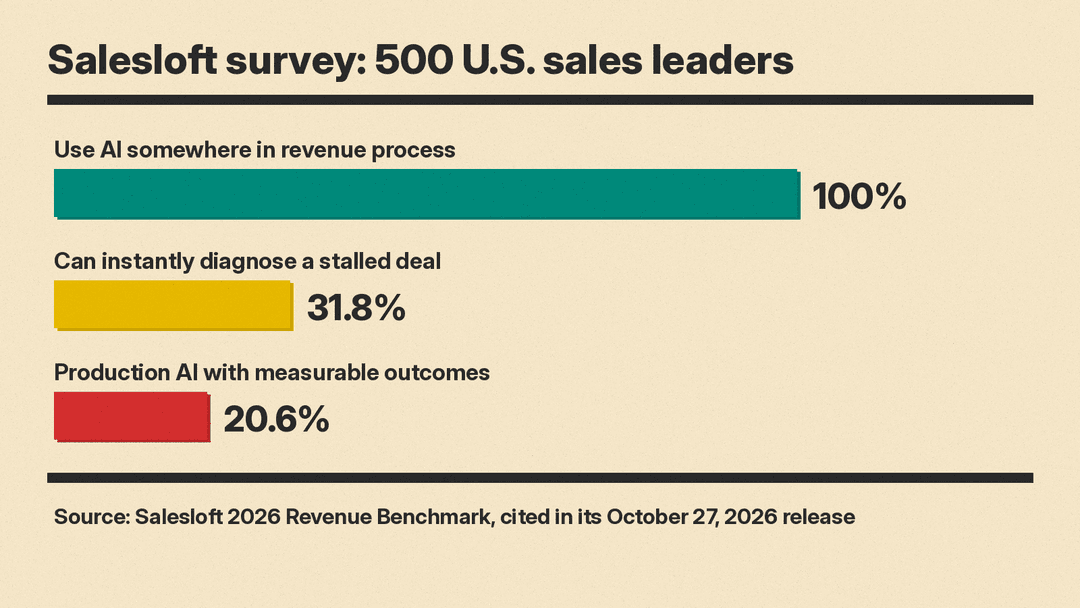
Salesloft frames the gap between AI use by all 500 respondents and the 20.6% with measurable production results as the problem: "The challenge is no longer simply adopting AI." CEO Steve Cox put it this way: "the bigger opportunity is to make the workflow itself agentic, not just the tasks inside it."
A different vendor survey offers a practical lesson. In Salesforce's agentic AI report, the organizations that got returns fastest picked one narrow job, cleaned the data for that job and decided in advance when a person takes over.
How this fits the wider sales AI race
Salesloft first described this direction in a September vision post, which listed Agentic Playbook as coming work alongside Agentic Forecasting, expanded real-time conversation intelligence and a "Context Intelligence" layer. The October release puts Agentic Playbook into early access.
Rival Outreach has shipped a narrower tool. Its Deal Agent, described in an October 1 blog post, reads recorded calls and meetings and suggests CRM field updates and deal summaries. Each update links to the meeting, a transcript excerpt and a timestamp, and teams choose whether updates apply on their own or wait for a seller to accept, edit or reject them.
The difference is scope. Deal Agent keeps CRM data accurate. Agentic Playbook aims to decide what to do next and then start doing it. That is a bigger promise and a bigger risk, since an agent that sends outreach can do more damage than one that suggests a field value.
Other vendors are moving in the same direction. Microsoft's Sales Development Agent, now in public preview, can do first-pass prospecting on its own, and monday.com's Harmony uses voice AI agents to call and qualify sales leads.
What sales teams should do now
- If you use Salesloft, ask your account team about early access, and which plays can run without human review.
- Start with low-risk plays. Pipeline gap reports and meeting briefs carry less risk than outreach. Hold off on agents that send outreach on their own until you have checked their drafts for a few weeks.
- Write your playbook down first. The Context Engine works from your sales method and competitive playbooks. If those live only in people's heads, the agents have little to work with.
- Ask for evidence. Outreach links each AI update to the source moment in a call. Ask Salesloft how a seller can see why an agent recommended an action.
- Watch the November 4 event. Salesloft says it will show these tools at its Behind Every Win virtual summit on November 4.
