
monday.com has launched Harmony, a voice AI platform that places and takes sales calls for a business. The launch release, dated October 19, 2026, calls it "a voice AI agent platform purpose-built for enterprise sales teams." The agents call leads, qualify them, handle objections, and pass warm prospects to a human rep.
Harmony is notable for two reasons. It comes from a public work-software company with nearly 250,000 customers, according to the release. And it has a public price list with a per-minute rate. Below is what Harmony does, how monday.com says it works, what it costs as of October 2026, and what a sales or support lead should check before turning it on.
What Harmony does
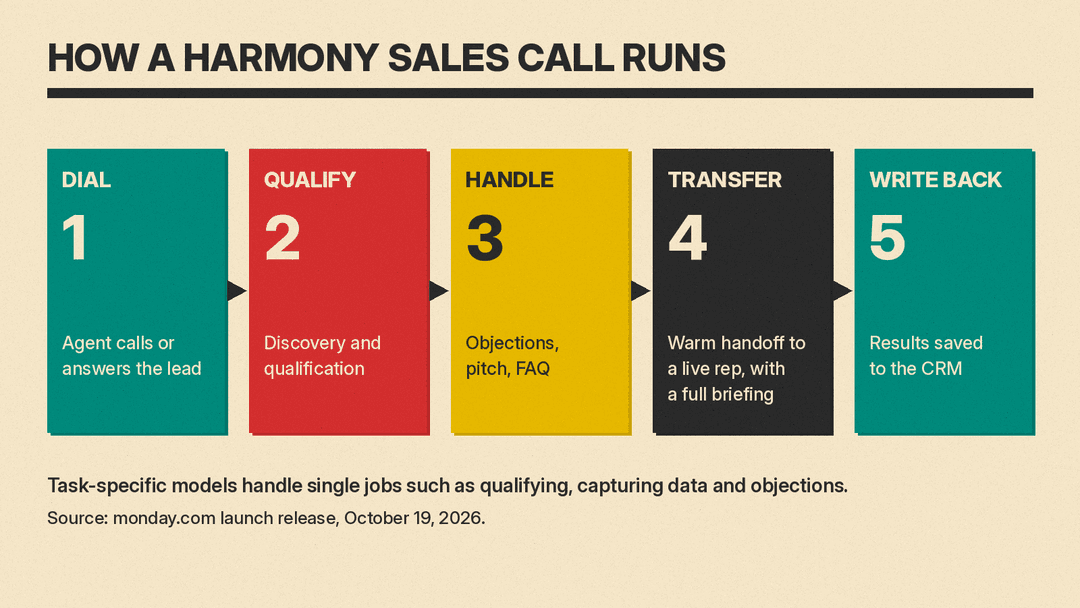
The release says Harmony agents "run the full sales cycle, from prospecting, discovery, and qualification to objection handling, pitching, and warm transfers to live reps with a full briefing." The Harmony site lists the jobs it targets:
- Lead qualification for inbound contacts
- Appointment setting and discovery calls
- Follow-ups that re-engage dormant pipeline
- Renewals, upsell and cross-sell calls
- Payment reminders for overdue balances
- Retention and win-back calls when a customer signals they may cancel
Around the agent sits what the release calls "complete AI call center capabilities": unlimited phone numbers with branded caller ID, predictive and power dialing, inbound routing, consent and compliance controls, and native CRM write-back. monday.com says these are built on Twilio's platform. The pricing page names Salesforce, HubSpot and monday.com as its native CRM integrations.
The release says Harmony is available now "for mid-market and enterprise customers in the United States, United Kingdom, Australia, and Singapore, with additional markets and languages to come."
How it works: small models, one job each
monday.com says Harmony does not lean on one general-purpose model. Its agents use voice technology acquired from OneAI and "a suite of proprietary, task-specific LLMs trained on real customer conversations and orchestrated by a real-time predictive engine." The release adds: "Each model is dedicated to a single function: qualifying leads, capturing data, handling objections, and more."
monday.com first disclosed the OneAI deal in its first-quarter 2026 results on May 11, where it said it had "Agreed to acquire OneAI, adding voice agent capabilities."
The company's argument for small models is speed and control. Because the models "are compact and run largely on Harmony's own infrastructure," the release says they deliver "approximately 200ms audio-in to audio-out latency." The subheadline also claims "a contact rate of up to 70%." Both figures come from monday.com, and the release does not say how they were measured.
The pitch on control matters as much as the speed. "Unlike generic solutions that rely on third-party LLMs, our specialized models and structured logic translate into conversations that sound human and a response time that feels human," said Vitali Margolin, Head of Harmony, in the release. The site's FAQ positions Harmony against developer tools: it says Bland, Retell and Vapi "are developer toolkits for assembling a voice bot," while Harmony "is a system for running revenue calls." If your team already builds its own voice stack, our comparison of real-time voice agent frameworks covers the do-it-yourself route.
One customer's numbers
The release includes one named customer, Bright Car Finance, a UK car finance broker that the release describes as FCA-regulated. Its director, Richard Stubbs, said the firm generates "around 2,500 approved applications a month" but was "only converting about 5% of them into finance agreements because leads went cold before a rep could reach them."
With Harmony, he said, the AI agent "follows up with every approved applicant right away. It qualifies about half of the conversations it has and hands 80% of those live to our advisers, driving a 9% increase in deals closed in less than a year."
That is the use case where voice AI makes the most sense today: a large pile of leads that a human team cannot call fast enough. It is also a single customer quote in a vendor release, so treat it as an example, not a benchmark.
What Harmony costs (as of October 2026)
The pricing page lists two plans.
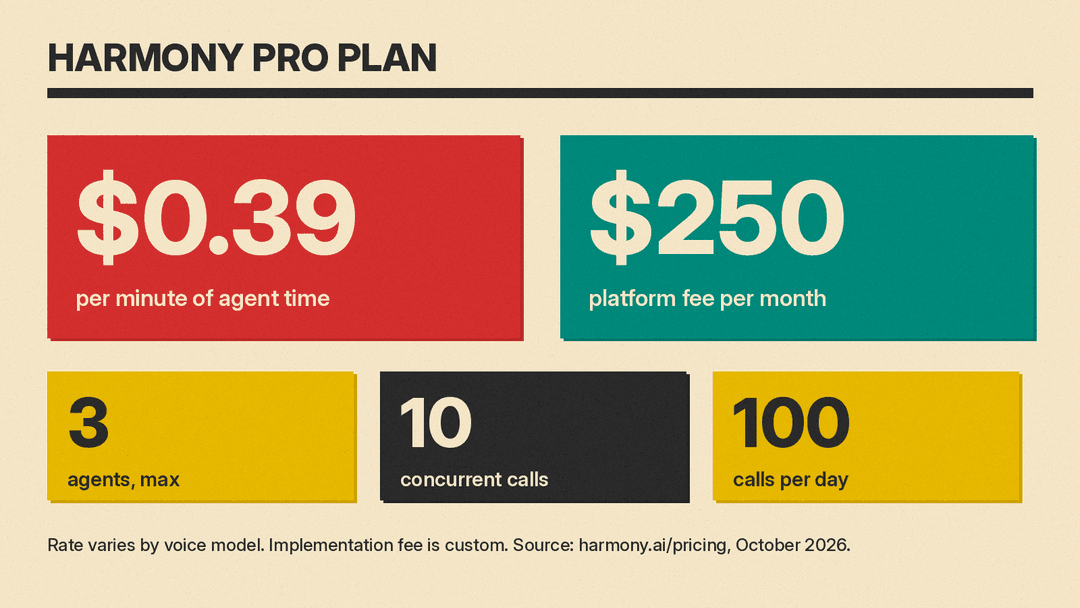
Pro
- $0.39 per minute of AI voice agent time. The page notes the "Rate varies by voice model."
- Platform fee of $250 per month
- Implementation fee: custom
- Up to 3 agents, up to 10 concurrent calls, 100 calls per day
Enterprise
- Custom pricing, platform fee and implementation fee
- Unlimited agents and custom concurrency and call volume
- Adds hot transfers, advanced insights and self-learning, API and MCP access, and white-glove implementation
As a simple example at the listed Pro rate, 1,000 minutes of agent time in a month would cost $390 in usage plus the $250 platform fee, before any implementation fee or a different voice model rate.
Two details are worth noting. First, the Pro plan's cap of 100 calls per day is small for a call center but fine for a pilot. Second, the pricing page lists hot transfers under Enterprise, while the release describes warm transfers to live reps as part of the core product. If live handoff to your reps is the point of your pilot, confirm which plan includes it before you sign.
What to check before you deploy it
AI that calls customers carries more risk than AI that drafts an email. The release itself makes the point: at worst, it says, generative AI solutions "can go off-script, creating legal, reputational, and regulatory damage." A few questions to settle first:
- Disclosure. The Harmony FAQ says "By default the agent tells people it is an AI, and you can change that disclosure to fit your business and the rules in your country." Decide your disclosure policy with legal before launch, not after.
- Consent and calling rules. On TCPA and HIPAA, the FAQ says compliance "depends far more on how the agent is configured than on the technology." Harmony offers consent capture, region-specific recording rules and transcripts, but your team owns the configuration.
- Where the AI stops. Map which calls the agent can finish alone and which go to a person. Bright Car Finance's setup, where the agent qualifies and hands warm leads live to human advisers, is a sensible starting pattern.
- Telephony. The FAQ says Harmony "runs on your existing telephony and writes back to your CRM." Check that your numbers and CRM fields map cleanly before you scale past a pilot.
- Measurement. Track contact rate, qualification rate and closed deals against a control group of human-only follow-up. Vendor figures like the "up to 70%" contact rate are a ceiling, not a forecast.
Why it matters
Work-software suites are moving from AI that suggests to AI that acts. Google is putting coworker agents into Workspace, and Huntington Bank is packaging AI tools for small businesses. Harmony takes that shift to the phone, where the agent talks directly to your customers. The bet is that small models, each trained for one part of a sales call, are faster and easier to keep on script than one general model. The published per-minute price makes it easy to test that bet on a slice of your pipeline before you commit.
