
Salesforce published a small business reading of its first State of Agentic AI in the Enterprise report on October 27, 2026. The survey covers 2,025 agentic AI decision-makers across 20 countries, and Salesforce says 21% of them run small and medium businesses. The main finding is useful for any lean team thinking about AI agents: the organizations that got returns fastest did not spend the most or move first. They picked one narrow job, cleaned the data for that job, and decided in advance when a person takes over.
This is a vendor survey, and Salesforce sells AI agents through Agentforce, so treat the numbers as Salesforce's figures rather than independent research. Still, most of the advice is cheap to follow and does not depend on which tool you buy.
What the report measured
An "agentic AI" system is software that does not only answer questions but takes actions, such as routing a support ticket, updating a CRM record, or sending a follow-up. The full report says the survey ran from May 14 to May 28, 2026. Of the respondents, 30% have fully deployed agents, 47% are running pilots and 23% are evaluating products to buy within 12 months, and most findings focus on the deployed group. The report looks at what helped organizations reach a return on investment (ROI) and what they would change.
According to Salesforce, organizations with agents live in production reach ROI in about 8 months on average. A companion post by Shibani Ahuja, Salesforce's SVP of Data and AI Strategy, adds more detail from the same study.
Lesson 1: Start with one tightly scoped job
Out of ten success factors Salesforce measured, two tied for the top: clean, accessible data at the point where the agent acts, and a narrowly scoped use case. Each was cited by 36% of deployed organizations. Escalation paths defined before launch came next at 35%. Model quality, platform choice and a unified orchestration layer each landed around 30%, according to the companion post.
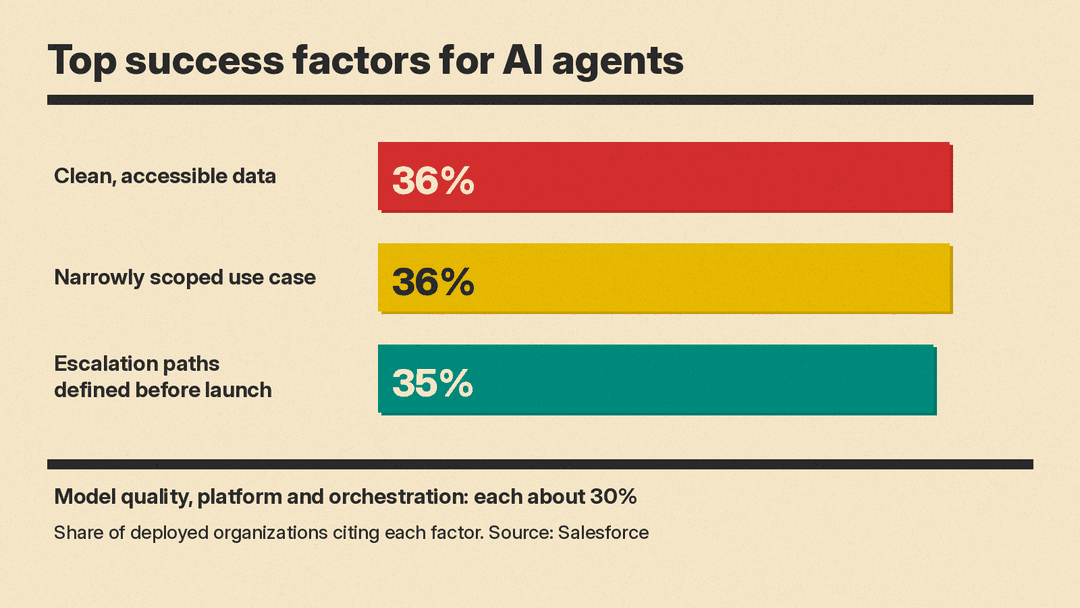
For a small business, that ordering matters. The factors at the top are things you control without a big budget. Salesforce's own examples of a good first job are routing support tickets and qualifying leads. Vendors already sell agents for both jobs, such as Microsoft's Sales Development Agent and Service Agent and monday.com Harmony, whose voice agents call and qualify sales leads.
Lesson 2: You do not need perfect data, but you need a plan
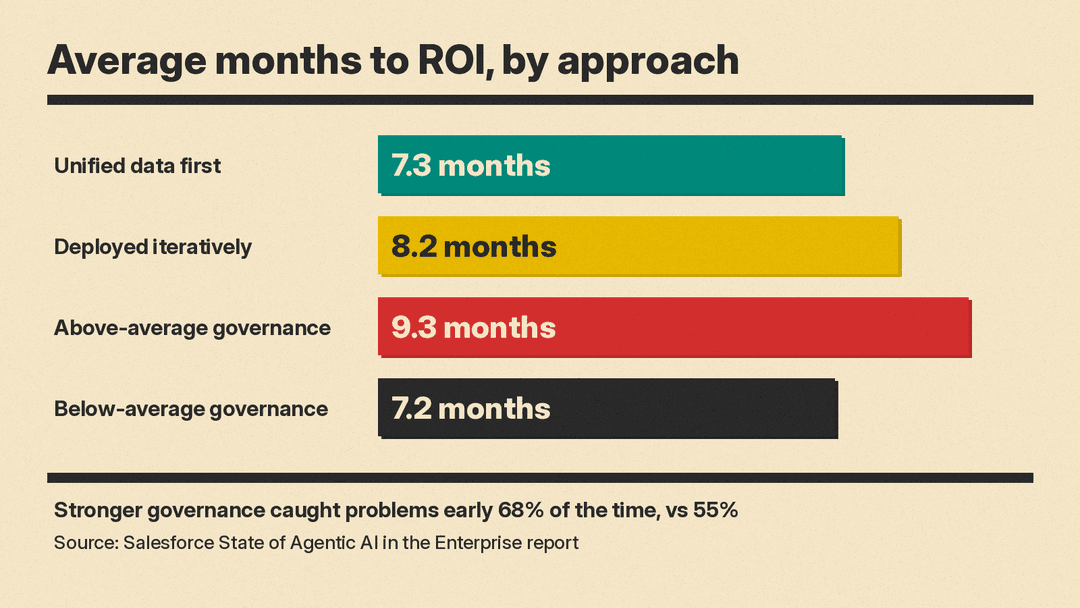
Only 31% of organizations fully unified their data before deploying agents. Ahuja's post says that group reached ROI in 7.3 months. Another 34% deployed iteratively, starting with what they had and connecting more over time, and reached ROI in 8.2 months. Salesforce calls that a modest gap.
The warning sits right beside it. Salesforce says 63% of organizations hit agent errors tied to stale, missing or wrong data, and 79% of those also had data connectivity problems. The small business post also cites Salesforce's separate State of Commerce report: among SMBs held back by fragmented data, 40% report slow or ineffective responses to customers and 39% struggle to measure the impact of their tech spending.
Joe Inzerillo, Salesforce's President of Enterprise and AI Technology, put the approach this way in the post: "People think they need to boil the ocean, get all their data perfect in one place before starting. What we're finding is you can go use case by use case: get the data accurate, mechanized, and semantically described so agents understand what it is and how to use it."
In practice, that means fixing the data for the one workflow you automate first. If an agent answers order questions, make sure order status, return policy and shipping times are current and in one place the agent can read.
Lesson 3: Autonomous does not mean unsupervised
Salesforce reports that 36% of organizations run agents in production with full autonomy. The same survey found that 81% saw more human reentry into workflows as their deployments grew, and 89% are rethinking their workforce models to account for agents. The companion post adds that only 1 to 2% of deployed organizations report agents that run without any human involvement at all.
Salesforce's reading is that agents clear the routine work so people can focus on what needs a human touch. For a small team, Salesforce suggests letting agents handle routine questions and off-hours coverage while staff handle complex conversations.
Lesson 4: Set simple governance on day one
Salesforce calls one governance figure counterintuitive. Governance here means the rules for who checks what an agent does. Organizations with above-average governance took longer to reach ROI, 9.3 months versus 7.2 months for those with below-average governance. But they caught problems proactively 68% of the time, compared with 55%.
Hindsight supports the slower path. Salesforce says 43% of organizations had to stall or scale back an AI initiative. Among them, the top regret, cited by 39%, was not budgeting for AI fluency training and reskilling upfront, followed by not setting clearer governance before scaling (38%).
Salesforce's point for small teams is that governance does not need a committee. It can be as simple as naming the person who reviews the agent's work and writing down where the agent must hand off to a human.
A short checklist before your first agent
Based on the report's findings, here is what a small team can decide before it turns an agent on:
- One job. Pick a single workflow, such as ticket routing or lead qualification, with a clear way to tell if it worked.
- Data for that job. Check that the records the agent reads are current and reachable. Fix gaps there before anywhere else.
- A handoff rule. Write down which cases go to a person, and how the agent passes them along.
- An owner. Name one person who reviews what the agent does.
- Training time. Budget time to show staff what the agent will and will not do, since missing training was the top regret among teams that scaled back.
Why it matters
Salesforce's own bottom line for small businesses is that none of this requires enterprise headcount or budget. Even with its vendor framing, the report points to scope, data and oversight as the deciding factors, not spend. Banks are pitching agents to the same owners: Huntington's 1866 Studio offers AI agents for small businesses. On governance, the small business post argues that building oversight in from day one "costs less than retrofitting it later."
Salesforce has published the full report on its website. Most figures here come from Salesforce's two blog posts about it.
