
Anthropic added a gallery of ready-to-use legal "artifacts" to Claude for Legal on October 28, 2026. Artifacts are interactive tools, such as trackers and dashboards, that teams use and share inside Claude. Anthropic says the gallery covers the work legal teams raised with it most often, such as checking citations, comparing laws across states or countries, reviewing stacks of contracts and taking in requests from the rest of the business.
Anthropic announced the gallery on its Claude blog. It also said it is funding public interest groups that build access-to-justice tools, funding legal education programs, and starting a Legal Ambassadors Program for legal professionals who build with Claude.
What changed
Claude for Legal launched in May. According to Anthropic, the most common requests from legal teams since then were for simpler setup and easier ways to work with colleagues. The artifact gallery is its answer to both.
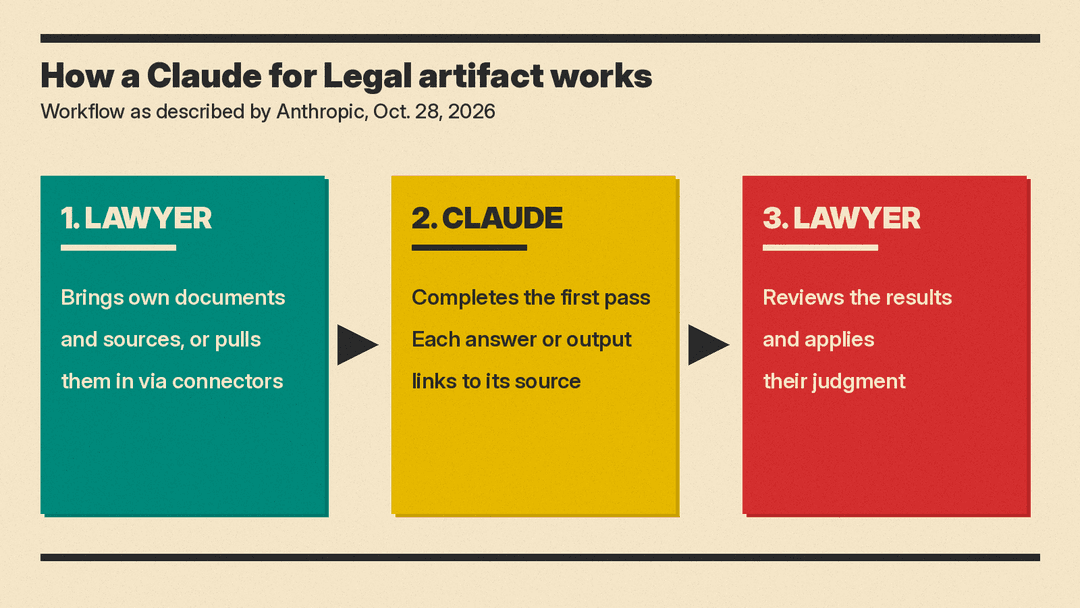
Each artifact opens with an example, so legal professionals can see how the work comes together before adding their own data and connectors. Anthropic says each answer or output links to its source. The intended workflow, in Anthropic's words, is that a legal professional brings their own documents and sources, Claude completes the first pass, and a lawyer applies their judgment to the results.
The six Anthropic-built artifacts
Anthropic lists six artifacts of its own in the gallery:
- Cite check compares a legal document with its sources and flags quotes that don't match, wrong page numbers, and sources that don't support the claim.
- Jurisdiction survey matrix compares one legal topic, such as data breach notice rules, across states or countries in a single table, with links to the underlying law.
- Matter board turns engagement letters, emails or spreadsheets into one board of open matters with the owner, next step and next deadline.
- Playbook deviation board compares contracts with a company's standard terms, flags each clause that differs, and sends it to the person who approves exceptions.
- Regulatory horizon scan maps upcoming regulations on a timeline based on the company's business and where it operates, and ranks them by impact with source links.
- Tabular review builds a table from a set of contracts showing the terms a user asks about, such as severance or non-competes, with links to the exact language.
Law firms and legal tech companies are building too
The gallery is also open to outside builders. Anthropic named four partner artifacts at launch:
- AI Governance Benchmark, built by the law firm Goodwin, benchmarks a company's approach to AI governance to surface potential gaps.
- Harvey Intake, built by Harvey, gives business users one place in Claude to send legal questions. It answers routine ones from the legal team's own guidance in Harvey and routes the rest to a lawyer, whose reply comes back in Claude.
- Obligations Checker, built by Foley & Lardner, reviews agreements for the obligations of both parties and helps check expectations before closing and track them after closing.
- Subpoena Response Tool, built by PwC, turns a team's precedents, standard objections and templates into first drafts of subpoena responses.
Anthropic said more artifacts are coming from Legora and Orrick. It also said it has added more than 60 legal connectors since Claude for Legal launched, including Bloomberg Law, Filevine, Ivo, Legora and Patlytics. Connectors let an artifact pull in a team's playbooks or research sources so nobody has to upload documents by hand.
On sharing, Anthropic says teams can work on an artifact with colleagues, clients or partners, with sharing settings meant to protect privacy and support ethical walls between teams. Robert Mahari, head of Claude for Legal, told Reuters (syndicated by The Economic Times) that the tools inherit the permissions and guardrails an organization has already turned on.
"A lot of legal work doesn't fit very neatly in a back-and-forth chat. There's a need for a different kind of interface - and artifacts provide that," Mahari told Reuters. Mark Pike, associate general counsel at Anthropic, told Reuters his own team uses artifacts internally for contracts, privacy impact assessments and patent issues.
Access-to-justice tools
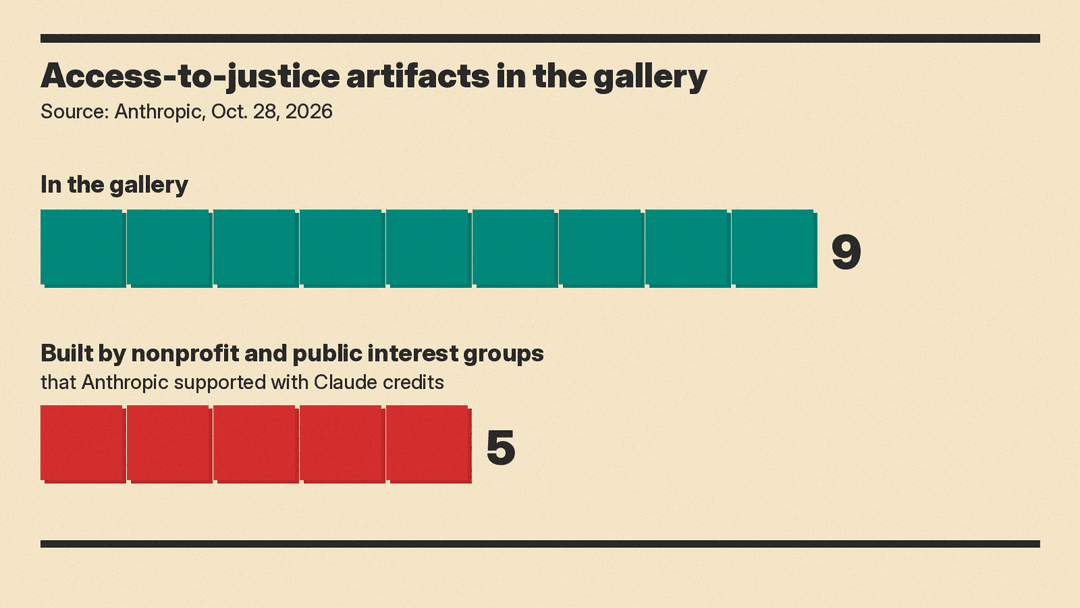
The gallery includes nine access-to-justice artifacts. Anthropic says five were built by nonprofit and public interest groups it supported with Claude credits:
- Criminal Charge Reality Check (Zealous) shows defense teams the sentencing range for a charge, public data on how such cases usually end, and standard release playbooks. New York only.
- Immigration Papers Reader (Mobile Pathways) turns a client's immigration paperwork into a plain-language first read of key dates and missing documents.
- Rent Ledger Reviewer (Rising for Justice) helps attorneys find errors in a landlord's rent ledger in eviction cases. Based on D.C. law.
- Record-Sealing Screener (Rising for Justice) helps attorneys check whether a criminal record is eligible for sealing. Based on D.C. law.
- Record Clearance (The Access Project) helps legal aid teams work out whether a client's record can be cleared under their state's rules.
Anthropic also pointed to the Oxford Justice Innovators Programme, a 12-month program with the Oxford Institute of Technology and Justice and Microsoft that supports up to 10 innovators working on access to justice.
Why it matters
Reuters said the launch comes amid intense competition among AI companies to court professional users. It noted that Google expanded Gemini Enterprise with tools for lawyers in August, that Reuters parent Thomson Reuters launched a proprietary large language model called Thomson 1.0 the same month, and that Microsoft recently added legal features to Copilot. The launch is not a new model. Reuters describes artifacts as an alternative to Claude's chatbot interface, and Anthropic says they work best when connected to the systems legal teams already use.
The partner list shows the approach. Harvey, Legora and Ivo are legal AI companies in their own right, and here their products connect into Claude. Large firms also license these tools directly, as Hogan Lovells Cadwalader did with Harvey and Legora this month. One customer quote on Anthropic's page, from Spellbook co-founder and CEO Scott Stevenson, says Spellbook is "approaching 500,000 contracts per month" and that Claude powers it.
The launch also fits a pattern in Anthropic's launches this month: industry-specific packaging of Claude, such as Claude for Financial Advisors and the Claude for Nonprofits plugin, plus new admin tools such as Claude Enterprise smart reports.
How to get it
Anthropic says legal teams can browse the gallery in Claude or start from its Claude for Legal page. For larger rollouts, it points to its sales team and implementation partners including Accenture, Deloitte, KPMG and PwC. Legal professionals who want to join the Legal Ambassadors Program can sign up for a waitlist. Anthropic's post does not list prices for the artifacts.
