
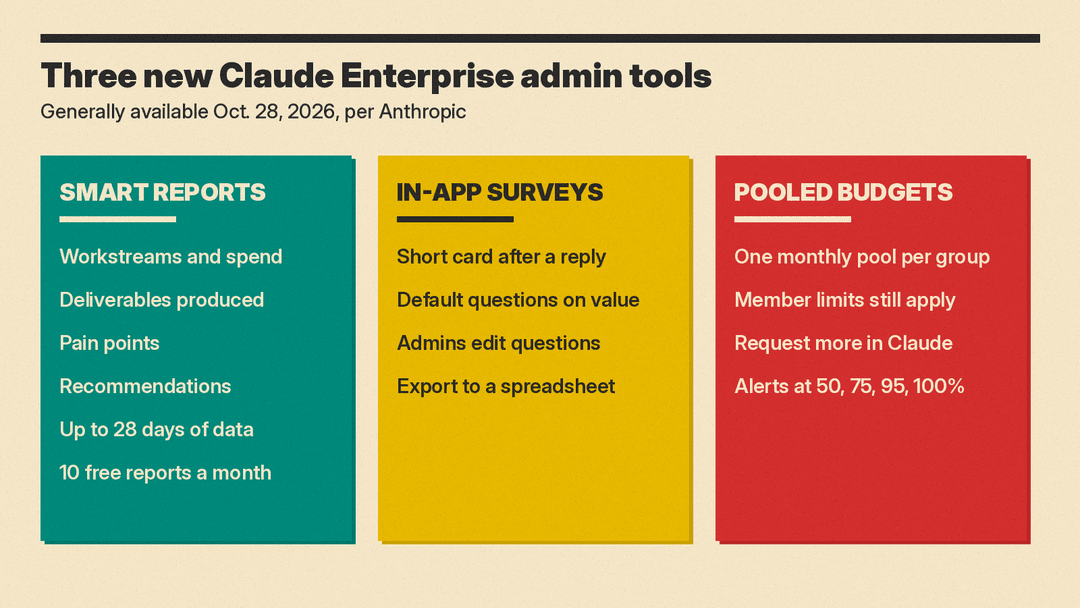
Anthropic made three admin tools generally available for Claude Enterprise on Oct. 28: smart reports, in-app surveys and pooled group budgets. TechCrunch describes them as tools to give customers a more granular understanding of the value they get from their token spend. Anthropic's announcement says many members have already found work Claude can unlock, and frames the next step as expanding that work to every team.
As TechCrunch reported, the launch came in the same week Anthropic shared financials with investors. TechCrunch called it "a clear attempt to demonstrate the return on investment of Anthropic's tools."
Smart reports: what a team did, and what it cost
A smart report starts with an admin picking a team, a date range and the products to include. According to the Claude Help Center setup guide, the range can cover up to the last 28 days, and the products can be one or more of chat, Claude Code, Claude Cowork, or the unified chat and Cowork experience. Claude then reads a sample of the team's transcripts, groups them into workstreams and types of output, attaches spend to each group, and writes up what it found. Spend is shown at list price.
Sections in each report include:
- Workstreams, ranked by sessions and by spend side by side
- Deliverables produced, grouped by type such as analysis, documentation, content drafts and code
- Average cost per session for each type of output
- The most common pain points, such as a connector that was not set up, output that did not match the ask, approval or sign-in gating, tool failures or rework loops
- An inefficiencies count of sessions that produced nothing usable or were personal or off-topic, shown only as an aggregate count and cost
- The most expensive sessions, and sessions that scored highest on task complexity, time saved, how long Claude worked on its own and the expertise required
Each report has one consolidated list of recommendations. Anthropic says these include recurring workflows to turn into skills and rules to add to a code repository. The report also flags people whose work is being held back by their spend limit. An admin with billing permission who is using the report's attributed view can raise that limit from inside the report.
Reports usually take a few hours to generate, per the Help Center, and can be downloaded as HTML. Each organization can run up to 10 reports per month at no charge. The feature is off by default, and a Primary Owner or Owner has to turn it on.
The privacy rules matter as much as the charts
Smart reports read employee transcripts, and Anthropic's documentation sets limits on how they can be used. The Help Center says smart reports help organizations understand adoption and plan investment, and "aren't designed and should not be used for evaluating individual performance or making employment decisions." The announcement says the same in shorter form.
The Help Center lists several safeguards. Names are hidden by default: drilldowns show "User" in place of a name. If an Owner turns on a separate attribution setting, which is off by default, report viewers get a control to reveal names, and each reveal is logged. Sessions Claude identifies as involving restricted topics, including health, union activity, harassment complaints, political or religious views and personal life, are used only for aggregate analysis and get no summary. Admins also cannot write custom questions about those topics.
There are limits on who can use it. The Help Center says organizations with customer-managed encryption keys, a HIPAA configuration, or a hybrid deployment that runs inference on their own cloud provider cannot use smart reports. If an organization uses zero data retention for Claude Code, reports cover chat and Cowork but leave out Claude Code. TechCrunch added that Anthropic says it will not use this data for model training by default.
In-app surveys: the employee's side
Surveys add self-reported value to the usage data. The default questions, per Anthropic, ask about the most valuable thing someone did with Claude recently, how Claude changed the time that work took, which use a teammate should copy, and what would break first if the team lost access tomorrow. Members see a short card after a reply in the tool they are already using. Admins can edit questions, pick who gets the survey and export responses to a spreadsheet. Surveys also work for organizations with customer-managed encryption keys.
Pooled group budgets: one pot per team
The third tool changes how spend limits work. A regular group spend limit gives every member the same monthly cap, which Anthropic says can leave heavy users stuck early in the month while others leave budget unspent. The pooled budget help article says a pooled budget adds one shared monthly amount for the whole group. Every request counts against both the member's own limit and the pool, and a member stops at whichever runs out first. Users who hit a limit can request more from inside Claude.
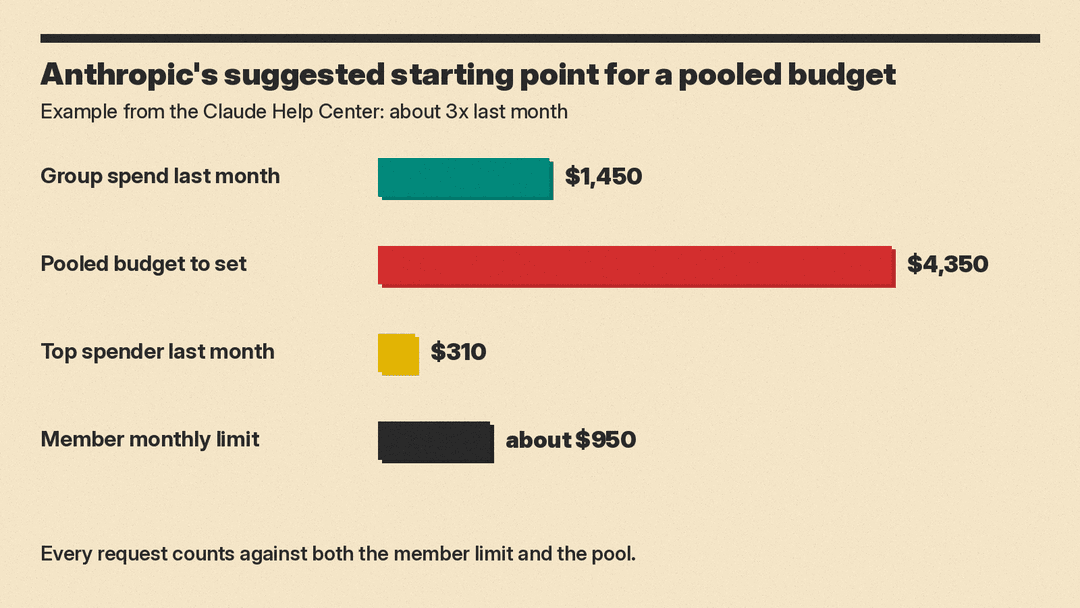
The Help Center suggests a starting point: a pool of about three times last month's group spend, and a member limit of about three times the top spender's spend. Its own example is a group that spent $1,450 with a top spender at $310, which gives a $4,350 pool and a member limit of about $950. Billing admins get email alerts at 50%, 75%, 95% and 100% of the budget. Pooled budgets are available on usage-based Enterprise plans and on Standard or Premium seat plans with usage credits enabled. On those seat plans, a pooled budget applies only to usage credits, not to the usage each seat includes. Pooled budgets are not yet in the Admin API.
Why it matters
TechCrunch notes that businesses have been hunting for this kind of information as they work out how to deploy AI tools, and that most of the Fortune 500 are not seeing major gains from deploying AI. TechCrunch cited a Jellyfish report, based on agentic coding tool use by 276,000 of Jellyfish's customers, which found spending on those tools has grown 10x since the start of the year and now equals about 2% of total engineering cost. Nikolas Albarran, the AI product lead at Jellyfish, pointed TechCrunch to the forward-deployed engineering teams that AI labs embed inside customer organizations. TechCrunch wrote that the new reports "can be seen as a kind of FDE-lite, a lighter version of that hands-on help."
TechCrunch says Anthropic leads among enterprise customers. Albarran told TechCrunch that once a company has put effort into standardizing its workflows on one lab's tools, "that cost to switch is not zero." The Help Center also lists bringing evidence to budget renewals as a use case for smart reports. For more on Anthropic's enterprise push, see our posts on why gross margin is the wrong number to watch, Claude for Financial Advisors and on what Anthropic's S-1 shows.
