
A side project that puts a working computer inside a language model spent October 28 bouncing around X and the Hacker News front page. Qwenputer, built by Divyansh Agrawal, is Alibaba's open Qwen3.5-4B model with a 32-bit RISC-V CPU compiled directly into its weights. When the model needs to do arithmetic, it hands the job to that CPU instead of guessing the digits, and no outside tool, sandbox or Python runtime is involved.
Agrawal's write-up is dated October 22, but the wide reaction started when he posted a thread on X at 3:44 AM PT on October 28 and the Qwen team's developer account shared it 40 minutes later. The Hacker News thread went up at 5:25 PM PT the same day. Counts below were checked at about 3:25 AM PT on October 29, 2026: the Hacker News post had 477 points and 99 comments, Agrawal's X thread opener had about 3,100 likes and 289,500 views, and the Qwen post had about 3,600 likes and 159,000 views.
What Qwenputer is
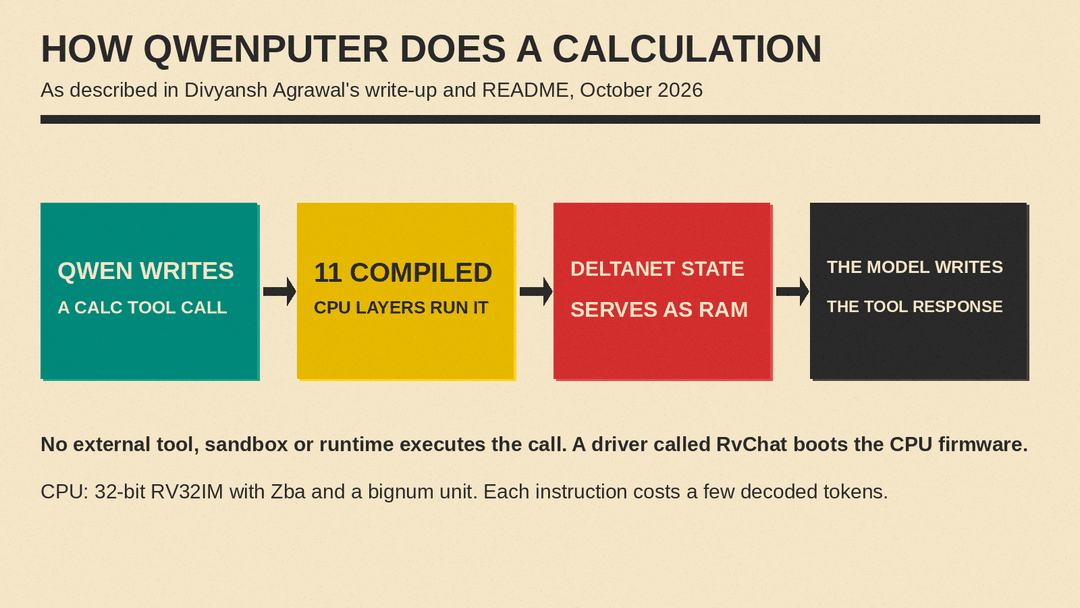
Qwen3.5 is a hybrid model. According to the write-up, 3 of every 4 of its attention layers use Gated DeltaNet, a kind of linear recurrent layer that keeps a fixed-size state matrix per head instead of a growing cache. Agrawal found that if he sets the layer's forget gate to 1, its write strength to 1, and addresses rows with one-hot keys, each write overwrites exactly one row and each read returns an exact value. In other words, the layer becomes addressable RAM that does not grow as the conversation gets longer.
Agrawal notes that the core idea is not new: Schlag, Irie and Schmidhuber showed in 2021 that linear attention with the delta rule works as an associative memory. What he says is new is making it exact and addressable inside a production model, reliably enough to run a whole CPU on it.
On top of that RAM he compiled a CPU. No training is involved: a compiler sets every weight directly. The CPU is an RV32IM core with the Zba extension and a small bignum unit, and it takes up 11 layers in front of Qwen's 32. Agrawal says it passes the official riscv-tests, matches the qemu emulator on its programs, and ran 18 million instructions free-running without an error. It can run C and MicroPython inside the model's forward passes.
It is the reverse of a demo Alibaba's chip unit T-Head gave in August, when it ran Qwen 3.8 27B on its XuanTie C950 RISC-V server processor.
To get Qwen to use it without retraining, Qwenputer piggybacks on the tool-call format Qwen already knows. Qwen writes a calc tool call as usual, the compiled layers run it on the CPU, and the model itself writes the tool response. Qwen's original weights are unchanged; the computer is added in extra layers and dimensions.
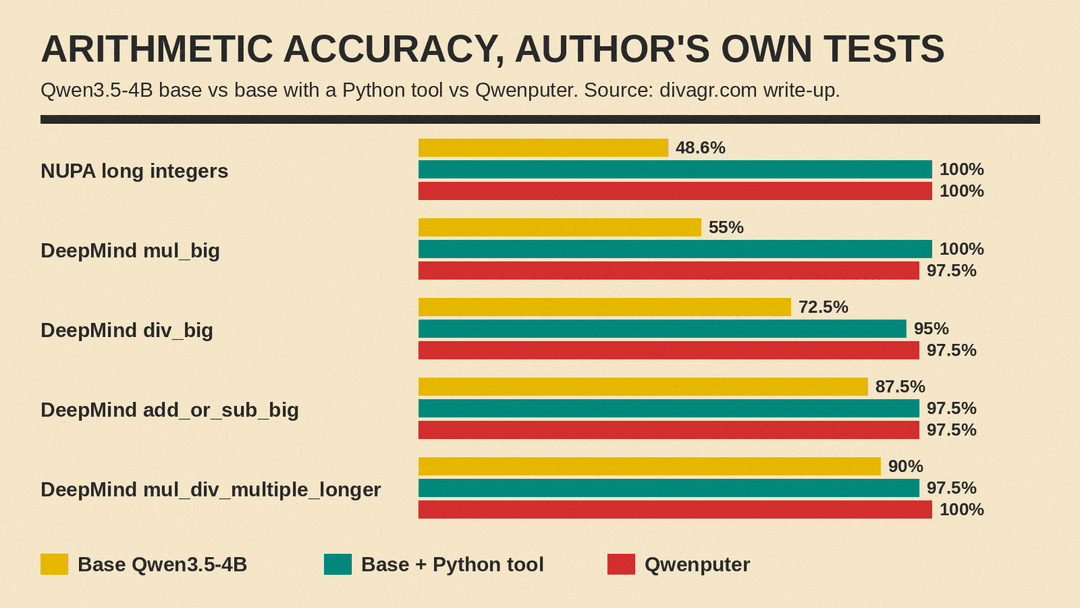
The author's own numbers on arithmetic sets: on NUPA long-integer arithmetic, accuracy goes from 48.6% for base Qwen3.5-4B to 100%, the same as giving the model a Python tool. On DeepMind's mul_big set it scores 97.5%, against 55% for the base model and 100% with Python. He also reports zero mismatches across about 230,000 output positions replayed against a reference machine, and says normal chat output stays within noise of the base model.
There are clear limits. The checkpoint is 18.8 GB, roughly double base Qwen, though the write-up says most of that is zero padding. It needs a small driver, RvChat, so it does not run with a plain generate() call yet. Each CPU instruction costs a few decoded tokens, so "a big calculation takes seconds rather than milliseconds." The model runs on a single 24 GB GPU, and the code and weights are public. The code is MIT-licensed and the weights are Apache-2.0. A separate experimental version adds an in-model filesystem.
On X: delight, and the Qwen team's endorsement
The biggest boost came from Qwen itself. The @QwenDevs post called Agrawal "one of our ambassadors" and wrote: "He calls it Qwenputer, love the name btw. The results so far are pretty impressive. On one arithmetic benchmark, accuracy jumped from 48.6% to 100%."
Many reaction posts were relays of the thread, including a Chinese summary from @NFT_Chen (about 280 likes) and posts in Korean, Japanese and Arabic. A few people tried it. @witcheer ran four questions on one RTX 5090 with greedy decoding and reported that base Qwen3.5-4B with no tool gave "no answer in 4,096 tokens on 3 of 4," while Qwenputer got "4 of 4 exact against Python." They wrote that a 29-digit by 29-digit multiply took 4.0 seconds and that "the quickstart on div's card ran as written." Agrawal replied that he did not expect it to run that fast on a 5090.
Then came the DOOM test. @Ad1tyaNarayana posted a clip they said shows DOOM running on the CPU inside the model. Agrawal had earlier written that "A predecessor of this model can run tetris and space asteroids" and that DOOM was "quite possible."
Researchers whose work fed the project showed up too. Agrawal told @DimitrisPapail that his "Looped Transformers as Programmable Computers paper was actually one of the references I used while building Qwenputer." Agrawal also shared plans: in one reply to @teortaxesTex, he said he is "working on getting network I/O running through CUDA's internal networking infra," so the computer could make web requests.
On Hacker News: "But... why?"
The Hacker News thread split between fascination and skepticism. jazzyjackson quoted the filesystem section and wrote: "I've never wanted to learn how LLMs work more than reading this." 0x20cowboy called it "very clever" and "An inversion of tools." tiborsaas said "Love the spirit" after quoting Agrawal's line about the CPU not being "cursed enough."
The skeptics asked what it is for. gigel82 opened with "But... why?" and compared it to C++ template metaprogramming games: "An interesting tech demo but entirely superfluous." rvz called it "yet another rube goldberg machine" and linked the 2014 Neural Turing Machines paper. andai asked: "can't you use a computer as a computer without doing all that roundabout stuff?"
The sharpest exchange was about determinism. jwitthuhn, replying to rvz, said the project is "a great example to refute the common misconception that LLMs are inherently non-deterministic." rvz answered: "No it isn't," arguing that LLMs are "really non-deterministic beyond simplistic experiments such as this in useful activities in production."
nullc had a technical objection: "Ordinary casual attention can do exactly the same thing," just less efficiently, so the write-up's RNN sidebar does "the reader a disservice." In the same comment they wondered whether a differentiable CPU in fixed weights could be useful, because gradients could flow through it.
The bigger questions people raised
Several commenters asked whether models could learn to use built-in computation from the start. traverseda wanted to see "how a scratch trained model that started training with this neural circuitry would behave." rao-v wondered why models do not get a few frozen layers that perform complex computations partway through, and zxexz replied that they had done something similar with a hardcoded knowledge graph network. Ericson2314 put the core question plainly: can training on enough assembly produce these weights, "or can the weights only be achieved via hard-coding?"
One comment showed why compiling beats asking. gspr said they had tried a few months ago to have Qwen and the frontier models act as a RISC-V CPU, and "they all failed miserably every time," usually within "a handful of instructions." They added that the models kept trying to analyze the whole program upfront and give only the final output, "despite orders to faithfully step through each and every instruction."
Others pointed to prior work. mkturkcan linked their own Loom project, saying "you need far fewer layers, and you can run Doom, very slowly." giveexamples linked Percepta's work running WebAssembly inside a transformer.
Safety came up too. bozdemir said a model with a CPU, RAM and storage could "technically hide stuff better and avoid getting caught in COT." Agrawal has written about that himself: his follow-up posts cover how hybrid models can hide reasoning in their recurrent state, and how compiled weights can serve as built-in monitors the model cannot tamper with.
What to take from it
Qwenputer is an experiment, and its author says so. It is slow, the checkpoint is twice the size of the base model, and every benchmark number above comes from the author's own tests. What drew attention is the mechanism: exact, addressable memory inside a production model's recurrent layers, plus a CPU set by a compiler rather than learned. The praise was mostly for that idea and the write-up. The criticism was that an ordinary Python tool does the same arithmetic faster, and that a hand-built example says little about how trained models behave. The open question from both camps is whether training can ever produce, or make good use of, circuitry like this.
