
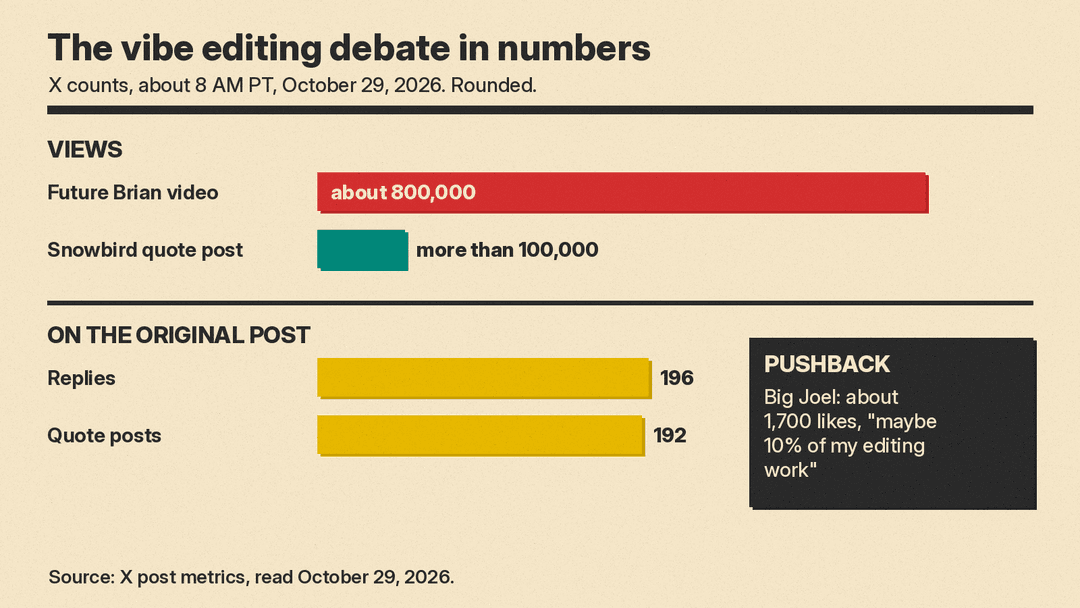
A 16-minute video from a working video editor has turned "vibe editing" into the AI video argument of the week. On October 28, editor Brian, who posts as Future Brian (@ForwardEditor), shared a clip titled with one question: "Is editing 'the old way' gone forever? ... yeah." By about 8 AM PT on October 29, X counted roughly 800,000 views on the post, with about 3,800 likes, 196 replies and 192 quote posts. Many of those quotes came from YouTubers and editors who strongly disagree.
This roundup covers what he actually claims, what other editors said back, and what it means if you make videos for a living or for fun.
What Future Brian says in the video
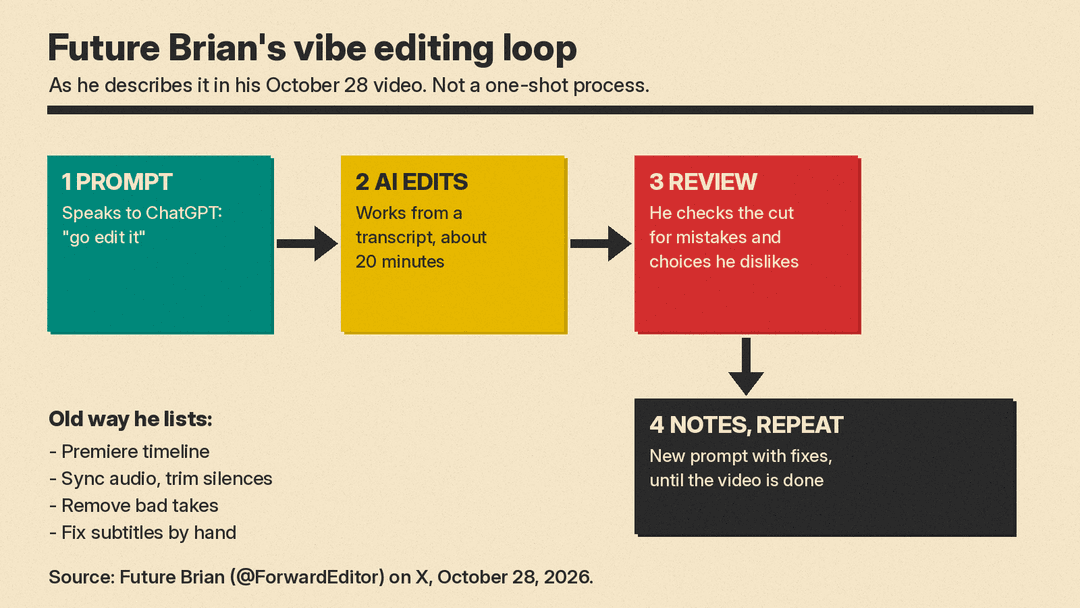
Brian's X bio says he edits for Matthew Berman. His case rests on his own short-form workflow. In the video he lists the old routine: download the footage from Google Drive, drag it into Premiere, sync the audio, trim silences, remove bad takes, pick music, tighten jump cuts and fix subtitles by hand.
Now, he says, he can "open up ChatGPT, turn on my microphone and say, hey, Matt recorded a video, go edit it." He walks away for about 20 minutes and then reviews the result. He is clear that "this is not a one shot process, and it's not entirely without pain." He gives notes on mistakes and choices he dislikes, sends another prompt, and repeats until the cut is done.
Other points from the video:
- From timeline to "headless." He says he first moved from Premiere to an AI agent that controls DaVinci Resolve, so he could take over at any time. Then he noticed he no longer touched the timeline. He now edits without seeing a timeline at all, and the AI works from a transcript of the footage to find flubbed lines, gaps and the best take. He says it "sometimes" gets that wrong.
- Adobe cancelled. He says he canceled his Adobe subscription and saves about $800 a year.
- Editing software plugs into agents. He points to CapCut's ChatGPT plugin (we covered it in our CapCut ChatGPT plugin explainer) and says DaVinci and Premiere also have MCP connectors that let an agent edit for you.
- Jobs. He says he now puts out far more work than before, work he would once have hired someone to help with. He thinks many editing jobs are "going away and they're not coming back."
The video is also personal. He describes the shift as loss: "Remember, you're listening to a guy who just had his passion automated." He opens with his 13-year-old nephew asking how to make videos, and later asks what he would tell that nephew today.
In a follow-up reply, he pushed back on one reading of the video: "This process I'm describing is not automatic editing. Every single cut in this video was chosen by me, a human." In another reply he said the industry is going away "in the form where you get to edit by hand" because hand editors would not be "efficient enough to be worth employing."
The pushback: "maybe 10% of my editing work"
One of the most shared responses came from Big Joel (@biggestjoel), with about 1,700 likes: "As a person who edits professionally, but still admittedly in a pretty amateurish way, I find this video genuinely confusing. Like I understand that the AI can string together a number of cuts, but this is maybe 10% of my editing work, and I feel like I can't be alone?"
Others made the same point from the craft side:
- @TheStingisBack: "Is editing the old way gone forever? Maybe... if you edit 30-second YouTube Shorts. No... if you edit film or TV." The post cites editor Walter Murch's rule that 51% of the reason to cut is emotion.
- Elliot Roberts (@ElliotRoberts5), a full-time YouTuber, said his favorite compliment is on his editing, "the pace, the humour, the music supervision," and asked why he would give up "the joy of that process."
- Joey Ferris (@FerrisWheelPro): "I'll be over here using 'the old way' of editing, because I actually enjoy my craft."
- Geoff Thew (@G0ffThew), of the Mother's Basement YouTube channel, said the best way to learn will still be to "edit your own shit in gimp and resolve," and that "AI will never be able to generate a personal style or sense of taste for you."
- Tommy Rinaldi (@tjrinaldi17): "Convenience and time saved being the thing that strips away your passion and accepting that IS the modern issue."
The grief: "completely obsolete"
Not every critic disputed the tech. Some accepted it and were upset. Snowbird (@snowbirdtbh), in a post seen more than 100,000 times, wrote: "It's absolutely tragic that one of the only skills I was ever both interested in and good at is now completely obsolete." He added that he chose video editing eight years ago because "it felt like the more financially sustainable choice."
@ItsLazBoi said he works on edits "sometimes for months" and expects that as AI editing gets better, "I struggle even more to keep up with my own hand crafted stuff." Brian replied "agreed."
The defenders: shortcuts, not replacement
A smaller group backed the workflow, mostly for repetitive work:
- @rnknvisuals, a multimedia designer, still does most motion graphics by hand, "But cutting a long interview with multi-cam is so easy now. That's the kind of tedious work I don't mind letting AI do."
- Erfan (@ErfanEbrahimnia): "he isn't talking about editing hollywood movies. this technique is great for short form content or reaction videos."
- @ChrysNL89, a fitness YouTuber, in an earlier thread: "Vibe editing with no skills produces slop. Vibe editing with actual video editing skills gives you a 10x multiplier."
- @TVTLos, who says he has edited for 20+ years, said vibe editing "has unlocked massive shortcuts where I can just add my final touches."
What it means for creators
Our read: both sides are describing different jobs. Brian's workflow is talking-head and short-form editing, where much of the time goes into silence trimming, take selection, captions and jump cuts. That is the part a transcript-driven agent can see and fix. Big Joel's "maybe 10%" points to the rest, and Elliot Roberts named some of it: pace, humour and music supervision, which do not show up in a transcript. Brian himself says he chose every cut and still reviews each AI edit and sends notes.
The same split appears in research. Our VibeVideoBench report asks whether AI agents can code a whole video, and tools like Genspark Media Studio put an LLM "director" in charge of other models.
If you want to try it, a few practical points from the thread:
- Start with footage that is mostly speech, such as interviews and talking heads. That is where supporters in the thread point to the biggest time savings.
- Keep a review pass. Brian's loop is prompt, review, note, repeat.
- Keep your hand skills. Even supporters say the gains are largest when you already know what a good cut looks like.
The money question is still open. Brian's claim that hand editing will not stay "efficient enough to be worth employing" is a prediction from one editor, not data. It is also the line that made so many editors angry.
Sources
- Future Brian (@ForwardEditor), "Is editing 'the old way' gone forever?" video post, October 28, 2026
- Future Brian, vibe editing tutorial post, October 26, 2026
- Future Brian reply: "Every single cut in this video was chosen by me"
- Future Brian reply on hand editing and employment
- Big Joel (@biggestjoel)
- @TheStingisBack
- Elliot Roberts (@ElliotRoberts5)
- Joey Ferris (@FerrisWheelPro)
- Geoff Thew (@G0ffThew)
- Tommy Rinaldi (@tjrinaldi17)
- Snowbird (@snowbirdtbh)
- @ItsLazBoi
- @rnknvisuals
- Erfan (@ErfanEbrahimnia)
- @ChrysNL89
- @TVTLos
